The Future of Data Storage Lies in DNA Microcapsules

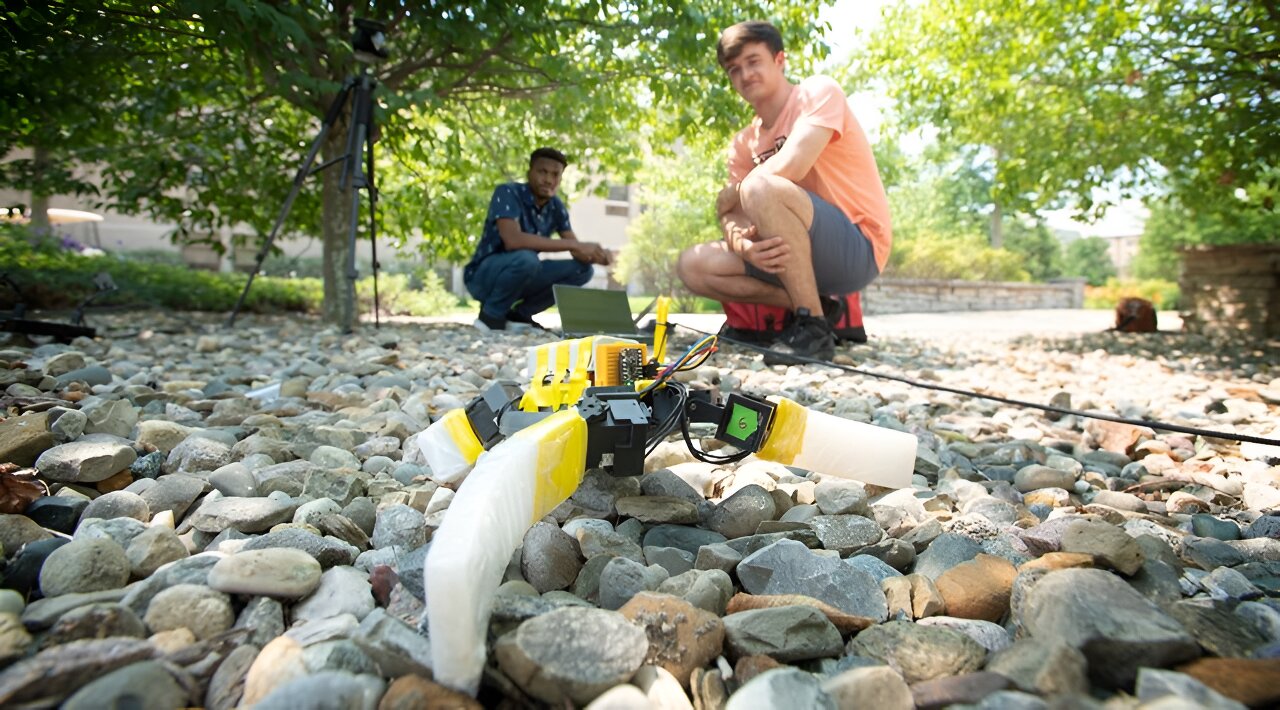
Photo: Bart van Overbeeke

DNA archival storage within reach thanks to new PCR technique. Storing data in DNA sounds like science fiction, yet it lies in the near future. Professor Tom de Greef expects the first DNA data center to be up and running within five to ten years. Data won’t be stored as zeros and ones in a hard drive but in the base pairs that make up DNA: AT and CG. Such a data center would take the form of a lab, many times smaller than the ones today. De Greef can already picture it all. In one part of the building, new files will be encoded via DNA synthesis. Another part will contain large fields of capsules, each capsule packed with a file. A robotic arm will remove a capsule, read its contents and place it back.

We’re talking about synthetic DNA...

Read More

Astronomers Spot a Star Swallowing a Planet

A dynamic rendering shows, on the left, the edge of a gigantic, yellow spherical star. A tiny red planet is in the middle and has skimmed the star. Rays of white light and blue energy radiate out from their touch.
Caption:This artist’s impression shows a doomed planet skimming the surface of its star. Astronomers used a combination of telescopes to spot the first direct evidence of an aging, bloated sun-like star, like the one pictured here, engulfing its planet. These telescopes included the Zwicky Transient Facility (ZTF) at Caltech’s Palomar Observatory, the W.M. Keck Observatory, and NASA’s NEOWISE mission.
Credits:Image: K. Miller/R. Hurt (Caltech/IPAC)

Earth will meet a similar fate in 5 billion years. As a star runs out of fuel, it will billow out to a million times its original size, engulfing any matter — and planets — in its wake...

Read More

Study using X-Ray Telescope indicates that Dark Energy is Uniformly Distributed in Space and Time

eROSITA X-Ray study indicates that dark energy is uniformly distributed in space and time
X-ray (over) and optical pseudo-color (below) images of three low mass clusters identified in the eFEDS survey data. The highest redshift cluster come from a time when the universe was approximately 10 billion years younger than today. The cluster galaxies in that case are clearly much redder than the galaxies in the other two clusters. Credit: eRosita

When Edwin Hubble observed distant galaxies in the 1920s, he made the groundbreaking discovery that the universe is expanding. It was not until 1998, however, that scientists observing Type Ia supernovae further discovered that the universe is not just expanding but has begun a phase of accelerating expansion. “To explain this acceleration, we need a source,” says Joseph Mohr, astrophysicist at LMU...

Read More

Scientists deliver siRNA Therapy to Lung

Fluoresce images of lung tissue after treatment (top, red), show local distribution of chemically modified siRNA and robust gene silencing in the lung.

Delivery technology successfully blocks SARS-CoV-2 infection in mice; adaptable for multiple diseases

Scientists at UMass Chan Medical School have developed a technology to deliver gene therapy directly to lung tissue through intranasal administration, a development that could potentially create a new class of treatments for lung disease.

Published in the journal Proceedings of the National Academy of Sciences, the study by a multidisciplinary team of RNA biologists, chemical biologists, immunologists and virologists describes the delivery of siRNA molecules locally to lung tissue...

Read More