Can Jack-of-all-Trades AI Reshape Medicine?

Computer screen and physician hands

Researchers chart course for the design, testing, and implementation of next-gen AI in medicine.

Most medical AI models in use today are trained to perform one or two specific tasks and have limited utility. Next-generation AI — called generalist medical AI — incorporates various types of data to perform a variety of complex tasks in a range of clinical scenarios. Generalist medical AI can reshape medicine by augmenting clinical decision-making, real-time surgical and bedside support, and more.

The vast majority of AI models used in medicine today are “narrow specialists,” trained to perform one or two tasks, such as scanning mammograms for signs of breast cancer or detecting lung disease on chest X-rays.

But the everyday practice of medicine involves an endless array of clin...

Read More

Nifty Nanoparticles help ‘Peel back the Curtain’ into the world of Super Small Things

Physicists at The Australian National University (ANU) are using nanoparticles to develop new sources of light that will allow us to “peel back the curtain” into the world of extremely small objects – thousands of times smaller than a human hair – with major gains for medical and other technologies.

The findings, published in Science Advances, could have major implications for medical science by offering an affordable and effective solution to analyse tiny objects that are too small for microscopes to see, let alone the human eye. The work could also be beneficial for the semiconductor industry and improving quality control of the fabrication of computer chips.

The ANU technology uses carefully engineered nanoparticles to increase the frequency of light that cameras and ...

Read More

Superflare with Massive, High-Velocity Prominence Eruption

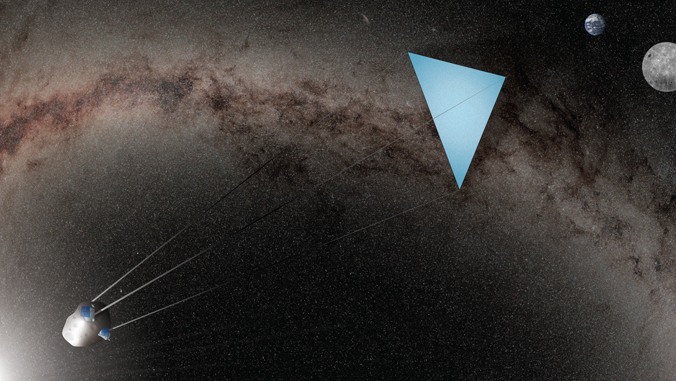
Artist’s impression of the superflare observed on one of the stars in the V1355 Orionis binary star system. The binary companion star is visible in the background on the right. (Credit: NAOJ) 

A team of Japanese astronomers used simultaneous ground-based and space-based observations to capture a more complete picture of a superflare on a star. The observed flare started with a very massive, high-velocity prominence eruption. These results give us a better idea of how superflares and stellar prominence eruptions occur.

Some stars have been seen releasing superflares over 10 times larger than the largest solar flare ever seen on the Sun. The hot ionized gas released by solar flares can influence the environment around the Earth, referred to as space weather...

Read More

Scientists Slow Aging by Engineering Longevity in Cells

Image of engineered cells showing oscillating abundance of a master aging regulator.
Engineered cells show oscillating abundance of a master aging regulator. Credit: Hao Lab, UC San Diego

Human lifespan is related to the aging of our individual cells. Three years ago a group of University of California San Diego researchers deciphered essential mechanisms behind the aging process. After identifying two distinct directions that cells follow during aging, the researchers genetically manipulated these processes to extend the lifespan of cells.

As described in a new article published April 27, 2023, in Science, the team has now extended this research using synthetic biology to engineer a solution that keeps cells from reaching their normal levels of deterioration associated with aging.

Cells, including those of yeast, plants, animals and humans, all contain gene regu...

Read More