
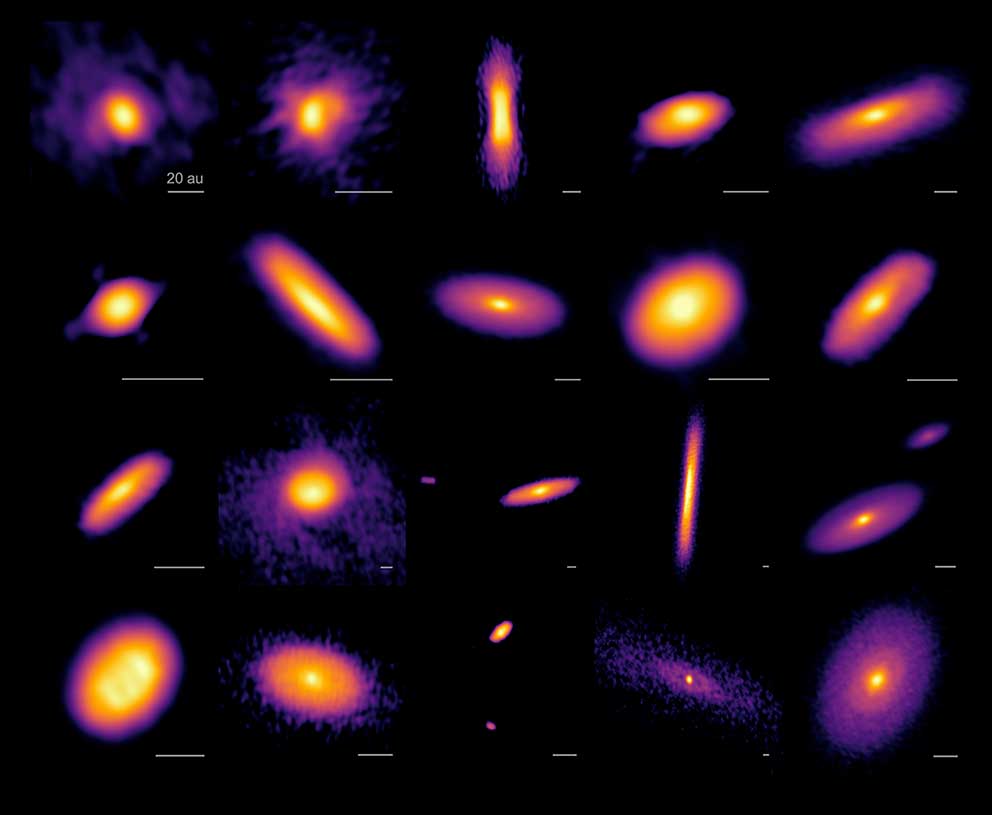
An international research team used the Atacama Large Millimeter/submillimeter Array (ALMA) to observe disks around 19 protostars with a very high resolution to search for the earliest...
Read More


Until we recognize the essential role of biology, our attempts to truly unify the universe will remain a train to nowhere. ~Robert Lanza Read More

Good health is not something we can buy. However, it can be an extremely valuable savings account. ~Anne Wilson Schaef Read More

The only way forward, if we are going to improve the quality of the environment, is to get everybody involved. ~Richard Rogers Read More

To raise new questions, new possibilities, to regard old problems from a new angle, requires creative imagination and marks real advance in science. ~Albert Einstein Read More

Old Newtonian physics claimed that things have an objective reality separate from our perception of them. Quantum physics, and particularly Heisenberg's Uncertainty Principle, reveal that, as our perception of an object changes, the object itself literally changes. ~Marianne Williamson Read More

Astronomy compels the soul to look upwards and leads us from this world to another. ~ Read More
An international research team used the Atacama Large Millimeter/submillimeter Array (ALMA) to observe disks around 19 protostars with a very high resolution to search for the earliest...
Read More
This cloud of orange and red, part of the Sh2-284 nebula, is shown here in spectacular detail using data from the VLT Survey Telescope, hosted by the European Southern Observatory (ESO). This nebula is teeming with young stars, as gas and dust within it clumps together to form new suns. If you take a look at the cloud as a whole, you might be able to make out the face of a cat, smiling down from the sky.
The Sh2-284 stellar nursery is a vast region of dust and gas and its brightest part, visible in this image, is about 150 light-years (over 1400 trillion kilometers) across. It’s located some 15,000 light-years away from Earth in the constellation Monoceros.
Nestled in the center of the brightest part of the nebula—right under...
Read More
June 28, 2023,
 Health/Medical, Biology/Biotechnology

Researchers at the Centre for Genomic Regulation (CRG) in Barcelona and the Max Delbrück Center for Molecular Medicine in the Helmholtz Association in Berlin have revealed how cells accelerate changes to their identity, a process known as cell fate conversion.
The study, published today in the journal eLife, has implications for cancer research as the disease often arises from errors in cell fate decisions. The study could eventually lead to new methods of accelerating or manipulating the molecular mechanisms involved in the formation of cancer.
Central to the study is C/EBPα...
Read More
Toshiba Europe and global telecommunications corporation Orange say they have achieved a significant advance in securing network communications from ever-more powerful computer attacks.
Security experts have been warning that a new generation of quantum computers is likely only a few years away from attaining the ability to crack today’s stringent public key encryption codes.
Some experts say quantum computers will be strong enough to crack the widely adopted RSA-2048 encryption standard for secure online transactions within about 15 years. The Cloud Security Alliance had a more dire—and precise—prediction: Encryption safeguards will be overtaken by April 14, 2030...
Read More
Recent Comments