To raise new questions, new possibilities, to regard old problems from a new angle, requires creative imagination and marks real advance in science.
~Albert Einstein
Read More
Old Newtonian physics claimed that things have an objective reality separate from our perception of them. Quantum physics, and particularly Heisenberg's Uncertainty Principle, reveal that, as our perception of an object changes, the object itself literally changes.
~Marianne Williamson
Read More
Courtesy of NASA/ESA/CSA/Alyssa Pagan (STScI)/Geronimo Villanueva (NASA-GSFC) SwRI contributed to new Cycle 1 JWST findings that show the plume of water escaping from Saturn’s moon Enceladus extends 6,000 miles or more than 40 times the moon’s size. In light of this discovery, SwRI’s Dr. Christopher Glein was awarded a NASA JWST Cycle 2 allocation to study the plume as well as the icy surface of Enceladus, to better understand the potential habitability of this ocean world.
Two Southwest Research Institute scientists were part of a James Webb Space Telescope (JWST) team that observed a towering plume of water vapor more than 6,000 miles long—roughly the distance from the U.S. to Japan—spewing from the surface of Saturn’s moon, Enceladus...
A large-scale study led by researchers at Columbia and Brigham and Women’s Hospital/Harvard is the first to establish that a diet low in flavanols—nutrients found in certain fruits and vegetables—drives age-related memory loss.
The study found that flavanol intake among older adults tracks with scores on tests designed to detect memory loss due to normal aging and that replenishing these bioactive dietary components in mildly flavanol-deficient adults over age 60 improves performance on these tests.
“The improvement among study participants with low-flavanol diets was substantial and raises the possibility of using flavanol-rich diets or supplements to improve cognitive function in older adults,” says Adam Brickman, Ph.D...
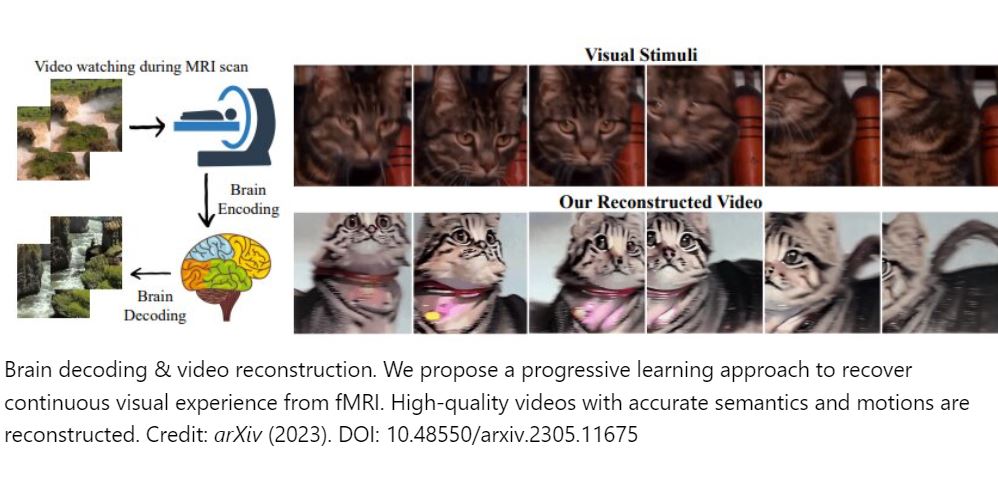
“Alexa, play back that dream I had about Kirsten last week.” That’s a command that may not be too far off in the future, as researchers close in on technology that can tap into our minds and retrieve the imagery of our thoughts.
Researchers at the National University of Singapore and the Chinese University of Hong Kong reported last week that they have developed a process capable of generating video from brain scans. The research is published on the arXiv preprint server.
Using a process called functional magnetic resonance imaging (fMRI), researchers Jiaxin Qing, Zijiao Chen and Juan Helen Zhou coupled data retrieved through imaging with the deep learning model Stable Diffusion to create smooth, high quality videos.
Successful recreations of still imagery gleaned from brain ...
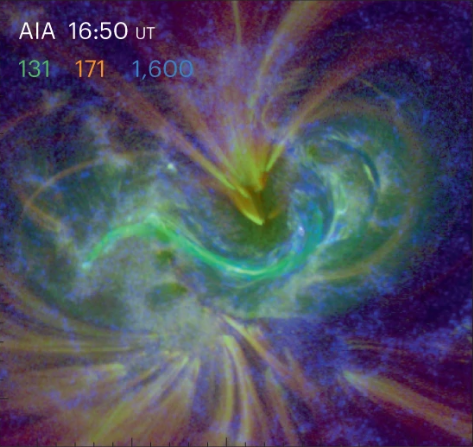
Recently, a research team led by Prof. Gou Yanyu from the University of Science and Technology of China (USTC) of the Chinese Academy of Sciences (CAS) found that the solar outburst structure undergoes a complex reconfiguration evolution during the early outbursts. This is an important advancement in the study of solar outburst activity. This study was published in Nature Astronomy.
In classical images, the core structure of a solar eruption is a magnetic rope consisting of spirally wound magnetic lines. When the eruption begins, the magnetic ropes around the core are transformed by magnetic reconnection into spirally wound magnetic lines, which wrap around the original core, leading to its rapid growth in a “snowball” fashion...












Recent Comments