Screen-Printing Method can make Wearable Electronics Less Expensive

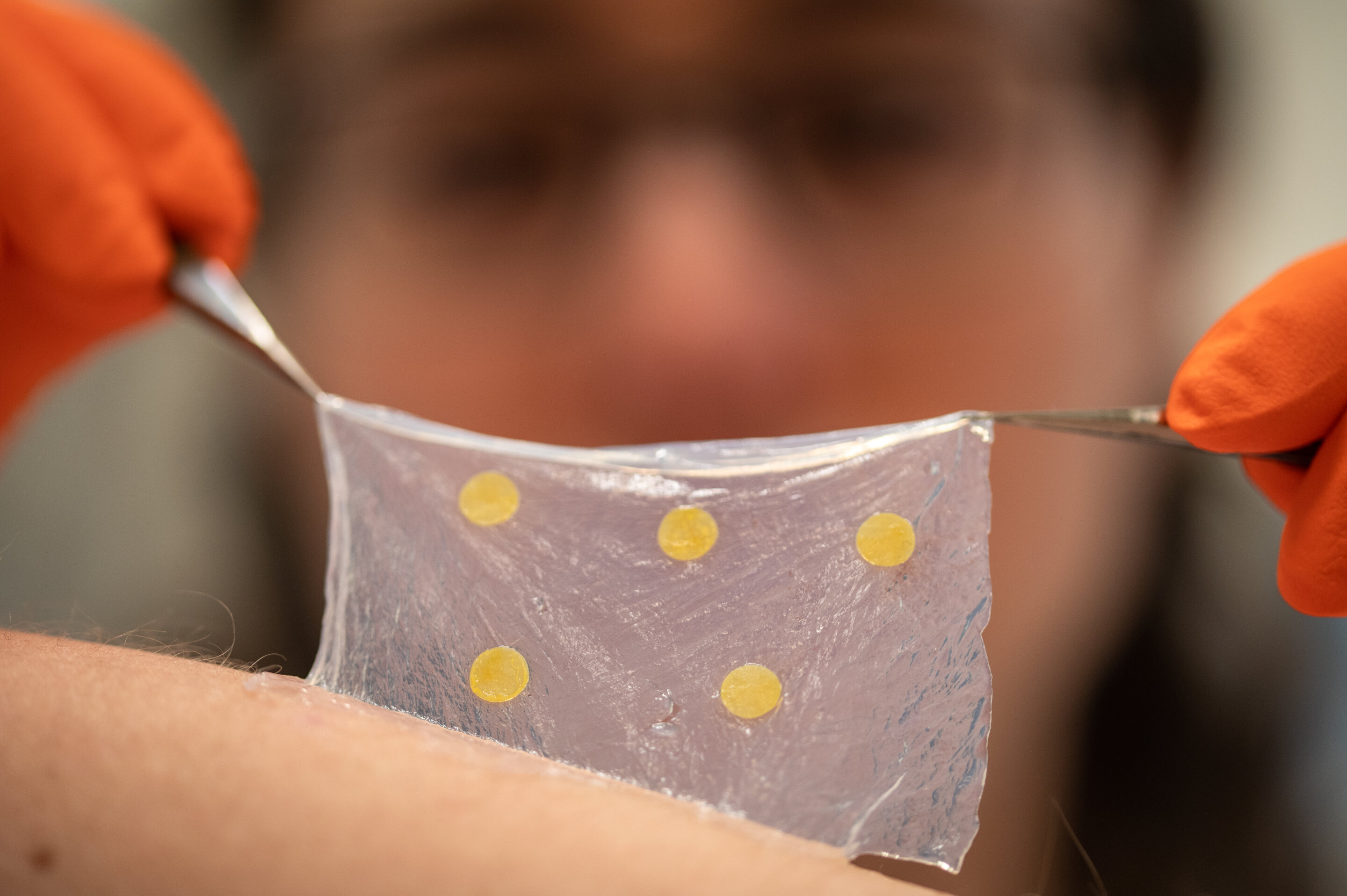
A blue-gloved hand holding a clear sheet containing 12 small, golden square electrode patterns.
A set of screen-printed electrodes

A new study demonstrates that electrodes can be made using just screen printing, creating a stretchable, durable circuit pattern that can be transferred to fabric and worn directly on human skin. Such wearable electronics can be used for health monitoring in hospitals or at home. Current commercial manufacturing of wearable electronics requires expensive processes involving clean rooms. While some use screen printing for parts of the process, this new method relies wholly on screen printing, which can make manufacturing flexible, wearable electronics much easier and less expensive.

The glittering, serpentine structures that power wearable electronics can be created with the same technology used to print rock concert t-shirts, new research shows.

...Read More

New Webb Image Reveals Dusty Disk Like Never Seen Before

These two images are of the dusty debris disk around AU Mic, a red dwarf star located 32 light-years away in the southern constellation Microscopium. Scientists used Webb’s Near-Infrared Camera (NIRCam) to study AU Mic. NIRCam’s coronagraph, which blocked the intense light of the central star, allowed the team to study the region very close to the star. The location of the star, which is masked out, is marked by a white, graphical representation at the center of each image. The region blocked by the coronagraph is shown by a dashed circle.
Credits: NASA, ESA, CSA, and K. Lawson (Goddard Space Flight Center). Image processing: A. Pagan (STScI)

NASA’s James Webb Space Telescope has imaged the inner workings of a dusty disk surrounding a nearby red dwarf star...

Read More

Study reveals Obesity-related Trigger that can lead to Diabetes

Researchers at Washington University School of Medicine in St. Louis have found that a defect in an enzyme called APT1 interferes with the ability to secrete insulin, contributing to the development of Type 2 diabetes in people who are overweight or obese. In this microscopic image of the surface of an insulin-secreting beta cell from a mouse with diabetes, granules containing insulin are green; granules containing a protein affected by APT1 are red; and the yellow granules are those that release excess insulin due to a defect in APT1.

Many with elevated insulin levels also have defects in an enzyme key to fatty acid processing...

Read More

Converting Temperature Fluctuations into Clean Energy with Novel Nanoparticles and Heating Strategy

Illustration of potential applications of combining pyroelectric materials and the localized thermo-plasmonic effect of noble metal nanomaterials. Photo credit: Dr Lei Dangyuan’s group / City University of Hong Kong

Pyroelectric catalysis (pyro-catalysis) can convert environmental temperature fluctuations into clean chemical energy, like hydrogen. However, compared with the more common catalysis strategy, such as photocatalysis, pyro-catalysis is inefficient due to slow temperature changes in the ambient environment...

Read More