To raise new questions, new possibilities, to regard old problems from a new angle, requires creative imagination and marks real advance in science.
~Albert Einstein
Read More
Old Newtonian physics claimed that things have an objective reality separate from our perception of them. Quantum physics, and particularly Heisenberg's Uncertainty Principle, reveal that, as our perception of an object changes, the object itself literally changes.
~Marianne Williamson
Read More
University of Minnesota researchers have invented new catalyst technology that improves the process and substantially reduces the cost of manufacturing renewable chemicals that can be used in a wide range of products including paints, coatings and diapers. Graphic credit: John Beumer, NSF Center for Sustainable Polymers, University of Minnesota
Research discovery will enable the manufacturing of biorenewable materials from trees and corn. A team led by University of Minnesota Twin Cities researchers has invented a groundbreaking new catalyst technology that converts renewable materials like trees and corn to the key chemicals, acrylic acid, and acrylates used in paints, coatings, and superabsorbent polymers...
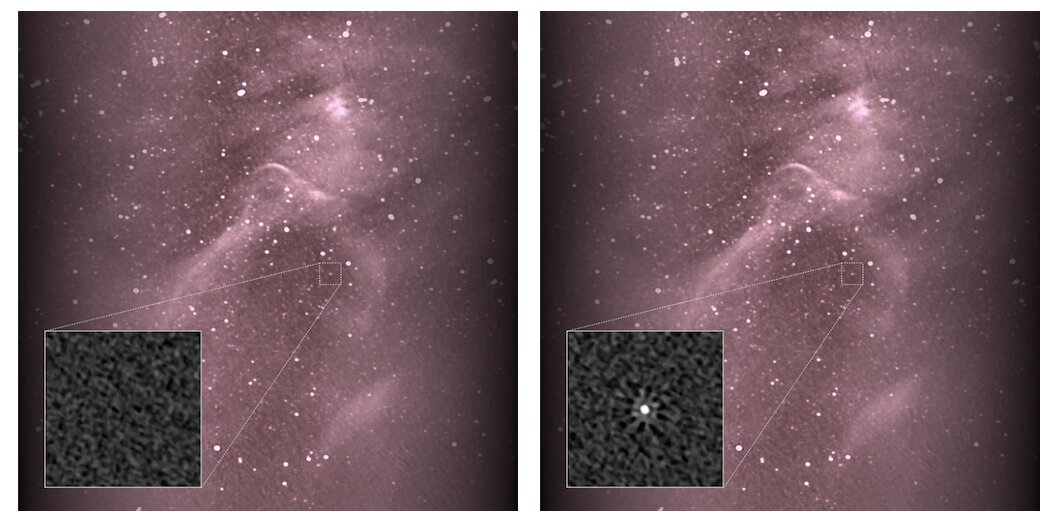
Credit: ALMA (ESO/NAOJ/NRAO); M. Weiss (NRAO/AUI/NSF)
While studying a nearby pair of merging galaxies using the Atacama Large Millimeter/submillimeter Array (ALMA) – an international observatory co-operated by the U.S. National Science Foundation’s National Radio Astronomy Observatory (NRAO) – scientists discovered two supermassive black holes growing simultaneously near the center of the newly coalescing galaxy. These super-hungry giants are the closest together that scientists have ever observed in multiple wavelengths. What’s more, the new research reveals that binary black holes and the galaxy mergers that create them may be surprisingly commonplace in the Universe...
High magnification image showing part of the mouse hippocampus in which a sparse population of neurons encoding a specific learning event are labelled in red. Neurons that are not activated by the learning event are shown in blue. | Illustration Havekes Lab, University of Groningen
Students sometimes pull an all-nighter to prepare for an exam. However, research has shown that sleep deprivation is bad for your memory. Now, University of Groningen neuroscientist Robbert Havekes discovered that what you learn while being sleep deprived is not necessarily lost, it is just difficult to recall.
Together with his team, he has found a way to make this “hidden knowledge” accessible again days after studying while sleep-deprived using optogenetic approaches, and the human-approved asthma drug...
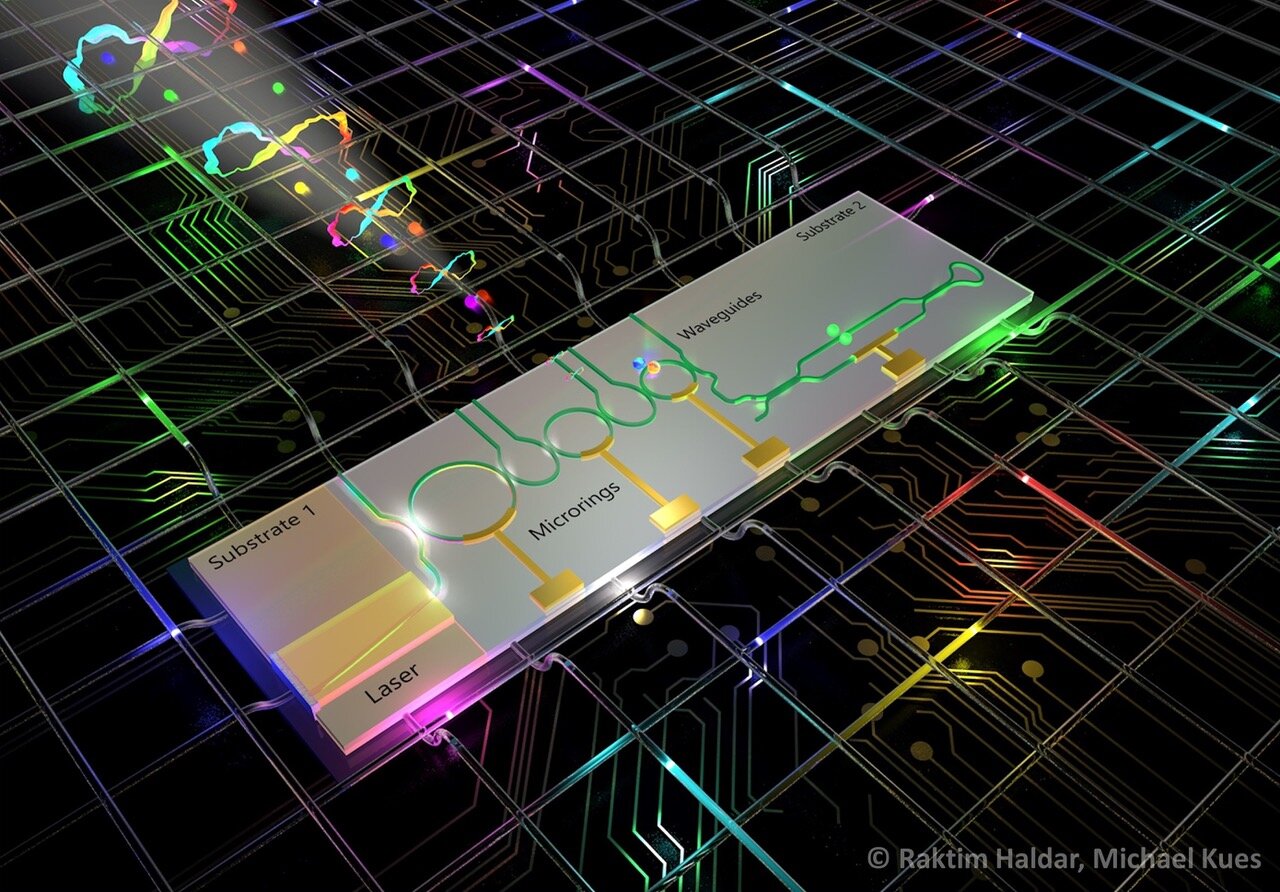
Massively parallel universal linear transformations using a wavelength-multiplexed diffractive deep neural network. Image courtesy of Ozcan Research Group, UCLA.
In today’s digital age, computational tasks have become increasingly complex. This, in turn, has led to an exponential growth in the power consumed by digital computers. Thus, it is necessary to develop hardware resources that can perform large-scale computing in a fast and energy-efficient way.
In this regard, optical computers, which use light instead of electricity to perform computations, are promising. They can potentially provide lower latency and reduced power consumption, benefiting from the parallelism that optical systems have. As a result, researchers have explored various optical computing designs.
Recent Comments