Stars can Eat their Planets, and Spit them Back Out Again

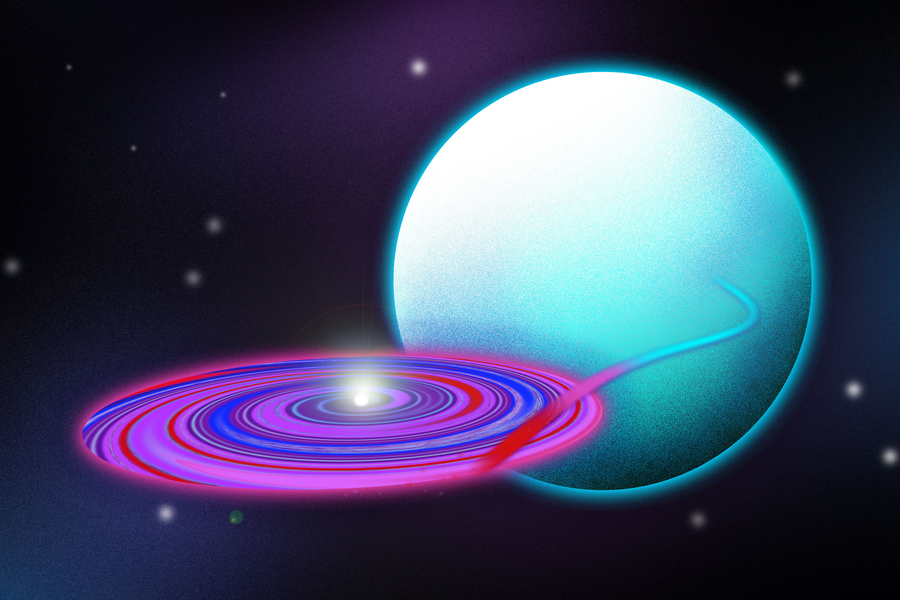
As tragic as it is, engulfment of a planetary object by its stellar parent is a common scenario throughout the universe. But it doesn’t have to end in doom. A team of astrophysicists have used computer simulations to discover that planets can not only survive when their star eats them, but they can also drive its future evolution.

Models of the formation of planetary systems have shown that many planets often end up being consumed by their parent star. It’s simply a matter of orbital dynamics. Random interactions among newly forming planets and the protoplanetary disk that surrounds a young star can send planets on chaotic trajectories. Some of those trajectories end up driving the planet out of the system altogether, while other trajectories send them hurdling into the star.

An...

Read More

A 4D Printer for Smart Materials with Magneto- and Electro-Mechanical Properties

A 4D printer for smart materials with magneto-and electro-mechanical properties
A new smart printer enables the manufacture of soft multifunctional materials by continuously adapting extrusion parameters. Combining experimental and computational methods, it prints conductive and magneto-active materials with mechanical properties that mimic biological tissues. Credit: UC3M

Researchers at Universidad Carlos III de Madrid (UC3M) have created software and hardware for a 4D printer with applications in the biomedical field. In addition to 3D printing, this machine allows for controlling extra functions: programming the material’s response so that shape-changing occurs under external magnetic field, or changes in its electric properties develops under mechanical deformation...

Read More

The Planet that could End Life on Earth

Artist’s concept of Kepler-62f, a super-Earth-size planet orbiting a star smaller and cooler than the sun, about 1,200 light-years from Earth. (NASA Ames/JPL-Caltech/Tim Pyle)

Experiment demonstrates solar system’s fragility. A terrestrial planet hovering between Mars and Jupiter would be able to push Earth out of the solar system and wipe out life on this planet, according to a UC Riverside experiment.

UCR astrophysicist Stephen Kane explained that his experiment was meant to address two notable gaps in planetary science.

The first is the gap in our solar system between the size of terrestrial and giant gas planets. The largest terrestrial planet is Earth, and the smallest gas giant is Neptune, which is four times wider and 17 times more massive than Earth...

Read More

The Marathon Runners of the Immune System

Highlights
Interleukin-33 (IL-33) promotes the expansion of stem-like CD8 T cells (CD8+SL)
IL-33 signals augment chromatin accessibility of CD8+SL in chronic viral infection
IL-33 prevents the loss of Tcf-1 expression by balancing type I interferon effects
IL-33 signaling to CD8+SL preserves these cells’ stemness and re-expansion capacity

When it comes to chronic infections and cancer, a particular type of immune cell plays a central role in our defenses. Researchers at the University of Basel have uncovered the key to the tenacity of these immune cells in coping with the marathon that is fighting a chronic infection. Their results lay the foundations for more effective therapies and vaccination strategies.

Infected and abnormal cells have to go...

Read More