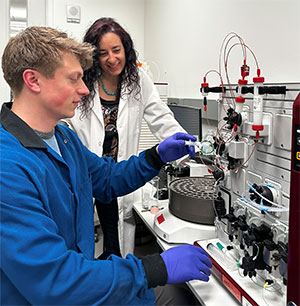
New Life flashed into Lithium-ion Anodes

Fast ‘green’ process revives essential battery components for reuse. How many rechargeable lithium-ion batteries are you wearing? How many are in your general vicinity?

Probably more than a few, and they’re great for powering all the things important to modern lives: cellphones, watches, computers, cars and so much more.

But where they go when they fail is a growing problem. Rice University scientists believe they have a partial solution that relies on the unique “-flash” Joule heating process they developed to produce graphene from waste.

The Rice lab of chemist James Tour has reconfigured the process to quickly regenerate graphite anode materials found in lithium-ion batteries, removing impurities so they can be used again and again.

The lab’s work appears in Advanced Ma...

Read More

Discovering Rare Red Spiral Galaxy Population from Early Universe with the James Webb Space Telescope

Morphology of galaxies contain important information about the process of galaxy formation and evolution. With its state-of-the-art resolution, NASA’s James Webb Space Telescope has now captured several red spiral galaxies in its first image at an unprecedented resolution. Researchers have now analyzed these galaxies, revealing that these are among the furthest known spiral galaxies till date. The analysis further detected a passive red spiral galaxy in the early universe, a surprising discovery.

Spiral galaxies represent one of the most spectacular features in our universe. Among them, spiral galaxies in the distant universe contain significant information about their origin and evolution...

Read More

Nanomaterial influences Gut Microbiome and Immune system Interactions

Decorative image
A new study by researchers at Karolinska Institutet shows that the aryl hydrocarbon receptor (AhR) in intestinal epithelial cells senses the nanomaterial graphen oxide and activates specific immune cells known as innate lymphoid cells. Illustration by Getty Images.

The nanomaterial graphene oxide — which is used in everything from electronics to sensors for biomolecules — can indirectly affect the immune system via the gut microbiome, as shown in a new study on zebrafish by researchers at Karolinska Institutet in Sweden. The findings are reported in the journal Nature Nanotechnology.

“This shows that we must factor the gut microbiome into our understanding of how nanomaterials affect the immune system,” says the paper’s corresponding author Bengt Fadeel, professor at the Institute o...

Read More

Paper-Thin Solar Cell can turn Any Surface into a Power Source

Gloved hands hold a sheet containing 6x5 grid of solar cells.
MIT researchers have developed a scalable fabrication technique to produce ultrathin, lightweight solar cells that can be stuck onto any surface.
Credits:Credit: Melanie Gonick, MIT

MIT engineers have developed ultralight fabric solar cells that can quickly and easily turn any surface into a power source.

These durable, flexible solar cells, which are much thinner than a human hair, are glued to a strong, lightweight fabric, making them easy to install on a fixed surface. They can provide energy on the go as a wearable power fabric or be transported and rapidly deployed in remote locations for assistance in emergencies...

Read More