A Novel Waste Removal Factor Treats Brain Hemorrhage

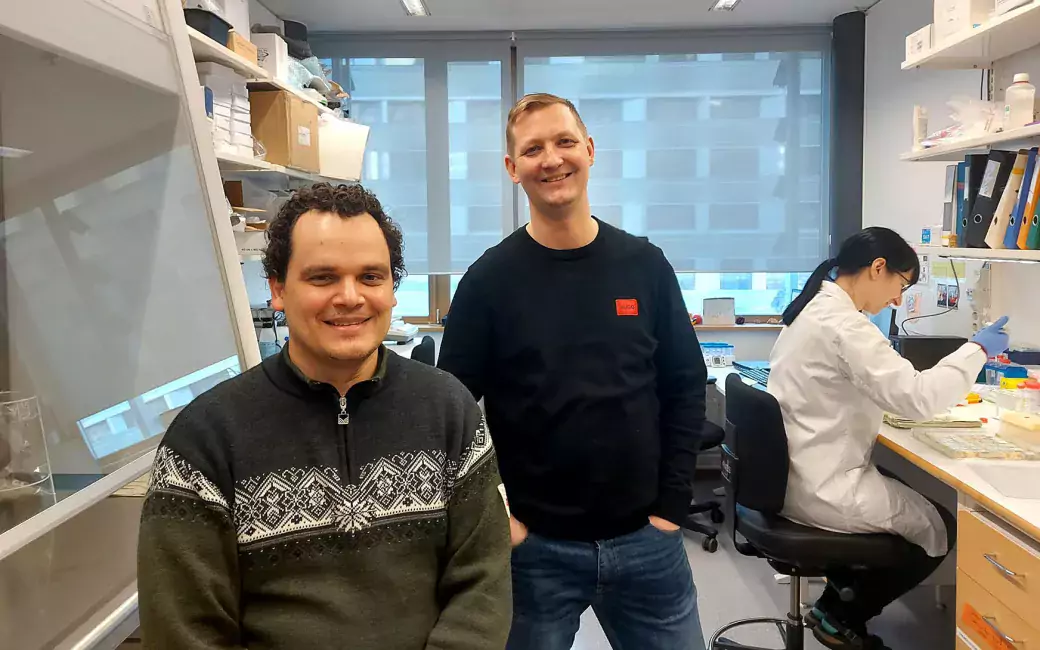
Vassileios Stratoulias and Mikko Airavaara.
Vassileios Stratoulias and Mikko Airavaara at the BrainRepair laboratory, University of Helsinki.

University of Helsinki and Taiwanese researchers have found a new way to remove waste from the brain after haemorrhage.

Intracerebral haemorrhage, and bleeding into the brain tissue, is a devastating neurological condition affecting millions of people annually. It has a high mortality rate, while survivors are affected by long-term neurological deficits. No medication has been found to support brain recovery following hemorrhage.

In an international collaboration, researchers from the Brain Repair laboratory, University of Helsinki, together with their Taiwanese colleagues investigated whether a protein called cerebral dopamine neurotrophic factor (CDNF) has potential as a treatment ...

Read More

Breakthrough in the Understanding of Quantum Turbulence

The researchers used a unique rotating cryostat in their study

Researchers have shown how energy disappears in quantum turbulence, paving the way for a better understanding of turbulence in scales ranging from the microscopic to the planetary.

Dr Samuli Autti from Lancaster University is one of the authors of a new study of quantum wave turbulence together with researchers at Aalto University.

The team’s findings, published in Nature Physics, demonstrate a new understanding of how wave-like motion transfers energy from macroscopic to microscopic length scales, and their results confirm a theoretical prediction about how the energy is dissipated at small scales.

Dr Autti said: “This discovery will become a cornerstone of the physics of large quantum systems.”

Quantum turbulence at large scales – such as turbulence around moving aeropla...

Read More

‘Terminator Zones’ on Distant Planets could harbor life

'Terminator zones' on distant planets could harbor life, astronomers say
Some exoplanets have one side permanently facing their star while the other side is in perpetual darkness. The ring-shaped border between these permanent day and night regions is called a “terminator zone.” In a new paper in The Astrophysical Journal, physics and astronomy researchers at UC Irvine say this area has the potential to support extraterrestrial life. Ana Lobo / UCI

These in-between regions could be prime sites for liquid water. In a new study, University of California, Irvine astronomers describe how extraterrestrial life has the potential to exist on distant exoplanets inside a special area called the “terminator zone,” which is a ring on planets that have one side that always faces its star and one side that is always dark.

“These planets have a permanent day side ...

Read More

New Research establishes How and Why Western Diets High in Sugar and Fat cause Liver Disease

fatty sugary food

Research is unlocking how the food we eat contributes to an epidemic of chronic liver disease. New research from the University of Missouri School of Medicine has established a link between western diets high in fat and sugar and the development of non-alcoholic fatty liver disease, the leading cause of chronic liver disease.

The research, based in the Roy Blunt NextGen Precision Health Building at MU, has identified the western diet-induced microbial and metabolic contributors to liver disease, advancing our understanding of the gut-liver axis, and in turn the development of dietary and microbial interventions for this global health threat.

“We’re just beginning to understand how food and gut microbiota interact to produce metabolites that contribute to the development of liver...

Read More