

Credits: NASA, ESA, CSA, and K. Lawson (Goddard Space Flight Center). Image processing: A. Pagan (STScI)
NASA’s James Webb Space Telescope has imaged the inner workings of a dusty disk surrounding a nearby red dwarf star...
Read More


Until we recognize the essential role of biology, our attempts to truly unify the universe will remain a train to nowhere. ~Robert Lanza Read More

Good health is not something we can buy. However, it can be an extremely valuable savings account. ~Anne Wilson Schaef Read More

The only way forward, if we are going to improve the quality of the environment, is to get everybody involved. ~Richard Rogers Read More

To raise new questions, new possibilities, to regard old problems from a new angle, requires creative imagination and marks real advance in science. ~Albert Einstein Read More

Old Newtonian physics claimed that things have an objective reality separate from our perception of them. Quantum physics, and particularly Heisenberg's Uncertainty Principle, reveal that, as our perception of an object changes, the object itself literally changes. ~Marianne Williamson Read More

Astronomy compels the soul to look upwards and leads us from this world to another. ~ Read More
January 13, 2023,
 Astronomy/Space
NASA’s James Webb Space Telescope has imaged the inner workings of a dusty disk surrounding a nearby red dwarf star...
Read More
January 12, 2023,
Health/Medical, Biology/Biotechnology

Many with elevated insulin levels also have defects in an enzyme key to fatty acid processing...
Read More
January 12, 2023,
Physics, Chemistry/Nanotechnology, Biology/Biotechnology, Environment/Geology

Pyroelectric catalysis (pyro-catalysis) can convert environmental temperature fluctuations into clean chemical energy, like hydrogen. However, compared with the more common catalysis strategy, such as photocatalysis, pyro-catalysis is inefficient due to slow temperature changes in the ambient environment...
Read More
January 12, 2023,
Astronomy/Space
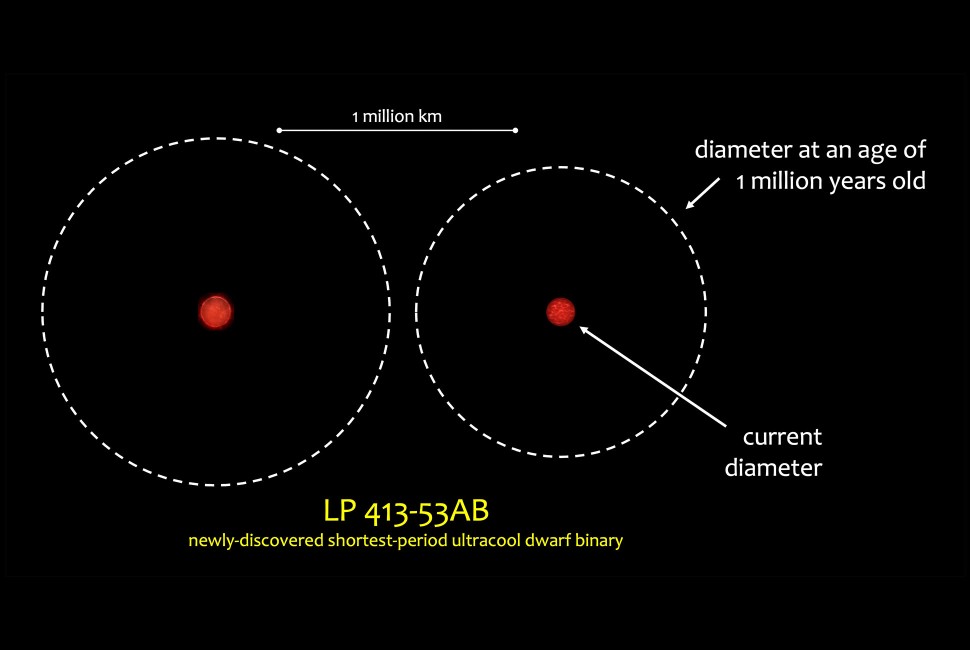
Northwestern University and the University of California San Diego (UC San Diego) astrophysicists have discovered the tightest ultracool dwarf binary system ever observed.
The two stars are so close that it takes them less than one Earth day to revolve around each other. In other words, each star’s “year” lasts just 20.5 hours.
The newly discovered system, named LP 413-53AB, is composed of a pair of ultracool dwarfs, a class of very low-mass stars that are so cool that they emit their light primarily in the infrared, making them completely invisible to the human eye. They are nonetheless one of the most common types of stars in the universe.
Previously, astronomers had only detected three short-period ultracool dwarf bi...
Read More
Recent Comments