How the brain’s activity, energy use and blood flow change as people fall asleep

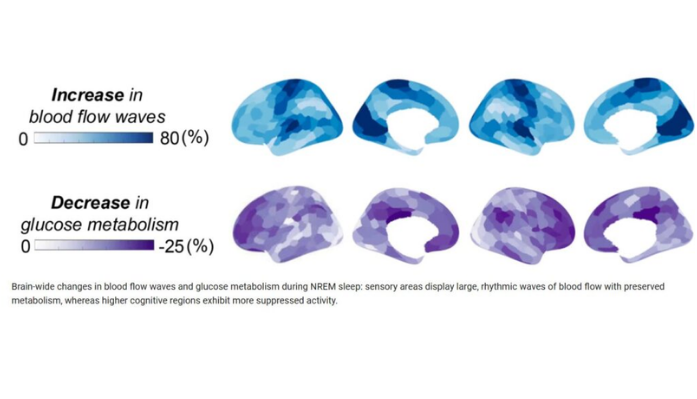
A new study by investigators from Mass General Brigham has used next-generation imaging technology to discover that when the brain is falling asleep, it shows a coordinated shift in activity.

The researchers found that during NREM (non-rapid eye movement) sleep, parts of the brain that handle movement and sensory input stay active and keep using energy, while areas involved in thinking, memory and daydreaming quiet down and use less energy. Their results are published in Nature Communications.

“This research helps explain how the brain stays responsive to the outside world even as awareness fades during sleep,” said corresponding author Jingyuan Chen, Ph.D., an assistant investigator at the Athinoula A. Martinos Center for Biomedical Imaging at Massachusetts General Hospital.

...Read More
DeepMind introduces AI agent that learns to complete various tasks in a scalable world model

DeepMind introduces an AI agent that learns to complete various tasks in a scalable world model
Dreamer 4 learns to solve complex control tasks by reinforcement learning inside of its world model. We decode the imagined training sequences for visualization, showing that the world model has learned to simulate a wide range of game mechanics from low-level mouse and keyboard actions, including breaking blocks, using tools, and interacting with crafting tables. Credit: arXiv (2025). DOI: 10.48550/arxiv.2509.24527

Over the past decade, deep learning has transformed how artificial intelligence (AI) agents perceive and act in digital environments, allowing them to master board games, control simulated robots and reliably tackle various other tasks...

Read More

Scientists discover elusive solar waves that could power the sun’s corona

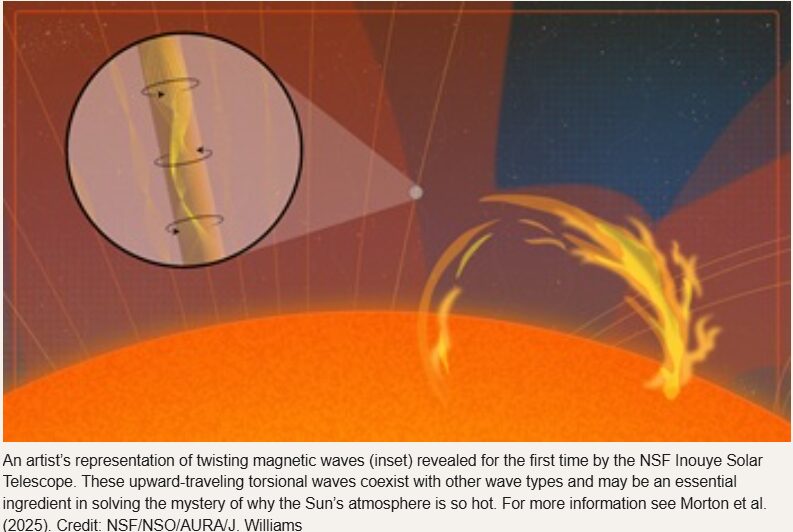
Researchers have achieved a breakthrough in solar physics by providing the first direct evidence of small-scale torsional Alfvén waves in the sun’s corona—elusive magnetic waves that scientists have been searching for since the 1940s.

The discovery, published in Nature Astronomy, was made using unprecedented observations from the world’s most powerful solar telescope, the U.S. National Science Foundation (NSF) Daniel K. Inouye Solar Telescope in Hawaii.

The findings could finally explain one of the sun’s greatest mysteries—how its outer atmosphere, the corona, reaches temperatures of millions of degrees while its surface is only around 5,500°C.

Alfvén waves, named after Nobel Prize winner Hannes Alfvén who predicted their existence in 1942, are magnetic disturbances tha...

Read More

How just minutes of running can supercharge your health

Interval running condenses the powerful effects of regular running into shorter, high-intensity bursts. Research shows it can improve cardiovascular health, regulate blood sugar, and reduce body fat more effectively than longer steady runs. Just a few short sprints per session can deliver major fitness gains.

Running offers a wide range of advantages for both body and mind. It can protect against disease, improve mood, and even slow down the body’s natural aging process.

Yet about 31% of adults still don’t get enough physical activity, including running. The most common reason people give is simple — they don’t have enough time.

That’s where interval running comes in. It promises nearly all the same benefits of regular running, but in a fraction of the time.

What Is Interv...

Read More