To raise new questions, new possibilities, to regard old problems from a new angle, requires creative imagination and marks real advance in science.
~Albert Einstein
Read More
Old Newtonian physics claimed that things have an objective reality separate from our perception of them. Quantum physics, and particularly Heisenberg's Uncertainty Principle, reveal that, as our perception of an object changes, the object itself literally changes.
~Marianne Williamson
Read More
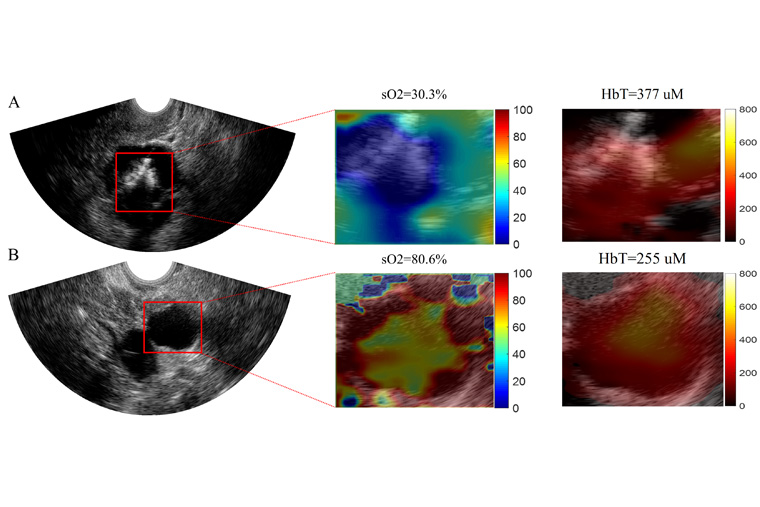
(From left) The top row shows an ultrasound image of a malignant lesion, the blood oxygen saturation, and hemoglobin concentration. The bottom row is an ultrasound image of a benign lesion, the blood oxygen saturation, and hemoglobin concentration. (Image: Zhu lab)
New research yields a novel method to use ultrasound to enhance machine learning’s ability to accurately diagnose — or rule out — ovarian cancer.
Although ovarian cancer is the deadliest type of cancer for women, only about 20% of cases are found at an early stage, as there are no real screening tests for them and few symptoms to prompt them...
Notre Dame’s Golden Dome partially photographed through a sample (top left) of the TRC coating.
Cooling accounts for about 15 percent of global energy consumption. Conventional clear windows allow the sun to heat up interior spaces, which energy-guzzling air-conditioners must then cool down. But what if a window could help cool the room, use no energy and preserve the view?
Tengfei Luo, the Dorini Family Professor of Energy Studies at the University of Notre Dame, and postdoctoral associate Seongmin Kim have devised a transparent coating for windows that does just that.
The coating, or transparent radiative cooler (TRC), allows visible light to come in and keeps other heat-producing light out...
Artist’s impression of star being tidally disrupted by a supermassive black hole Credit: ESO/M. Kornmesser
Astronomers have determined the source of an incredibly bright X-ray, optical and radio signal appearing from halfway across the Universe.
The signal, named AT 2022cmc, was discovered earlier this year by the Zwicky Transient Facility in California. Findings published today in Nature Astronomy, suggest that it is likely from a jet of matter, streaking out from a supermassive black hole at close to the speed of light.
The team, including researchers from MIT and the University of Birmingham, believe the jet is the product of a black hole that suddenly began devouring a nearby star, releasing a huge amount of energy in the process...
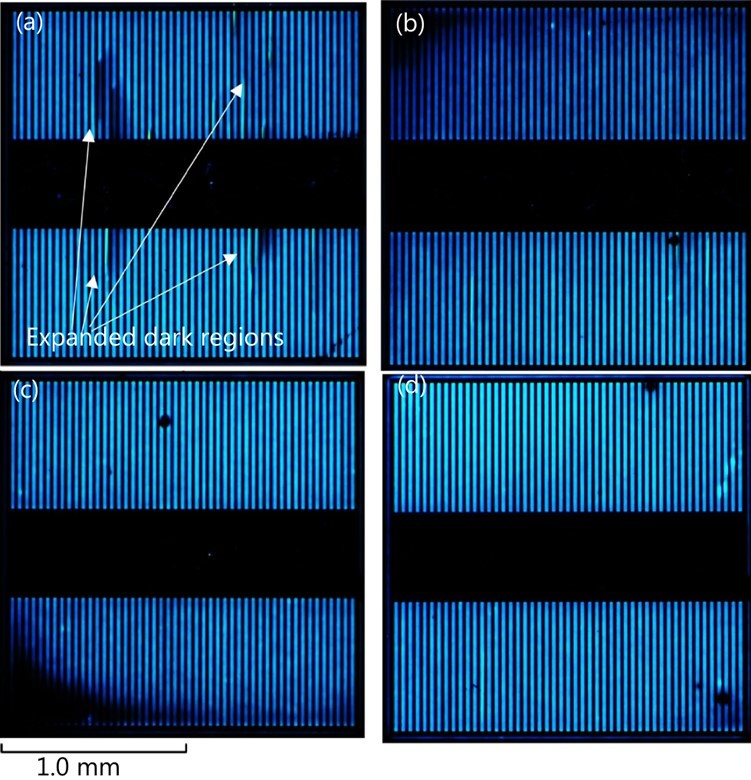
Proton implantation prevents the expansion of stacking faults and solves the problem of bipolar degradation. Electroluminescence images of PiN diodes made from silicon carbide after being subjected to electrical stress. In the first diode (a), on which proton implantation was not applied, expanded stacking faults show up as dark regions. The other three diodes (b, c, and d) undergo proton implantation at increasing hydrogen ion doses. Contrary to the first diode, these exhibit no stacking fault expansion and, in turn, bipolar degradation. Image credit:Masashi Kato from Nagoya Institute of Technology
Silicon carbide (SiC) is a promising semiconductor material for power electronic devices, but it suffers from bipolar degradation, which severely limits its lifespan...













Recent Comments