Robotic Motion in Curved Space Defies Standard Laws of Physics

Experimental realization of a swimmer on a sphere with actuated motors on a freely rotating boom arm.

When humans, animals, and machines move throughout the world, they always push against something, whether it’s the ground, air, or water. Until recently, physicists believed this to be a constant, following the law of conservation momentum. Now, researchers from the Georgia Institute of Technology have proven the opposite — when bodies exist in curved spaces, it turns out that they can in fact move without pushing against something.

The findings were published in Proceedings of the National Academy of Sciences on July 28, 2022...

Read More

Hyaluranic Acid, a naturally occurring Compound, Awakens Stem Cells to Repair Damaged Muscle

Muscle stem cell on a muscle fiber:
Muscle stem cell on a muscle fiber: When a muscle fiber is damaged, stem cells (in pink) start producing and coating themselves with hyaluronic acid (pale green outline). Once the coating gets thick enough, it causes the muscle stem cells to wake up

A new study published in the journal Science reveals a unique form of cell communication that controls muscle repair. In damaged muscle, stem cells must work together with immune cells to complete the repair process, yet how these cells coordinate to ensure the efficient removal of dead tissue before making new muscle fibers has remained unknown...

Read More

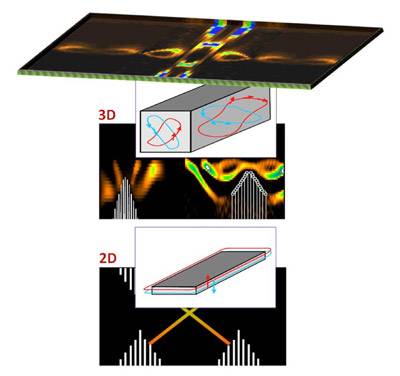
New Chip-based Beam Steering – Device Lays Groundwork for Smaller, Cheaper Lidar

Caption: The new OPA that replaces the multiple emitters of traditional OPAs with a slab grating to create a single emitter. This design enables a wide field of view without sacrificing beam quality.
Image Credit: Hao Hu, Technical University of Denmark

Technology could benefit lidar applications from autonomous driving to virtual reality. Researchers have developed a new chip-based beam steering technology that provides a promising route to small, cost-effective and high-performance lidar (or light detection and ranging) systems. Lidar, which uses laser pulses to acquire 3D information about a scene or object, is used in a wide range of applications such as autonomous driving, free-space optical communications, 3D holography, biomedical sensing and virtual reality.

“Optical beam ste...

Read More

Signs of Disturbance in Nearby Dwarf Galaxies indicate an Alternative Gavity Theory

The dwarf galaxy NGC1427A flies through the Fornax galaxy cluster and undergoes disturbances which would not be possible if this galaxy were surrounded by a heavy and extended dark matter halo, as required by standard cosmology.
The dwarf galaxy NGC1427A flies through the Fornax galaxy cluster and undergoes disturbances which would not be possible if this galaxy were surrounded by a heavy and extended dark matter halo, as required by standard cosmology.© ESO

According to the standard model of cosmology, the vast majority of galaxies are surrounded by a halo of dark matter particles. This halo is invisible, but its mass exerts a strong gravitational pull on galaxies in the vicinity. A new study challenges this view of the Universe. The results suggest that the dwarf galaxies of Earth’s second closest galaxy cluster — known as the Fornax Cluster — are free of such dark matter halos.

Dwarf galaxies are small, faint galaxies that can usually be found in galaxy clusters or near larger galaxies...

Read More