Scientists Reveal New Function of Enzyme ADAR1 Linking it to Age-Related Diseases via a Role Independent of RNA-editing during Aging

extended data figure 9
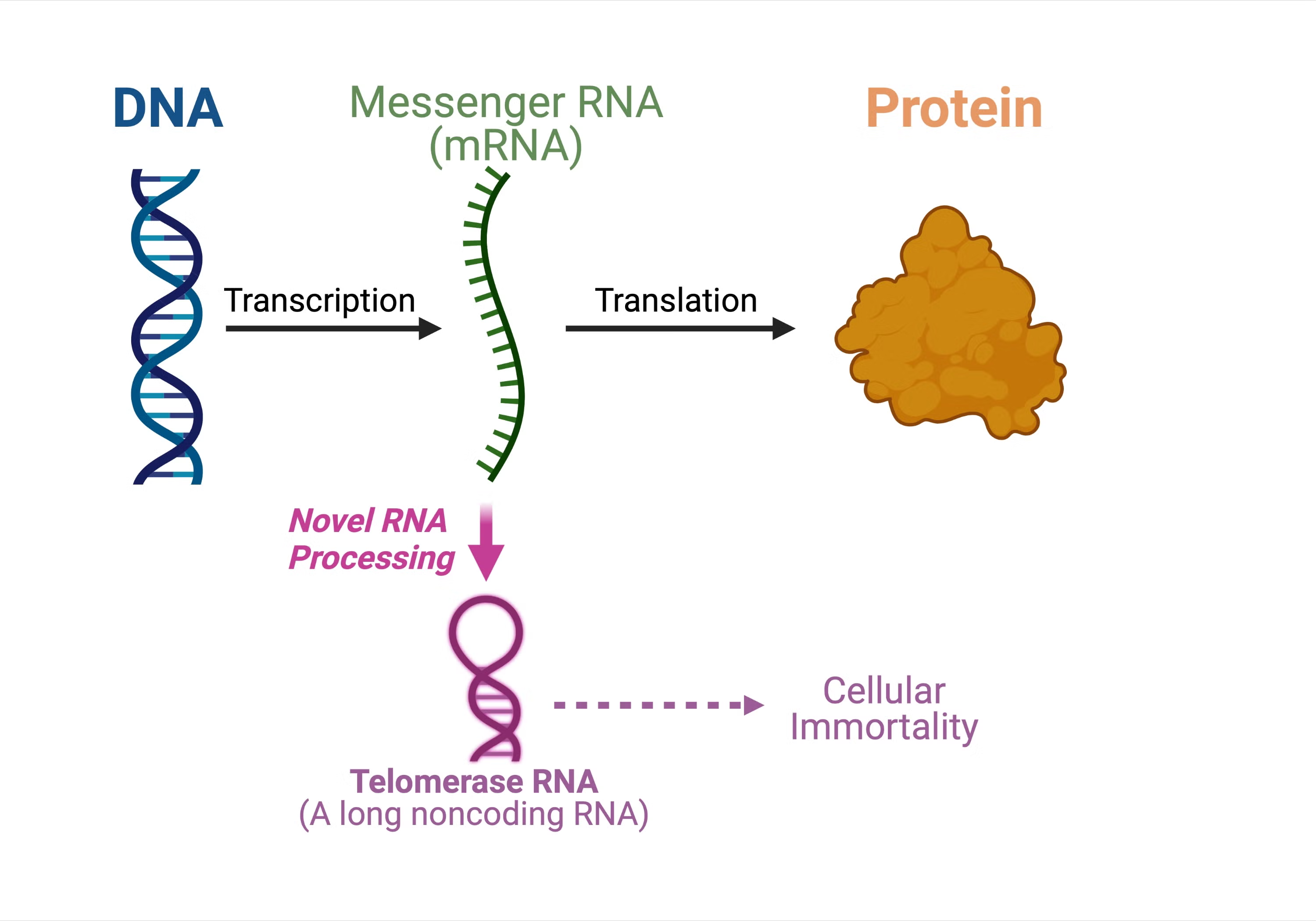
ADAR1 regulates SIRT1 expression.

Aging and age-related disorders pose a complex challenge to the biomedical research community. To better understand how senescence is regulated is of high significance to promote healthy aging and treat age-associated disorders. In a research paper published today in Nature Cell Biology, Rugang Zhang, Ph.D., deputy director of the Ellen and Ronald Caplan Cancer Center, Christopher M. Davis Endowed Professor, and program leader of the Immunology, Microenvironment & Metastasis Program, at The Wistar Institute, and his team revealed a novel ADAR1-SIRT1-p16INK4a axis in regulating cellular senescence and its potential implications in tissue aging.

“Understanding the basic mechanism underlying tissue aging is challenging and cellular senescence offers an...

Read More

Researchers Learn to Control Electron Spin at Room Temperature to make Devices more Efficient and Faster

In a Rashba-Dresselhaus spin transistor, the spin of electrons could be disrupted by spin-phonon coupling or non-ideal internal magnetic field distribution. Credit: Jian Shi

Electron spin, rather than charge, holds the key. As our devices become smaller, faster, more energy efficient, and capable of holding larger amounts of data, spintronics may continue that trajectory. Whereas electronics is based on the flow of electrons, spintronics is based on the spin of electrons.

An electron has a spin degree of freedom, meaning that it not only holds a charge but also acts like a little magnet. In spintronics, a key task is to use an electric field to control electron spin and rotate the north pole of the magnet in any given direction.

The spintronic field effect transistor harnesses th...

Read More

Researchers Capture the First Example of an Extremely Bright, and Fast-Evolving Astronomical Event in the Distant Universe

The schematic light curves of MUSSES2020J and other typical energetic transients (green and orange points denote the stages that MUSSES2020J was observed by the 8.2-m Subaru and follow-up telescopes, respectively). HSC g, r, and i composite multicolor thumbnail image of the host galaxy is shown in the bottom-right corner. A blue cross indicates the location of MUSSES2020J, which is almost at the nucleus of the host galaxy. (Credit: Kavli IPMU)

A team of astronomers have discovered a mysterious short-duration astronomical event, or transient, that is as bright as a superluminous supernova, but evolving much faster, reports a study in The Astrophysical Journal Letters published on July 12.

The universe is full of energetic transient phenomena, astronomical events that occur over a sho...

Read More

How Mitochondrial Damage Ignites the ‘Auto-Inflammatory Fire’

A colorized transmission electron micrograph depicts cellular mitochondria with its characteristic internal folds called cristae.
A colorized transmission electron micrograph depicts cellular mitochondria with its characteristic internal folds called cristae. Thomas Deerinck, National Center for Microscopy and Imaging Research, UC San Diego.

Researchers describe the biochemical pathway that results in the generation of oxidized mitochondrial DNA, how it is expelled by mitochondria and how it triggers the complex and destructive inflammatory response that follows.

Mitochondria are self-contained organelles (they possess their own mini-chromosome and DNA) residing within cells and are charged with the job of generating the chemical energy needed to fuel functions essential to life and well-being.

When stressed, damaged or dysfunctional, mitochondria expel their DNA (mtDNA), oxidized and cleaved, into the cyto...

Read More