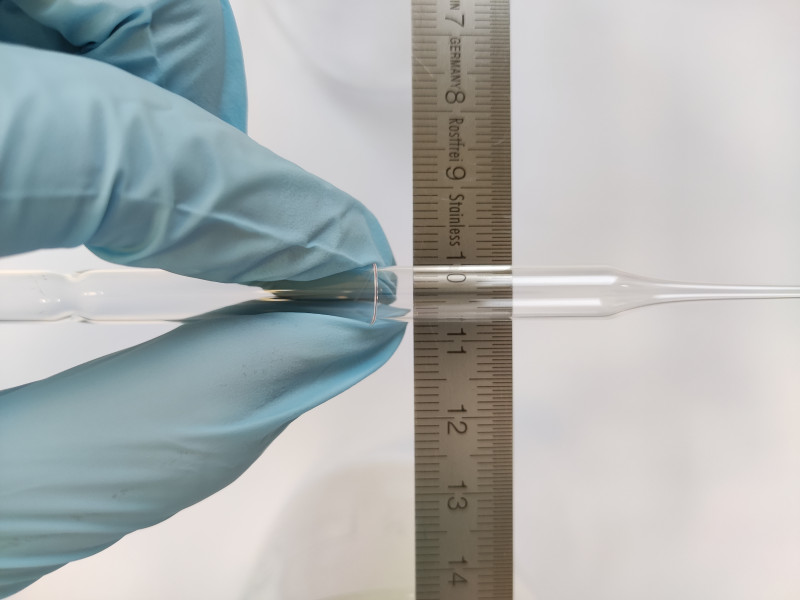
Researchers build Long, highly Conductive Molecular Nanowire

molecular series
A brief abstract figure of this work. Top: the two-step oxidation of the bis(triarylamines) molecular series.

The 2.6nm-long single molecule wire has quasi-metallic properties and shows an unusual increase of conductance as the wire length increases; its excellent conductivity holds great promise for the field of molecular electronics.

As our devices get smaller and smaller, the use of molecules as the main components in electronic circuitry is becoming ever more critical. Over the past 10 years, researchers have been trying to use single molecules as conducting wires because of their small scale, distinct electronic characteristics, and high tunability...

Read More

Citizen scientist leads discovery of 34 Ultracool Dwarf Binaries

How often do stars live alone? For brown dwarfs — objects that straddle the boundary between the most massive planets and the smallest stars — astronomers need to uncover more examples of their companions to find out. Ace citizen scientist Frank Kiwy has done just that by using the Astro Data Lab science platform at NSF’s NOIRLab to discover 34 new ultracool dwarf binary systems in the Sun's neighborhood, nearly doubling the number of such systems known.
llustration of an ultracool dwarf with a companion white dwarf

How often do stars live alone? For brown dwarfs — objects that straddle the boundary between the most massive planets and the smallest stars — astronomers need to uncover more examples of their companions to find out. Ace citizen scientist Frank Kiwy has done just that by using the Astro Data Lab science platform at NSF’s NOIRLab to discover 34 new ultracool dwarf binary systems in the Sun’s neighborhood, nearly doubling the number of such systems known.

A citizen scientist has searched NSF’s NOIRLab’s catalog of 4 billion celestial objects, known as NOIRLab Source Catalog DR2, to reveal brown dwarfs with companions...

Read More

How Sound Reduces Pain in Mice

Image of green and magenta neurons in mouse auditory cortex
Sound reduces pain in mice by lowering the activity of neurons in the brain’s auditory cortex (green and magenta) that project to the thalamus. Wenjie Zhou

Newly identified brain circuits may point to more effective pain therapies. An international team of scientists has identified the neural mechanisms through which sound blunts pain in mice. The findings, which could inform development of safer methods to treat pain, were published in Science. The study was led by researchers at the National Institute of Dental and Craniofacial Research (NIDCR); the University of Science and Technology of China, Hefei; and Anhui Medical University, Hefei, China. NIDCR is part of the National Institutes of Health.

“We need more effective methods of managing acute and chronic pain, and that starts...

Read More

Porosity of the Moon’s Crust reveals Bombardment History

map of lunar south pole
This multi-temporal illumination map of the lunar south pole was created from images taken by NASA’s Lunar Reconnaissance Orbiter.
Credits:Image: NASA/GSFC/Arizona State University

The moon sustained twice as many impacts as can be seen on its surface, scientists find. Researchers find that, early in its history, the moon was highly porous, which was likely a result of early, massive impacts that shattered much of the crust. They reached their conclusions with simulations and data from NASA’s GRAIL mission.

Around 4.4 billion years ago, the early solar system resembled a game of space rock dodgeball, as massive asteroids and comets, and, later, smaller rocks and galactic debris pummeled the moon and other infant terrestrial bodies. This period ended around 3.8 billion years ago...

Read More