Scientists Invent ‘Quantum Flute’ that can make Particles of Light Move Together

UChicago scientists invent 'quantum flute' that can make particles of light move together
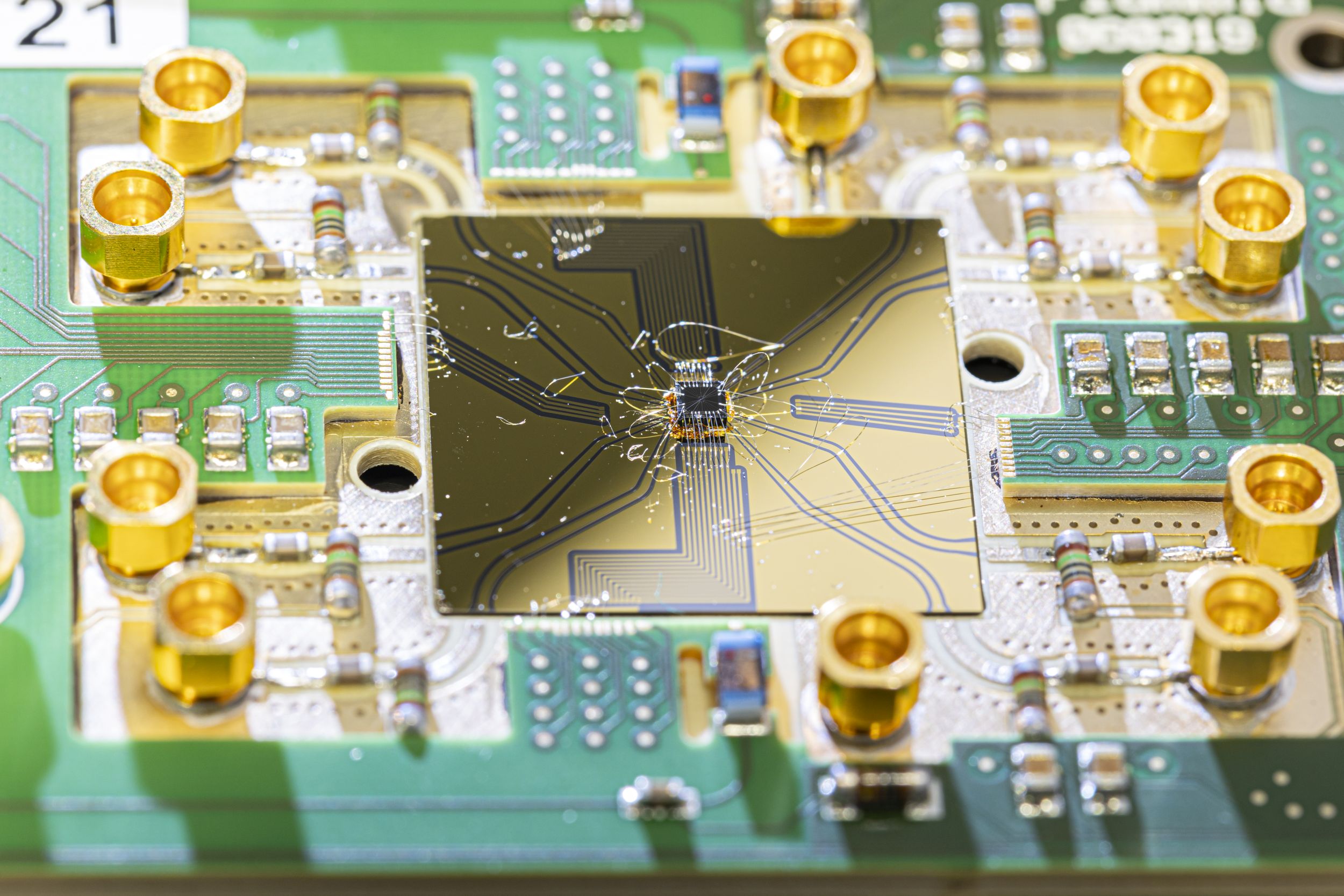
A new “quantum flute” experiment by University of Chicago physicists could point the way towards new quantum technology. The holes create different wavelengths, akin to ‘notes’ on a flute, that can be used to encode quantum information. Credit: Photo courtesy of the Schuster lab

Breakthrough could point the way towards new quantum technology. University of Chicago physicists have invented a “quantum flute” that, like the Pied Piper, can coerce particles of light to move together in a way that’s never been seen before.

Described in two studies published in Physical Review Letters and Nature Physics, the breakthrough could point the way towards realizing quantum memories or new forms of error correction in quantum computers, and observing quantum phenomena that cannot be seen in n...

Read More

Shedding New Light on Dark Matter

An artist’s rendition of big bang nucleosynthesis, the early universe period in which protons “p” and neutrons “n” combine to form light elements. The presence of dark matter “χ” changes how much of each element will form. Image courtesy of Cara Giovanetti/New York University

Analysis offers new means to predict ‘cosmological signatures’ for models of dark matter. A team of physicists has developed a method for predicting the composition of dark matter – invisible matter detected only by its gravitational pull on ordinary matter and whose discovery has been long sought by scientists.

Its work, which appears in the journal Physical Review Letters, centers on predicting “cosmological signatures” for models of dark matter with a mass between that of the electron and the proton...

Read More

A Rhythmic Small Intestinal Microbiome Prevents Obesity and Type 2 Diabetes

In mouse models, researchers found that how much animals ate and when altered their gut microbiome, sometimes for the worse. Photo credit: Public domain — original work of the U.S. Federal Government

Researchers found that in mice how much they ate and when altered the nature of their gut microbiome: too much food too frequently resulted in poorer microbial and metabolic health.

An estimated 500 to 1,000 bacterial species reside in each person’s gut, perhaps numbering 100,000 trillion microorganisms...

Read More

Magnetic Spins that ‘Freeze’ when Heated: Nature in the wrong direction

Magnetische spins
At cooler temperatures, the spins in the material form random patterns, where each pattern whirls like a helix with a particular twist. When heating up the material, the spins choose one of the particular helix patterns, a phenomenon that normally occurs when the temperature decreases in magnetic materials.

Physicists observed a strange new type of behaviour in a magnetic material when it’s heated up. The magnetic spins ‘freeze’ into a static pattern when the temperature rises, a phenomenon that normally occurs when the temperature decreases. They publish their findings in Nature Physics on July 4th.

The researchers discovered the phenomenon in the material neodymium, an element that they described several years ago as a ‘self-induced spin glass’...

Read More