The Protein that Keeps the Pancreas from Digesting itself

Left: Acinar cells (red) in a healthy pancreas. Right: Extensive pancreatic scarring (purple) when ERR gamma is lost from acinar cells.
Click here for a high-resolution image.
Credit: Salk Institute

Potential new therapeutic target for pancreatitis and pancreatic cancer. Now, Salk scientists report in the journal Gastroenterology on April 21, 2022, that a protein known as estrogen-related receptor gamma (ERR ɣ) is critical for preventing pancreatic auto-digestion in mice. Moreover, they discovered that people with pancreatitis have lower levels of ERR ɣ in cells affected by this inflammation.

These findings suggest that new therapies aimed at regulating ERR ɣ activity could help prevent or treat pancreatitis and pancreatic cancer.

“Our finding provides new insight into both the ...

Read More

Cheaper Solar Cells could be on the way thanks to New Materials

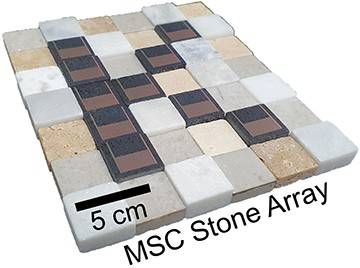
The solar cell with the ferrocene layer highlighted

New solar cell devices that are cheaper and easier to make could soon make their way to market thanks to materials made at Imperial College London.

Traditional solar cells are made from silicon, which has good efficiency and stability, but is relatively expensive to make and can only be manufactured in stiff panels.

Perovskite solar cells offer an intriguing alternative; they can be printed from inks, making them low cost, high efficiency, thin, lightweight and flexible. However, they have trailed behind silicon solar cells in efficiency and, importantly, stability, breaking down under normal environmental conditions.

New metal-containing materials called ferrocenes could help with these problems...

Read More

Why Venus Rotates, Slowly, despite Sun’s Powerful Grip

NASA’s Mariner 10 spacecraft captured this peaceful view of Venus. But, contrary to its serene appearance, Venus is a world of intense heat, crushing atmospheric pressure and clouds of corrosive acid. (NASA/JPL-Caltech)

Planet’s atmosphere explains the gravity of the situation. If not for the soupy, fast-moving atmosphere on Venus, Earth’s sister planet would likely not rotate. Instead, Venus would be locked in place, always facing the sun the way the same side of the moon always faces Earth.

The gravity of a large object in space can keep a smaller object from spinning, a phenomenon called tidal locking. Because it prevents this locking, a UC Riverside scientist argues the atmosphere needs to be a more prominent factor in studies of Venus as well as other planets.

These argument...

Read More

Researchers take Important Step towards Development of Biological Dental Enamel

To this day, cavities and damage to enamel are repaired by dentists with the help of synthetic white filling materials. There is no natural alternative to this. But a new 3D model with human dental stem cells could change this in the future. The results of the research led by KU Leuven Professor Hugo Vankelecom and Professor Annelies Bronckaers from UHasselt have been published in Cellular and Molecular Life Sciences.

Our teeth are very important in everyday activities such as eating and speaking, as well as for our self-esteem and psychological well-being. There is relatively little known about human teeth. An important reason is that certain human dental stem cells, unlike those of rodents, are difficult to grow in the lab...

Read More