To raise new questions, new possibilities, to regard old problems from a new angle, requires creative imagination and marks real advance in science.
~Albert Einstein
Read More
Old Newtonian physics claimed that things have an objective reality separate from our perception of them. Quantum physics, and particularly Heisenberg's Uncertainty Principle, reveal that, as our perception of an object changes, the object itself literally changes.
~Marianne Williamson
Read More
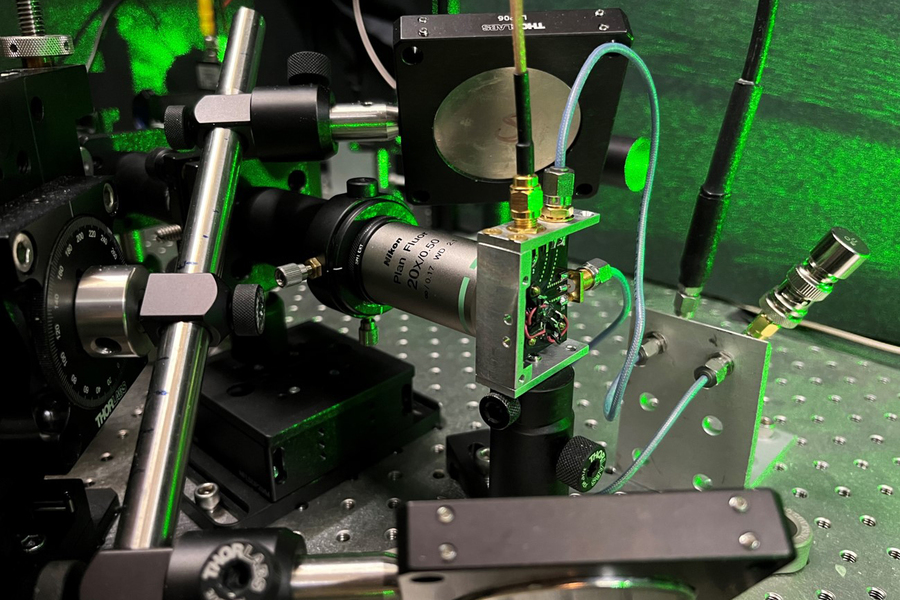
Caption:MIT researchers have developed a method to enable quantum sensors to detect any arbitrary frequency, with no loss of their ability to measure nanometer-scale features. Quantum sensors detect the most minute variations in magnetic or electrical fields, but until now they have only been capable of detecting a few specific frequencies, limiting their usefulness. Pci Credits:Credit: Guoqing Wang
Engineers expand the capabilities of these ultrasensitive nanoscale detectors, with potential uses for quantum computing and biological sensing. Quantum sensors, which detect the most minute variations in magnetic or electrical fields, have enabled precision measurements in materials science and fundamental physics...
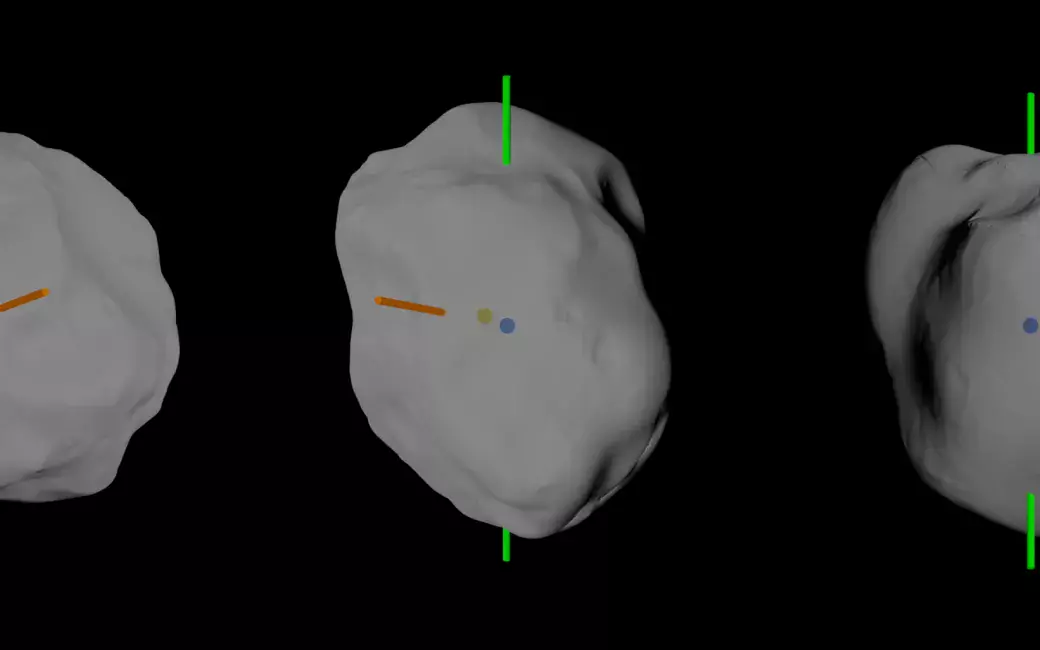
The Gaia DR3 astrometry is so accurate that the angular offset between the asteroid’s center of mass and the center of the area illuminated by the Sun and visible to Gaia must be accounted for. See for more details below. (Image: Reference and image credit: Tanga, P., Muinonen, K., Penttilä, A., et al., 2022, Astronomy & Astrophysics, in press.)
Southwest Research Institute scientists combined data from NASA’s New Horizons mission with novel laboratory experiments and exospheric modeling to reveal the likely composition of the red cap on Pluto’s moon Charon and how it may have formed. This first-ever description of Charon’s dynamic methane atmosphere using new experimental data provides a fascinating glimpse into the origins of this moon’s red spot as described in two recent papers.
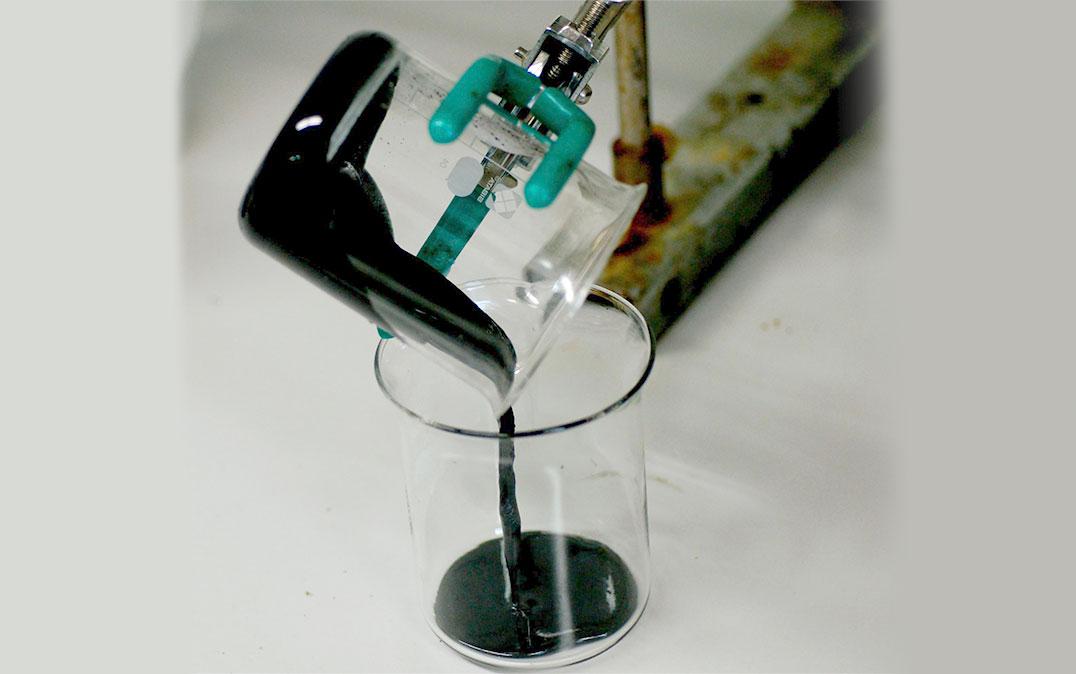
Researchers from the University of Tsukuba and collaborating partners prepared polyaniline in a wide range of cheap solvents. This development will facilitate advanced applications in printed circuit boards and other technologies
Researchers have synthesized electrically conductive polyaniline polymer in common organic solvents. A small quantity of added iodine facilitates the radical chain reaction that is critical to polymer synthesis. This protocol will facilitate processing of polyaniline in printed circuit boards, electrically conductive paints, and other advanced technologies, in a cheap and versatile manner.
Medical devices, cars, and many advanced technologies contain innumerable delicate components that are held together by electrically conductive polymers, such as polyanil...
UArizona astronomers have identified a new class of star system. The collection of mostly young blue stars are seen here using the Hubble Space Telescope Advanced Camera for Surveys.Michael Jones
University of Arizona astronomers have identified five examples of a new class of stellar system. They’re not quite galaxies and only exist in isolation.
The new stellar systems contain only young, blue stars, which are distributed in an irregular pattern and seem to exist in surprising isolation from any potential parent galaxy.
The stellar systems – which astronomers say appear through a telescope as “blue blobs” and are about the size of tiny dwarf galaxies – are located within the relatively nearby Virgo galaxy cluster...












Recent Comments