To raise new questions, new possibilities, to regard old problems from a new angle, requires creative imagination and marks real advance in science.
~Albert Einstein
Read More
Old Newtonian physics claimed that things have an objective reality separate from our perception of them. Quantum physics, and particularly Heisenberg's Uncertainty Principle, reveal that, as our perception of an object changes, the object itself literally changes.
~Marianne Williamson
Read More
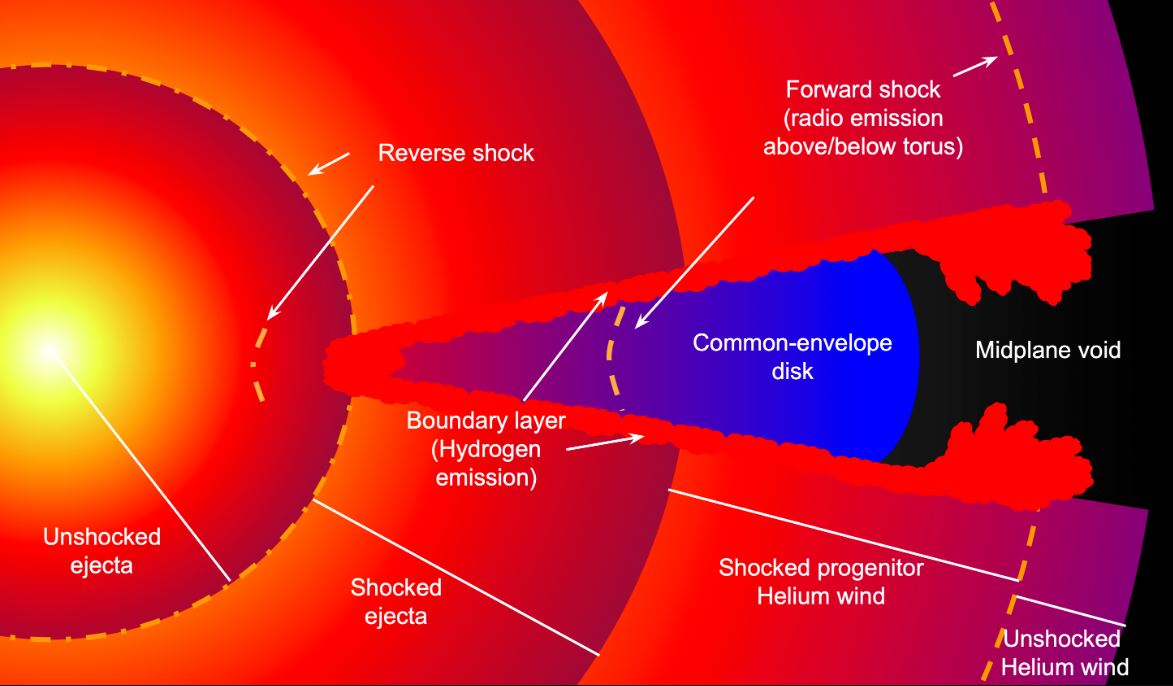
This schematic of Supernova 2014C shows the various ejecta and winds (red and purple) given off by the exploding star (left, yellow). The common-envelope disk (blue) surrounds both stars, the one exploding as a supernova and its binary partner (not shown). The boundary layer around the common-envelope disk is the source of the hydrogen the team detected. (credit: B. Thomas et al./UT Austin)
An international group of astronomers led by Benjamin Thomas of The University of Texas at Austin has used observations from the Hobby-Eberly Telescope (HET) at the university’s McDonald Observatory to unlock a puzzling mystery about a stellar explosion discovered several years ago and evolving even now...
In the gym, you are not just pumping iron, you are oxygenating muscle cells which keeps those muscles healthy, strong and growing in a process called hypertrophy.
Research findings may help identify drug targets for neuromuscular disorders. Using genetic approaches, researchers have demonstrated how a certain protein is involved in skeletal muscle growth. The findings open new avenues to develop drug targets for neuromuscular diseases and other pathological conditions.
In the gym, you are not just pumping iron, you are oxygenating muscle cells which keeps those muscles healthy, strong and growing — a process called hypertrophy, or an increase in muscle mass due to an increase in muscle cell size. Conversely, under the covers, lounging, your muscles may begin to atrophy, or shrink.
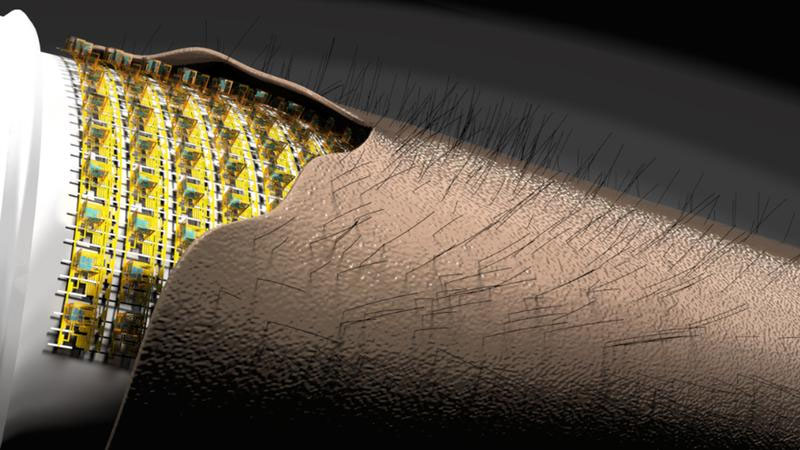
Artificial electronic skin (e-skin): Highly integrated flexible microelectronic 3D sensorics perceive movement of fine hairs on artificial skin. (Image: AG Prof. Dr. Oliver G. Schmidt)
A research team from Chemnitz and Dresden has taken a major step forward in the development of sensitive electronic skin (e-skin) with integrated artificial hairs. E-skins are flexible electronic systems that try to mimic the sensitivity of their natural human skin counterparts. Applications range from skin replacement and medical sensors on the body to artificial skin for humanoid robots and androids. Tiny surface hairs can perceive and anticipate the slightest tactile sensation on human skin and even recognize the direction of touch...
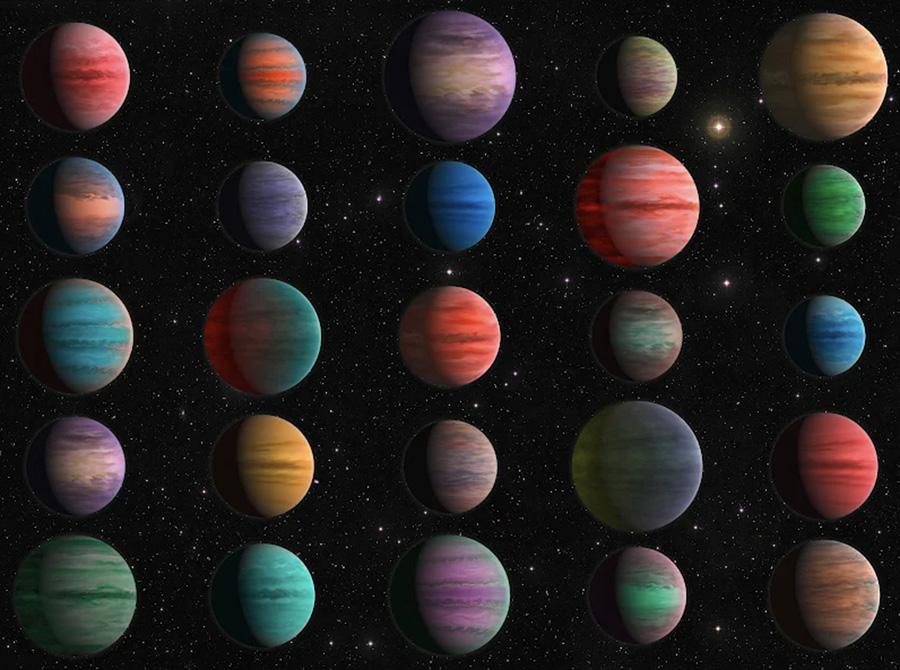
Artist’s conceptual image of the 25 exoplanets examined in this study. (Credit: ESA/Hubble, N. Bartmann)
An international team of researchers examined data for 25 exoplanets and found some links among the properties of the atmospheres, including the thermal profiles and chemical abundances in them. This marks the first time exoplanet atmospheres have been studied as populations, rather than individually. These findings will help establish a generalized theory of planet formation which will improve our understanding of all planets, including the Earth.
Today there are more than 3000 confirmed exoplanets, planets orbiting stars other than the Sun. Because they are far away from Earth, it is difficult to study them in detail...












Recent Comments