Physicists set record with 6,100-qubit array

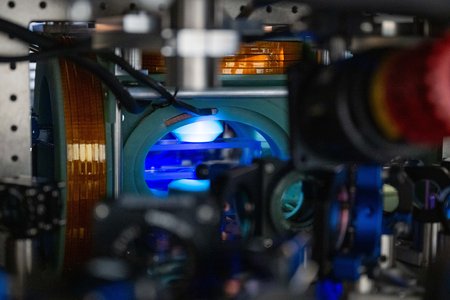
A chamber holding the 6,100 laser-trapped atoms in an ultra-high vacuum.Credit: Caltech/Lance Hayashida

Quantum computers will need large numbers of qubits to tackle challenging problems in physics, chemistry, and beyond. Unlike classical bits, qubits can exist in two states at once—a phenomenon called superposition. This quirk of quantum physics gives quantum computers the potential to perform certain complex calculations better than their classical counterparts, but it also means the qubits are fragile. To compensate, researchers are building quantum computers with extra, redundant qubits to correct any errors. That is why robust quantum computers will require hundreds of thousands of qubits.

Now, in a step toward this vision, Caltech physicists have created the largest qubit ar...

Read More

Mysterious moon rust explained by oxygen coming from Earth’s ‘wind’

Mysterious moon rust explained by oxygen coming from Earth's
The chemical and microstructure characteristics of O-irradiated magnetite (Mag) after H-implantation. Credit: Geophysical Research Letters (2025). DOI: 10.1029/2025gl116170

In 2020, scientists reported the detection of hematite, an iron oxide mineral otherwise known as rust, distributed through the higher latitudes of the moon, particularly on the nearside. This came as a surprise, considering the low concentrations of oxygen—which is required for the formation of rust—on the moon. Researchers proposed several theories to account for the origins of the oxygen in moon rust, including the degassing of volatiles from lunar magma, asteroids, comets, or large impact events.

However, the only explanation that could account for the distribution patterns of the hematite was that oxyge...

Read More

UK study finds microplastics in all beverages tested, raising exposure estimates

UK study finds microplastics in all beverages tested, raising exposure estimates
Microplastics were found in all 155 beverage samples tested from the UK market. Credit: Pxhere

Microplastics have found their way deep inside our bones, brains, and even babies. A UK study found that 100% of all 155 hot and cold beverage samples tested contained synthetic plastic particles.

The researchers tested different products from popular UK brands, including coffee, tea, juices, energy drinks, soft drinks, and even tap and bottled water, and not a single beverage was free of microplastics (MPs). Surprisingly, the more expensive tea bag brand showed a higher concentration of MPs, compared to the cheaper ones.

Traces of plastics, including polypropylene, polystyrene, polyethylene terephthalate, and polyethylene—commonly used for food packaging and disposable containers—were ...

Read More

Battery made from natural materials could replace conventional lithium-ion batteries

Battery made from natural materials could replace conventional lithium-ion batteries
(A) Structural design of polypeptides carrying redox-active pendant groups. (B) Riboflavin was selected as a potential electroactive alternative to viologen to enhance the sustainability and biocompatibility of the resulting redox-active polypeptide. Credit: Proceedings of the National Academy of Sciences (2025). DOI: 10.1073/pnas.2509325122

What if the next battery you buy was made from the same kinds of ingredients found in your body? That’s the idea behind a breakthrough battery material made from natural, biodegradable components. It’s so natural, it could even be consumed as food.

A team of researchers at Texas A&M University, including Distinguished Professor of Chemistry Dr. Karen Wooley and Professor of Chemical Engineering Dr...

Read More