Smart Sutures to Monitor Deep Surgical Wounds


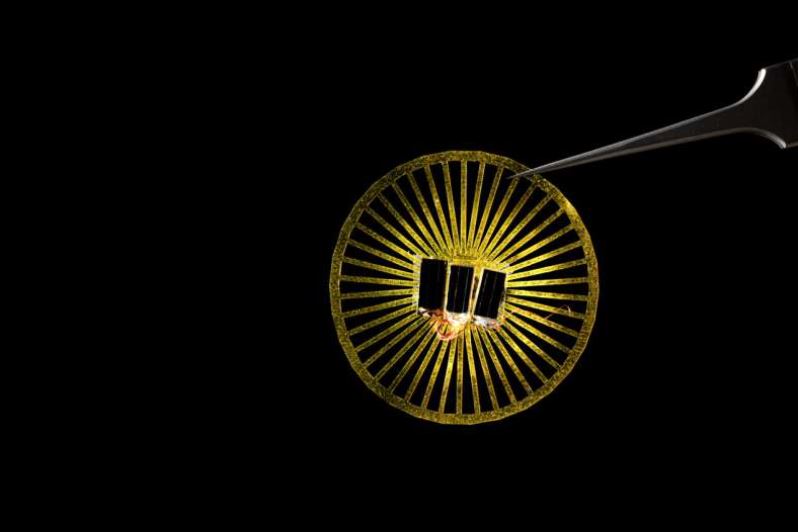
Surgical sutures with an attached electronic module for wireless and battery-free monitoring of deep surgical sites

Monitoring surgical wounds after an operation is an important step to prevent infection, wound separation and other complications. However, when the surgical site is deep in the body, monitoring is normally limited to clinical observations or costly radiological investigations that often fail to detect complications before they become life-threatening.

Hard bioelectronic sensors can be implanted in the body for continuous monitoring, but may not integrate well with sensitive wound tissue...

Read More

Plasma Lensing discovered in Black Widow Pulsar

The upper panel shows the total intensity of pulse emission vs. pulsar spin and orbital phase
s with the sub-integration of 1 s of PSR J1720-0533. Enlargements of the ingress and egress of the pulsar are shown in the middle left and middle right panels, respectively. The bottom panels show the pulse flux density variations near the eclipse. (Image by XAO)

Using the Five-hundred-meter Aperture Spherical radio Telescope (FAST), a research team led by Dr. Wang Shuangqiang from the Xinjiang Astronomical Observatory (XAO) of the Chinese Academy of Sciences discovered plasma lensing phenomenon in a black widow pulsar PSR J1720-0533.

Black widow pulsar systems have a low-mass companion star in a compact orbit with a millisecond pulsar...

Read More

COVID-19 Can Trigger Self-Attacking Antibodies

Photo by Getty Images.
An illustration of antibodies (Y-shaped) responding to SARS-CoV-2 (orange), the novel coronavirus that causes COVID-19.

Infection with the virus that causes COVID-19 can trigger an immune response that lasts well beyond the initial infection and recovery—even among people who had mild symptoms or no symptoms at all, according to Cedars-Sinai investigators. The findings are published in the Journal of Translational Medicine.

When people are infected with a virus or other pathogen, their bodies unleash proteins called antibodies that detect foreign substances and keep them from invading cells. In some cases, however, people produce autoantibodies that can attack the body’s own organs and tissues over time.

The Cedars-Sinai investigators found that people w...

Read More

Researchers offer Future 6G Network Concept

Credit: CC0 Public Domain

NIST and international researchers propose a “cognitive” 6G network—significantly enhancing the 5G network that encodes and transmits data with their meaning or semantics.

With commercial 5G rapidly deploying, researchers have begun to look at 6G. Its key technologies for mobile communication networks are expected to become available as early as 2023, with 6G networks emerging in 2030, according to Saad et al. Compared to 5G, the 6G network will increase data rates by over 100 times, to one terabyte per second or more, enabling the inclusion of edge intelligent devices and computing. To move large amounts of data to where and when it is needed, 6G networks will need to customize services to meet demands, transmit valued data, and interact with users.

T...

Read More