Templating Approach Stabilizes ‘Ideal’ Material for Alternative Solar Cells

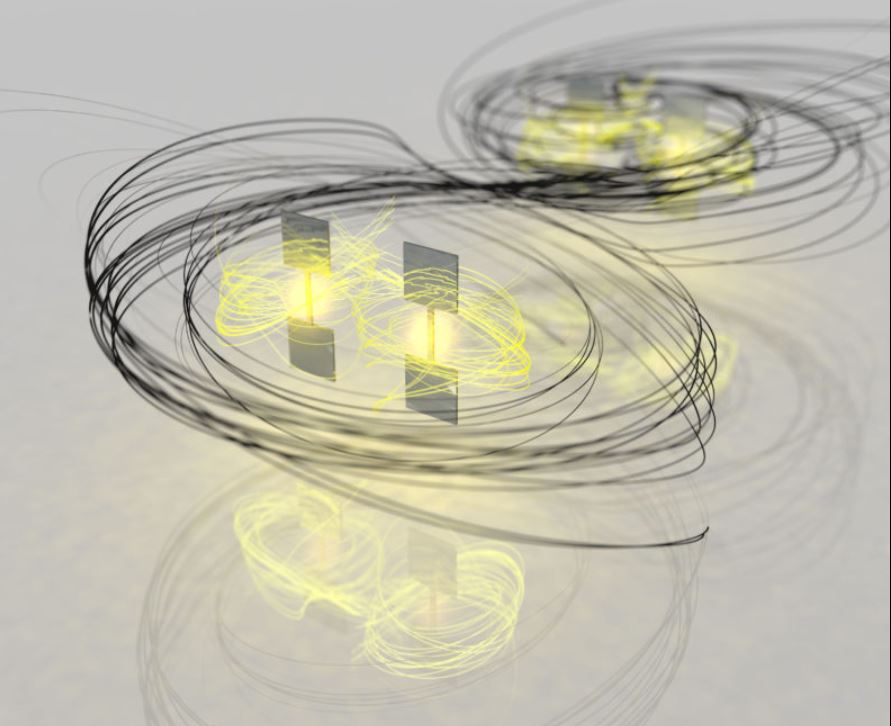
Artist’s impression of formamidinium (FA)-based crystal
Credit: Tiarnan Doherty

Researchers have developed a method to stabilise a promising material, perovskite for cheap solar cells, without compromising its near-perfect performance.

The researchers, from the University of Cambridge, used an organic molecule as a ‘template’ to guide perovskite films into the desired phase as they form. Their results are reported in the journal Science.

Perovskite materials offer a cheaper alternative to silicon for producing optoelectronic devices such as solar cells and LEDs.

There are many different perovskites, resulting from different combinations of elements, but one of the most promising to emerge in recent years is the formamidinium (FA)-based FAPbI3 crystal.

The compound is thermal...

Read More

Computer Simulation Models Potential Asteroid Collisions

Results to provide data for NASA’s upcoming Psyche mission. An asteroid impact can be enough to ruin anyone’s day, but several small factors can make the difference between an out-of-this-world story and total annihilation. In)l AIP Advances, by AIP Publishing, a researcher from the National Institute of Natural Hazards in China developed a computer simulation of asteroid collisions to better understand these factors.NASA’s Psyche mission aims to be the first spacecraft to explore an asteroid made entirely of metal. CREDIT: NASA/JPL-Caltech/ASU

The computer simulation initially sought to replicate model asteroid strikes performed in a laboratory...

Read More

Mapping the Musical Mind

Flat mind vision with music instrument and modern device. Concept woman person character with headphones, music plate and double bass. Vector illustration.

Interesting patterns of brain activity emerge during musical analysis exercises. Researchers in Japan used magnetic resonance imaging to study the brains of secondary school students during a task focused on musical observation. They found that students trained to play music from a young age exhibited certain kinds of brain activity more strongly than other students. The researchers also observed a specific link between musical processing and areas of the brain associated with language processing for the first time.

Professor Kuniyoshi L...

Read More

Researchers use Electron Microscope to turn Nanotube into Tiny Transistor

A designer view of a single-wall carbon nanotube intramolecular junction with metallic portions on left and right ends and a semiconductor ultrashort ~3,0nm channel in between. Credit: National University of Science and Technology, Moscow

An international team of researchers have used a unique tool inserted into an electron microscope to create a transistor that’s 25,000 times smaller than the width of a human hair.

The research, published in the journal Science, involves researchers from Japan, China, Russia and Australia who have worked on the project that began five years ago.

QUT Center for Materials Science co-director Professor Dmitri Golberg, who led the research project, said the result was a “very interesting fundamental discovery” which could lead a way for the future d...

Read More