Mars Habitability Limited by its Small Size, Isotope study suggests

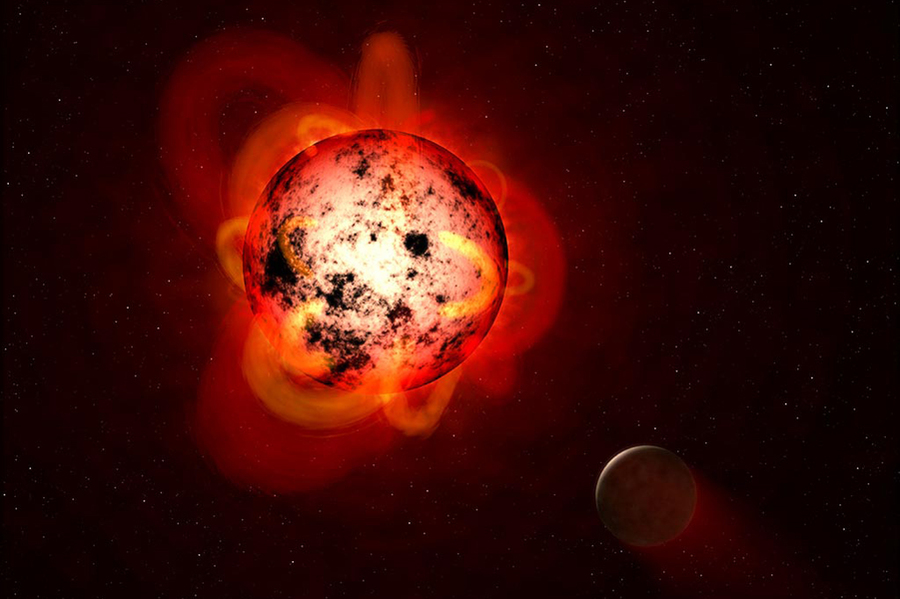
Water is essential for life on Earth and other planets, and scientists have found ample evidence of water in Mars’ early history. But Mars has no liquid water on its surface today. New research from Washington University in St. Louis suggests a fundamental reason: Mars may be just too small to hold onto large amounts of water.

Remote sensing studies and analyses of Martian meteorites dating back to the 1980s posit that Mars was once water-rich, compared with Earth. NASA’s Viking orbiter s1pacecraft—and, more recently, the Curiosity and Perseverance rovers on the ground—returned dramatic images of Martian landscapes marked by river valleys and flood channels.

Despite this evidence, no liquid water remains on the surface...

Read More

Staying Young, from the Cells On Up

A rendering of the enzyme complex named HTC
CREDIT: CHUM

Scientists discover a new enzymatic complex that can stop cells from aging, opening the way to possible new cancer therapies. Researchers at Université de Montréal and McGill University have discovered a new multi-enzyme complex that reprograms metabolism and overcomes “cellular senescence,” when aging cells stop dividing.

In their study published today in Molecular Cell, the researchers show that an enzyme complex named HTC (hydride transfer complex) can inhibit cells from aging.

“HTC protects cells from hypoxia, a lack of oxygen that normally leads to their death,” said senior author Gerardo Ferbeyre, an UdeM biochemistry professor and principal scientist at the CRCHUM, the university’s affiliated teaching hospital resea...

Read More

Now we’re Cooking with Lasers

Chicken being cooked by a blue laser. Light is being directed by two software-controlled mirror galvanometers.

Imagine having your own digital personal chef; ready to cook up whatever you want; able to tailor the shape, texture, and flavor just for you; and it’s all at the push of a button. Columbia engineers have been working on doing just that, using lasers for cooking and 3D printing technology for assembling foods.

Under the guidance of Mechanical Engineering Professor Hod Lipson, the “Digital Food” team of his Creative Machines Lab has been building a fully autonomous digital personal chef. Lipson’s group has been developing 3D-printed foods since 2007...

Read More

New discovery about Meteorites informs Atmospheric Entry Threat Assessment

Researchers at the University of Illinois Urbana-Champaign watched fragments of two meteors as they ramped up the heat from room temperature to the temperature it reaches as it enters Earth’s atmosphere and made a significant discovery. The vaporized iron sulfide leaves behind voids, making the material more porous. This information will help when predicting the weight of a meteor, its likelihood to break apart, and the subsequent damage assessment if it should land.

“We extracted samples from the interiors that had not already been exposed to the high heat of the entry environment,” said Francesco Panerai, professor in the Department of Aerospace Engineering at UIUC. “We wanted to understand how the microstructure of a meteorite changes as it travels through the atmosphere.”

Pa...

Read More