To raise new questions, new possibilities, to regard old problems from a new angle, requires creative imagination and marks real advance in science.
~Albert Einstein
Read More
Old Newtonian physics claimed that things have an objective reality separate from our perception of them. Quantum physics, and particularly Heisenberg's Uncertainty Principle, reveal that, as our perception of an object changes, the object itself literally changes.
~Marianne Williamson
Read More
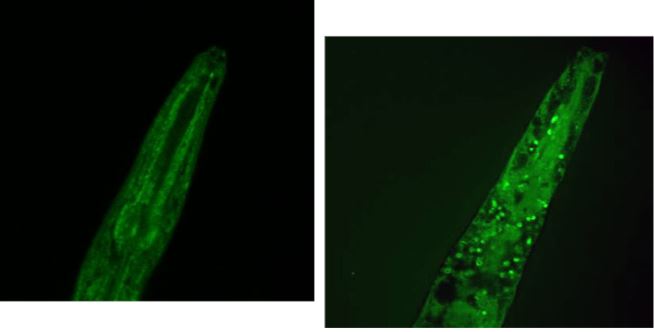
Alzheimer’s disease model of the worm C. elegans treated with the plant-derived compound fenchol (Left) and with a DMSO placebo (Right). Fenchol reduced accumulation of amyloid-β (green dots) in the organism’s head, compared to the placebo. | Images courtesy of Hariom Yadav, PhD, of the University of South Florida, first appeared as Fig. 4d in Frontiers in Aging Neuroscience, DIO: 10.3389/fnagi.2021.735933
Fenchol, a natural compound abundant in some plants including basil, can help protect the brain against Alzheimer’s disease pathology, a preclinical study led by University of South Florida Health (USF Health) researchers suggests.
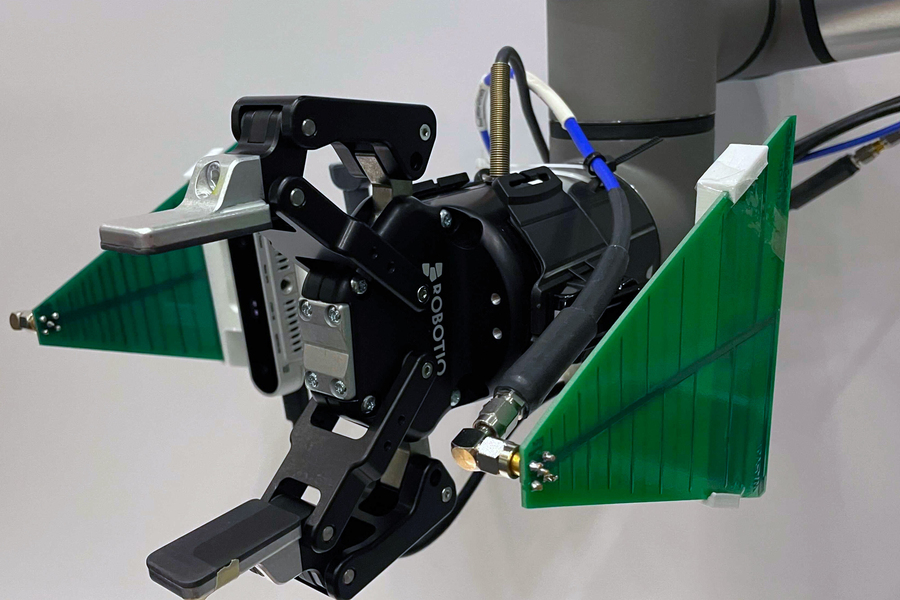
Researchers at MIT have developed a fully-integrated robotic arm that fuses visual data from a camera and radio frequency (RF) information from an antenna to find and retrieve objects, even when they are buried under a pile and fully out of view. Credits:Courtesy of the researchers
This robotic arm fuses data from a camera and antenna to locate and retrieve items, even if they are buried under a pile. A busy commuter is ready to walk out the door, only to realize they’ve misplaced their keys and must search through piles of stuff to find them. Rapidly sifting through clutter, they wish they could figure out which pile was hiding the keys.
Researchers at MIT have created a robotic system that can do just that...
The fiery exoplanet WASP-76b – a so-called hot Jupiter, where it rains iron – may be hotter than previously thought.
Considered an ultra-hot Jupiter – a place where iron gets vaporized, condenses on the night side and then falls from the sky like rain — the fiery, inferno-like WASP-76b exoplanet may be even more sizzling than scientists had realized.
An international team, led by scientists at Cornell University, University of Toronto and Queen’s University Belfast, reports the discovery of ionized calcium on the planet – suggesting an atmospheric temperature higher than previously thought, or strong upper atmosphere winds.
The discovery was made in high-resolution spectra obtained with Gemini North near the summit of Mauna Kea in Hawaii.
New research led by University of Limerick in Ireland has revealed a direct link between fatty tissue and Crohn’s disease. The study, carried out by researchers at UL along with a team from University Hospital Limerick, is suggesting for the first time that Crohn’s disease, which is an inflammatory bowel condition, may in fact be a fatty intestine condition.
The research, published in leading journal Scientific Reports, has been described as “an exciting starting point” for the further exploration of Crohn’s disease, which affects thousands of people every year in Ireland and internationally.
The study involved body composition analysis of patients with Crohn’s disease using equipment hosted on the UL campus, with the UL team collaborating with gastroenterology and surgical spec...













Recent Comments