Earthly Rocks point way to Water hidden on Mars

file of slightly red but mostly black hematite on left with pile of much redder hydrohematite on right
Hydrohematite (right) is a brighter red than anhydrous hematite (left).
IMAGE: Si Athena Chen, Penn State

A combination of a once-debunked 19th-century identification of a water-carrying iron mineral and the fact that these rocks are extremely common on Earth, suggests the existence of a substantial water reservoir on Mars, according to a team of geoscientists.

“One of my student’s experiments was to crystalize hematite,” said Peter J. Heaney, professor of geosciences, Penn State. “She came up with an iron-poor compound, so I went to Google Scholar and found two papers from the 1840s where German mineralogists, using wet chemistry, proposed iron-poor versions of hematite that contained water.”

In 1844, Rudolf Hermann named his mineral turgite and in 1847 August Breithaupt named hi...

Read More

Fighting of Food Poisoning depends on the Time of Day

The body’s ability to prevent food poisoning by producing a natural antimicrobial compound increases during the day, when exposure to noxious bacteria is most likely, a new study by UT Southwestern scientists suggests. The findings, published online in Cell, could eventually lead to timed therapies and vaccination regimens designed to maximize this immune response.

“This study shows that our immune systems are not turned on all the time, which is an unexpected result,” says study leader John F. Brooks II, Ph.D., a postdoctoral fellow in the laboratory of Lora Hooper, Ph.D., study co-leader and professor of immunology and microbiology at UTSW. “Our findings suggest that there are peak times in which the body is more primed to fight infections.”

Researchers have long known that vi...

Read More

Wirelessly Charging Multiple Devices Simultaneously

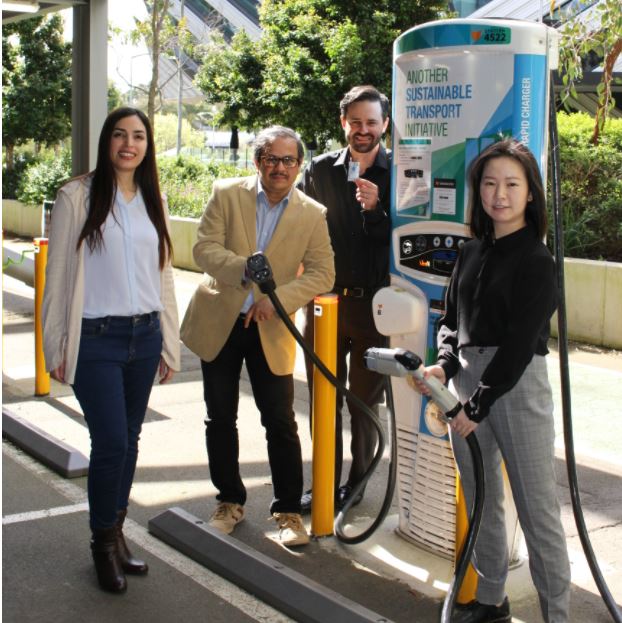
Omnidirectional Transmitter, image: Prasad Jayathurathnage/Aalto University
True wireless charging would mean a little less hassle in a world increasingly dependent on smart devices. Image: Prasad Jayathurathnage/Aalto University

A new type of wireless charger can charge multiple devices simultaneously, researchers report. The device transfers energy with 90% efficiency within 20cm charging range. Mobile phones and tablets have allowed us to stay in touch regardless of our location, yet they still rely on plugs, sockets, and charging pads to power up. New technology developed at Aalto University may be the key to true wireless charging for these and other electronics in years to come. The research team includes researches Dr. Prasad Jayathurathnage and Dr. Xiaojie Dang, and professors Sergei Tretyakov and Constantin Simovski...

Read More

First Detection of Light from behind a Black Hole

black hole
Credit: CC0 Public Domain

Watching X-rays flung out into the universe by the supermassive black hole at the center of a galaxy 800 million light-years away, Stanford University astrophysicist Dan Wilkins noticed an intriguing pattern. He observed a series of bright flares of X-rays—exciting, but not unprecedented—and then, the telescopes recorded something unexpected: additional flashes of X-rays that were smaller, later and of different “colors” than the bright flares.

According to theory, these luminous echoes were consistent with X-rays reflected from behind the black hole—but even a basic understanding of black holes tells us that is a strange place for light to come from.

“Any light that goes into that black hole doesn’t come out, so we shouldn’t be able to see anythin...

Read More