Throwing an ‘Axion Bomb’ into a Black Hole challenges fundamental Law of Physics

New research shows how the fundamental law of conservation of charge could break down near a black hole. Singularities such as those at the centre of black holes, where density becomes infinite, are often said to be places where physics ‘breaks down’. However, this doesn’t mean that ‘anything’ could happen, and physicists are interested in which laws could break down, and how.

Now, a research team from Imperial College London and the Cockcroft Institute and Lancaster University have proposed a way that singularities could violate the law of conservation of charge. Their theory is published in Annalen der Physik.

Co-author Professor Martin McCall, from the Department of Physics at Imperial, said: “‘Physics breaks down at a singularity’ is one of the most famous statements in pop-...

Read More

Common Plant Fiber Gel Doubled Rate of Tumor Eradication

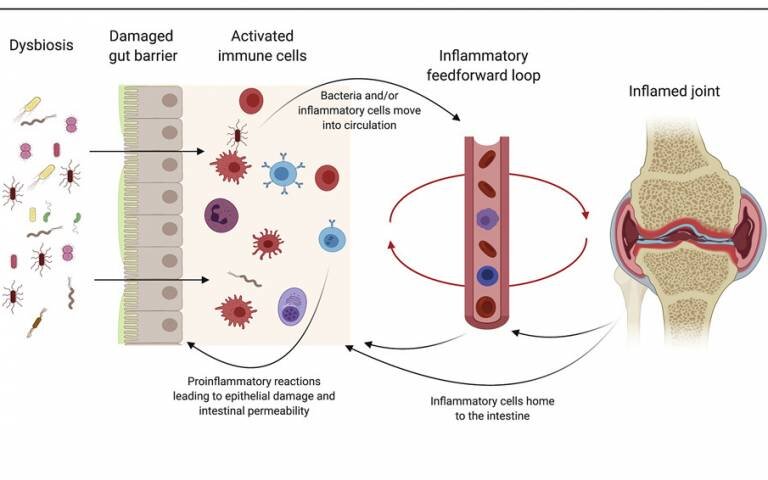
Many people don’t realize that the trillions of bacteria, viruses, and fungi residing within the gastrointestinal tract — collectively called the gut microbiome — are connected to overall health, and specifically to cancer.

Manipulating the gut microbiome to produce “beneficial” commensal microbes, which protect the host from pathogens and can boost immune responses, among other things, could potentially help patients respond better to cancer drugs called immune checkpoint inhibitors, a type of immunotherapy.

To that end, researchers at the University of Michigan have developed a new dietary fiber formulation that improves the potency of immunotherapies against cancer by modulating the gut microbiome...

Read More

First Clear View of a Boiling Cauldron Where Stars are Born

First clear view of a boiling cauldron where stars are born
The RCW 49 galactic nebula pictured above is one of the brightest star-forming regions in the Milky Way. By analyzing the movement of carbon atoms in an expanding bubble of gas surrounding the Westerlund 2 star cluster within RCW 49, a UMD-led team of researchers have created the clearest image to date of a stellar-wind driven bubble where stars are born. Credit: NASA/JPL-Caltec/E.Churchwell (University of Wisconsin).

UMD-led team used NASA’s SOFIA telescope to capture high-resolution details of a star nursery in the Milky Way. University of Maryland researchers created the first high-resolution image of an expanding bubble of hot plasma and ionized gas where stars are born...

Read More

No Lab Required: New technology can Diagnose Infections in Minutes

Patients will be able to receive confirmed diagnosis at the doctor’s office. The idea of visiting the doctor’s office with symptoms of an illness and leaving with a scientifically confirmed diagnosis is much closer to reality because of new technology developed by researchers at McMaster University.

Engineering, biochemistry and medical researchers from across campus have combined their skills to create a handheld rapid test for bacterial infections that can produce accurate, reliable results in less than an hour, eliminating the need to send samples to a lab.

Their proof-of-concept research, published today in the journal Nature Chemistry, specifically describes the test’s effectiveness in diagnosing urinary tract infections from real clinical samples...

Read More