Studies reveal Skull as unexpected source of Flexoelectric Brain Immunity

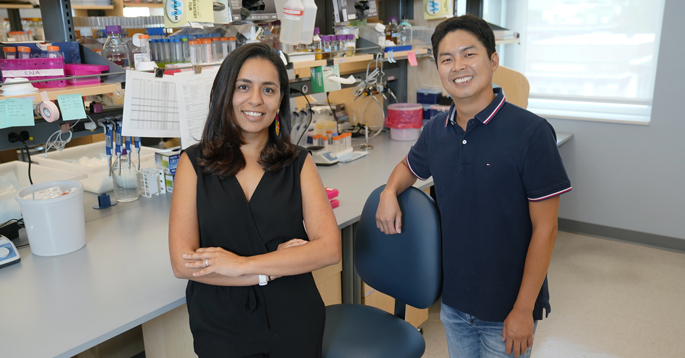
A newly developed B cell (green in middle of image) migrates from the bone marrow of the skull, where a cluster of other new B cells remain, then through the skull bone, to the protective tissue that covers the brain, which is populated mainly by other cells (blue). Researchers at Washington University School of Medicine in St. Louis have discovered that the immune cells stationed in the protective tissue known as the meninges come primarily from the skull. The finding opens up the possibility of developing therapies to target such cells as a way to prevent or treat brain conditions.

Immune cells from skull bone marrow guard the brain, spinal cord. Researchers have discovered that the immune cells that protect the brain and spinal cord come primarily from the skull...

Read More

Jets from Massive Protostars might be very different from Lower-Mass Systems

Artist’s conception of the young star Cep A HW2, showing a wide-angle wind originating close to the star and a disk of material orbiting the star (called an accretion disk), with a much narrower jet farther away.
Credit: Bill Saxton, NRAO/AUI/NSF

VLA reveals new details of protostellar jet. Astronomers studying the fast-moving jet of material ejected by a still-forming, massive young star found a major difference between that jet and those ejected by less-massive young stars. The scientists made the discovery by using the U.S. National Science Foundation’s Karl G. Jansky Very Large Array (VLA) to make the most detailed image yet of the inner region of such a jet coming from a massive young star.

Both low- and high-mass young stars, or protostars, propel jets outward perpendicular to ...

Read More

People who eat a Healthy Diet including Whole Fruits may be Less likely to develop Diabetes

People who eat a healthy diet including whole fruits may be less likely to develop  diabetes

Research links fruit but not fruit juice to lower type 2 diabetes risk. A new study finds people who consume two servings of fruit per day have 36 percent lower odds of developing type 2 diabetes than those who consume less than half a serving. The research was published in the Endocrine Society’s Journal of Clinical Endocrinology & Metabolism.

Diabetes is a disease where people have too much sugar in their bloodstream, and it is a huge public health burden. Approximately 463 million adults worldwide were living with diabetes in 2019, and by 2045 this number is expected to rise to 700 million. An estimated 374 million people are at increased risk of developing type 2 diabetes, the most common form of the disease...

Read More

Changing the Shape of Soft Matter using Logic Circuits made from DNA

Changing the shape of soft matter using logic circuits made from DNA
Credit: Angewandte Chemie International Edition (2021). DOI: 10.1002/anie.202102169

The myriad processes occurring in biological cells may seem unbelievably complex at first glance. And yet, in principle, they are merely a logical succession of events, and could even be used to form digital circuits. Researchers have now developed a molecular switching circuit made of DNA, which can be used to mechanically alter gels, depending on the pH. DNA-based switching circuits could have applications in soft robotics, say the researchers in their article in Angewandte Chemie.

DNA is a long molecule that can be folded and twisted in various ways. It has a backbone and bases that stick out from the backbone and pair up with counterparts in other DNA strands...

Read More