To raise new questions, new possibilities, to regard old problems from a new angle, requires creative imagination and marks real advance in science.
~Albert Einstein
Read More
Old Newtonian physics claimed that things have an objective reality separate from our perception of them. Quantum physics, and particularly Heisenberg's Uncertainty Principle, reveal that, as our perception of an object changes, the object itself literally changes.
~Marianne Williamson
Read More
As a compound of manganese sulfide is compressed in a diamond anvil cell, it undergoes dramatic transitions. In this illustration, the interaction between the manganese (Mn) atomic ions (purple circles) and disulfur (S2) molecular ions (figure 8s) increases from left to right until the overlap is significant enough to make the system metallic. (Illustration courtesy of Dean Smith, Argonne National Lab)
Remarkable things happen when a “squishy” compound of manganese and sulfide (MnS2) is compressed in a diamond anvil, say researchers from the University of Rochester and the University of Nevada, Las Vegas (UNLV).
“This is a new type of charge transfer mechanism, and so from a science community point of view this is very, very exciting...
On Aug. 26, 2020, NASA’s Fermi Gamma-ray Space Telescope detected a pulse of high-energy radiation that had been racing toward Earth for nearly half the present age of the universe. Lasting only about a second, it turned out to be one for the record books — the shortest gamma-ray burst (GRB) caused by the death of a massive star ever seen.
GRBs are the most powerful events in the universe, detectable across billions of light-years. Astronomers classify them as long or short based on whether the event lasts for more or less than two seconds. They observe long bursts in association with the demise of massive stars, while short bursts have been linked to a different scenario.
“We already knew some GRBs from massive stars could register as short GRBs, but we thought this was due to ...
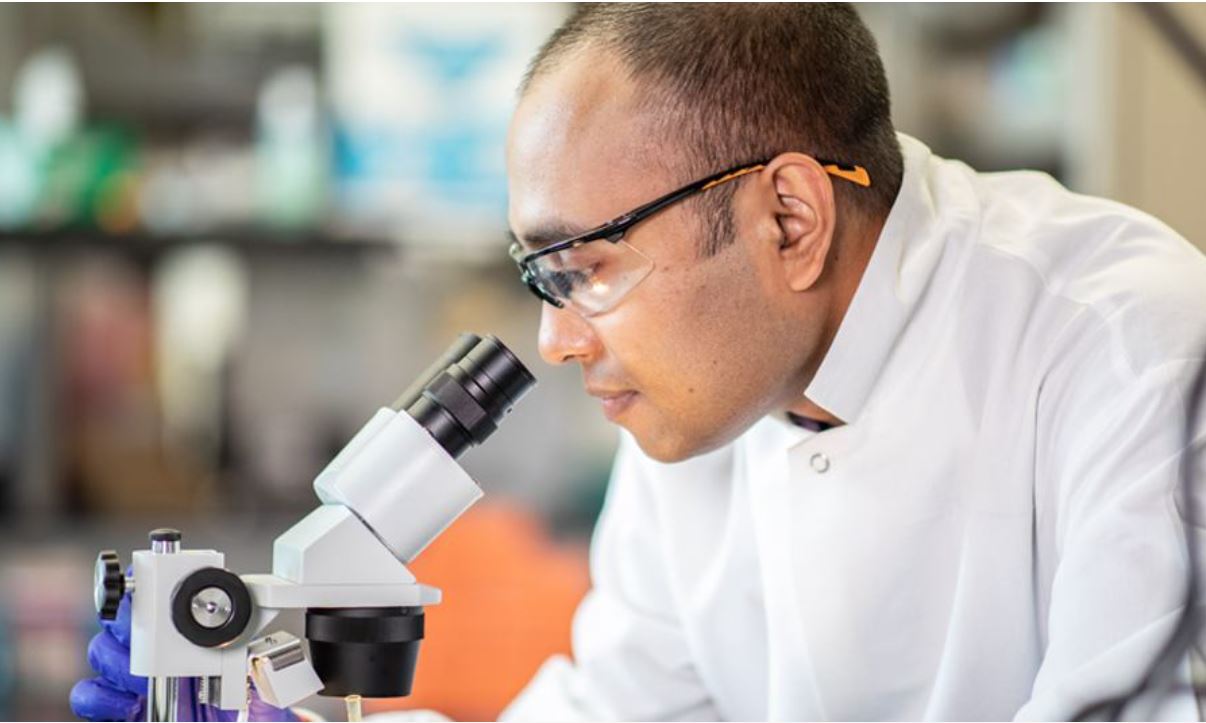
Abhishek Jain and his team at Texas A&M are collaborating with researchers at MD Anderson Cancer Center and Rice University to develop and test their new microdevice, the ovarian tumor microenvironment-chip. Texas A&M Engineering
In the evolving field of cancer biology and treatment, innovations in organ-on-a-chip microdevices allow researchers to discover more about the disease outside the human body. These organs-on-chips serve as a model of the state an actual cancer patient is in, thus allowing an opportunity to finding the correct treatment before administering it to the patient. At Texas A&M University, researchers are pushing these devices to new levels that could change the way clinicians approach cancer treatment, particularly ovarian cancer.
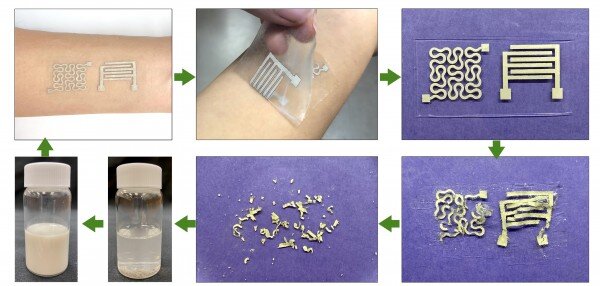
This image shows how the new recycling approach can take silver nanowires from a finished product (such as the flexible sensor patch in the top left) through the entire life cycle of the technology until it has been broken down for re-use (bottom left). Credit: Yong Zhu, North Carolina State University
Researchers at North Carolina State University have demonstrated a low-cost technique for retrieving nanowires from electronic devices that have reached the end of their utility, and then using those nanowires in new devices. The work is a step toward more sustainable electronics.
“There is a lot of interest in recycling electronic materials because we want to both reduce electronic waste and maximize the use we get out of rare or costly materials,” says Yuxuan Liu, first author of a ...












Recent Comments