



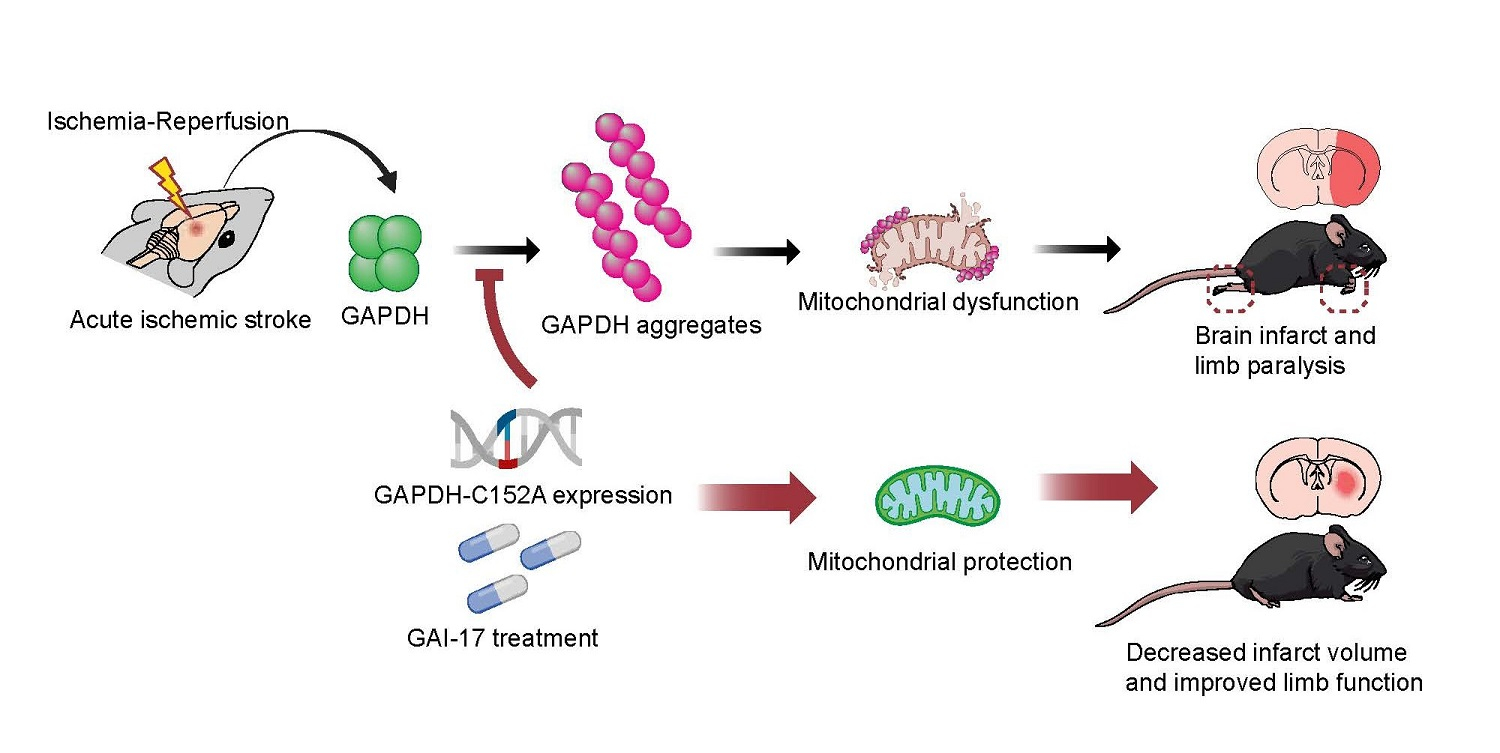
Ischemia-Reperfusion-induced GAPDH aggregates lead to cell death and paralysis, but both GAPDH-C152A expression and GAI-17 treatment can decrease the chances of post-stroke side effects.
Credit: Osaka Metropolitan University
Protein aggregation inhibitor shows lower levels of cell death and paralysis in mice with acute strokes.
Stroke kills millions, but Osaka researchers have unveiled GAI-17, a drug that halts toxic GAPDH clumping, slashes brain damage and paralysis in mice—even when given six hours post-stroke—and shows no major side effects, hinting at a single therapy that could also tackle Alzheimer’s and other tough neurological disorders.
Stroke is said to be the second leading cause of death worldwide after heart disease. To prevent the death of neurons in the brain, a research group led by Osaka Metropolitan University Associate Professor Hidemitsu Nakajima of the Graduate School of Veterinary Science has developed a drug that inhibits a protein involved in cell death.
The multifunctional protein GAPDH (glyceraldehyde-3-phosphate dehydrogenase) is linked to pathogenesis in many intractable brain and nervous system diseases. The team developed GAI-17, a GAPDH aggregation inhibitor. When this inhibitor was administered to model mice with acute strokes, there was a significantly lower level of brain cell death and paralysis compared to untreated mice.
GAI-17 also showed no side effects of concern, such as adverse effects on the heart or cerebrovascular system. Furthermore, experiments using GAI-17 showed improvement in the mice even when administered six hours after a stroke.
“The GAPDH aggregation inhibitor we have developed is expected to be a single drug that can treat many intractable neurological diseases, including Alzheimer’s disease,” stated Professor Nakajima. “Going forward, we will verify the effectiveness of this approach in disease models other than stroke and promote further practical research toward the realization of a healthy and long-lived society.” https://www.omu.ac.jp/en/info/research-news/entry-87378.html




Recent Comments