
3D printing tagged posts

Honey, I Shrunk Michelangelo’s David

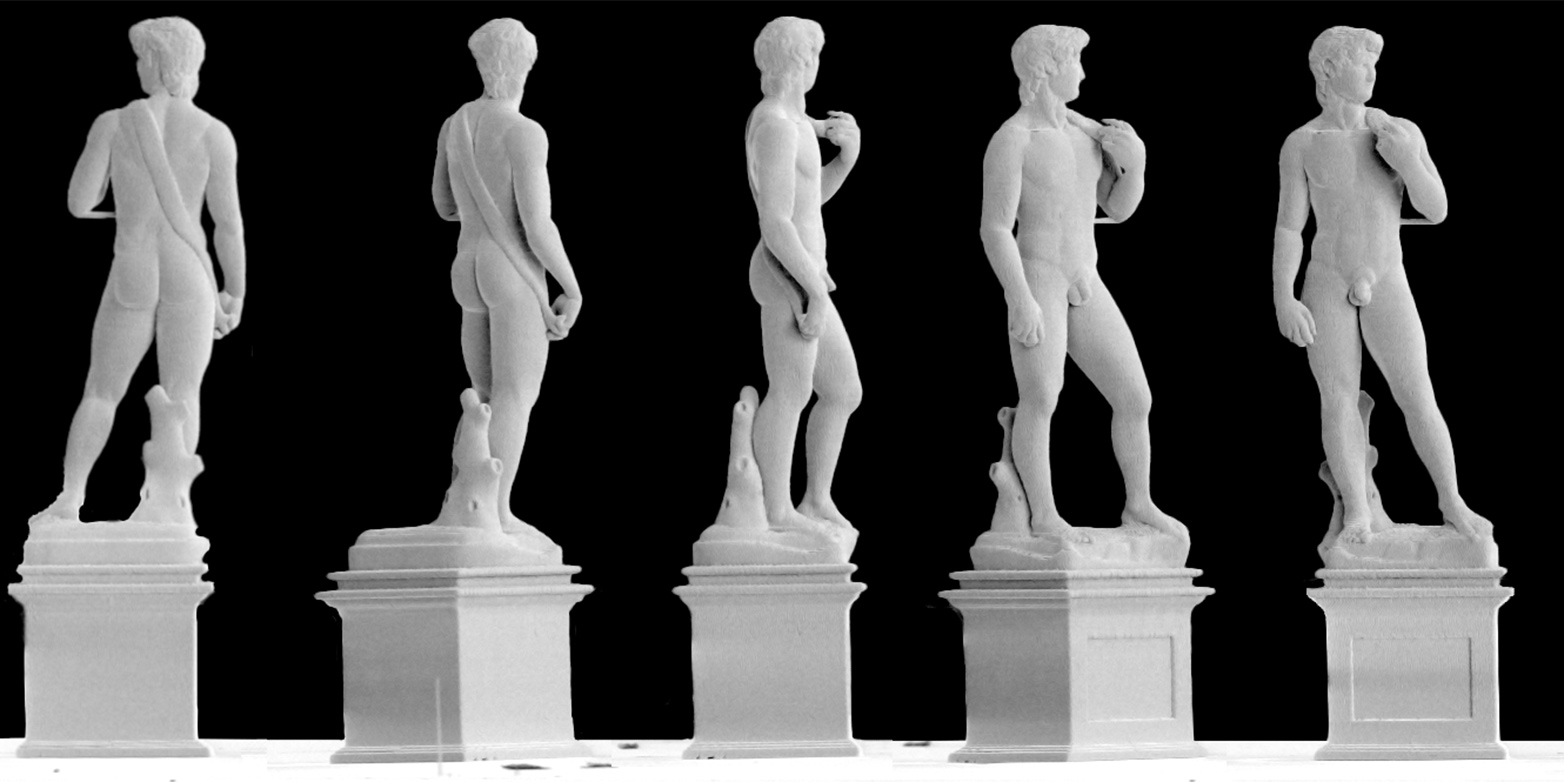
Different views of the 3D-​printed miniature David (1 mm high) made of pure copper. (Image: Giorgio Ercolano, Exaddon)

Researchers have reproduced Michelangelo’s David as a miniature in metal. Their achievement highlights the potential of a special 3D printing method. There he is, standing upon his pedestal: David by Michelangelo. A world-famous statue that nearly every child can recognise. But this David is just 1 millimeter tall, pedestal included, and is made not of marble like the 5.17-meter original, but of pure copper.

It was created using 3D printing by Giorgio Ercolano from Exaddon, an offshoot of ETH spin-off Cytosurge, together with the team led by ETH Professor Tomaso Zambelli from the Laboratory of Biosensors and Bioelectronics...

Read More

Improving 3D-printed Prosthetics and integrating Electronic Sensors

The mold of local teen Josie Fraticelli’s hand that was scanned during the development of a personalized prosthetic.
Credit: Photo by Logan Wallace. Virginia Tech

Scientists have made inroads in integrating electronic sensors with personalized 3D-printed prosthetics. With the growth of 3D printing, it’s entirely possible to 3D print your own prosthetic from models found in open-source databases. But those models lack personalized electronic user interfaces like those found in costly, state-of-the-art prosthetics.

Now, a Virginia Tech professor and his interdisciplinary team of undergraduate student researchers have made inroads in integrating electronic sensors with personalized 3D-printed prosthetics – a development that could one day lead to more affordable electric-powered prost...

Read More

New 3D Nanoprinting strategy opens door to revolution in Medicine, Robotics

Engineers at the University of Maryland (UMD) have created the first 3D-printed fluid circuit element so tiny that 10 could rest on the width of a human hair. The diode ensures fluids move in only a single direction — a critical feature for products like implantable devices that release therapies directly into the body.
Credit: DOI: 10.1038/s41598-018-36727-z

UMD engineers demonstrate their approach by printing the smallest-known 3D microfluidic circuit element. Engineers at the University of Maryland (UMD) have created the first 3D-printed fluid circuit element so tiny that 10 could rest on the width of a human hair. The diode ensures fluids move in only a single direction – a critical feature for products like implantable devices that release therapies directly into the body.

The...

Read More

3D Printing 100x Faster with Light


Concurrent, two-color photoinitiation and photoinhibition

Rather than building up plastic filaments layer by layer, a new approach to 3D printing lifts complex shapes from a vat of liquid at up to 100 times faster than conventional 3D printing processes, University of Michigan researchers have shown.

3D printing could change the game for relatively small manufacturing jobs, producing fewer than 10,000 identical items, because it would mean that the objects could be made without the need for a mold costing upwards of $10,000. But the most familiar form of 3D printing, which is sort of like building 3D objects with a series of 1D lines, hasn’t been able to fill that gap on typical production timescales of a week or two.

“Using conventional approaches, that’s not really attain...

Read More