6G tagged posts

Microcombs unlock 112Gbps wireless link at 560GHz for 6G

Photonic wireless transmission reaches 112 Gbps at 560 GHz using soliton microcombs
Conceptual illustration of microcomb-driven terahertz wireless communication. Optical frequency combs generated in a microresonator are used to produce low-noise terahertz signals via photomixing, enabling high-speed wireless transmission at 112 Gbps in the 560 GHz band for future 6G systems. Credit: Tokushima University

Researchers at Tokushima University have demonstrated single-channel wireless transmission at 112 Gbps in the 560 GHz band using soliton microcombs, marking a significant step toward next-generation 6G communications.

Conventional electronic technologies face fundamental limitations in generating stable high-frequency signals beyond 350 GHz, including reduced output power and increased phase noise...

Read More

Topological antenna could pave the way for 6G networks

Topological antenna could pave the way for 6G networks
On-chip THz topological LWA. Credit: Nature Photonics (2026). DOI: 10.1038/s41566-025-01825-8

Using ideas borrowed from topological photonics, researchers in Singapore, France and the US have designed a compact antenna capable of handling information-rich terahertz (THz) signals. Reporting their results in Nature Photonics, the team, led by Ranjan Singh at the University of Notre Dame, say that with further refinements, the design could help underpin future sixth-generation (6G) wireless networks, allowing data to be shared at unprecedented speeds.

Why 6G needs terahertz antennas
In the not-too-distant future, 6G networks are expected to enable data rates of around one terabit per second—the same as transferring roughly half the storage of a mid-range smartphone in a single second...

Read More

Telecommunications beyond 6G: the first standalone spinwave chip with a built-in magnetic field

Cross-section and top view of the magnonic device with integrated micromagnets

Credit
Politecnico di Milano

The Politecnico di Milano has created the first integrated and fully tunable device based on spin waves, opening up new possibilities for the telecommunications of the future, far beyond current 5G and 6G standards. The study, published in the journal Advanced Materials, was conducted by a research group led by Riccardo Bertacco of the Department of Physics of the Politecnico di Milano, in collaboration with Philipp Pirro of Rheinland-Pfälzische Technische Universität and Silvia Tacchi of Istituto Officina dei Materiali—CNR-IOM.

Magnonics is an emerging technology that uses spin waves—collective excitations of electronic spins in magnetic materials—as an alternative to elect...

Read More

Radiowaves enable energy-efficient AI on edge devices without heavy hardware

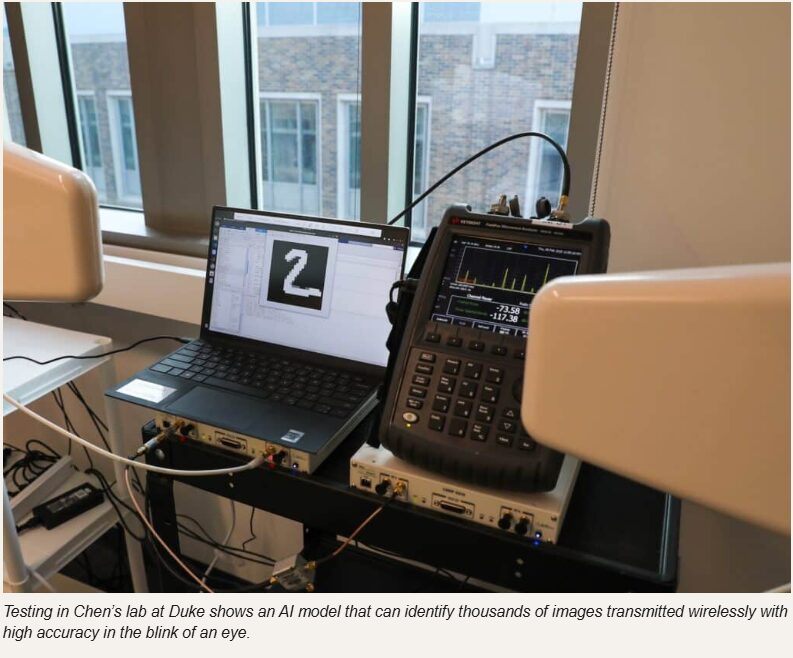
As drones survey forests, robots navigate warehouses and sensors monitor city streets, more of the world’s decision-making is occurring autonomously on the edge—on the small devices that gather information at the ends of much larger networks.

But making that shift to edge computing is harder than it seems. Although artificial intelligence (AI) models continue to grow larger and smarter, the hardware inside these devices remains tiny.

Engineers typically have two options, neither are ideal. Storing an entire AI model on the device requires significant memory, data movement and computing power that drains batteries. Offloading the model to the cloud avoids those hardware constraints, but the back-and-forth introduces lag, burns energy and presents security risks.

Researchers ...

Read More