accretion disk tagged posts

Scientists Map Gusty Winds in a far-off Neutron Star System

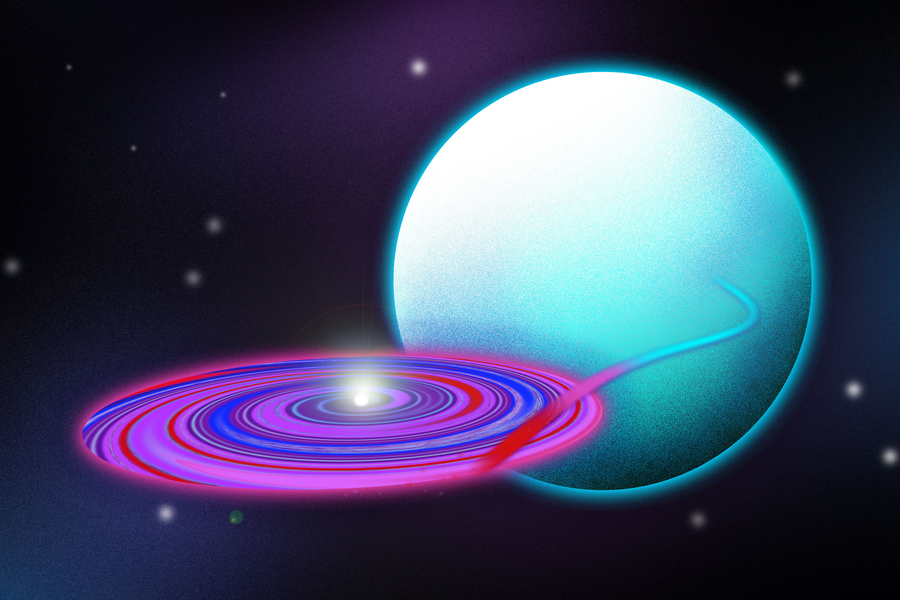
In black space, the accretion disk is represented as a flat swirling disk with blue, pink red colors, and in the middle of it is tiny, glowing white sphere, the neutron star. Behind the accretion disk is a large teal sphere, the sun-like star. A teal noodle flows from the star to the accretion disk, representing the material drawn away from the star.
Caption: MIT astronomers mapped the “disk winds” associated with the accretion disk around Hercules X-1, a system in which a neutron star is drawing material away from a sun-like star, represented as the teal sphere. The findings may offer clues to how supermassive black holes shape entire galaxies.
Credits:Credit: Jose-Luis Olivares, MIT. Based on an image of Hercules X-1 by D. Klochkov, European Space Agency

The 2D map of this ‘disk wind’ may reveal clues to galaxy formation.

Astronomers have mapped the ‘disk winds’ associated with the accretion disk around Hercules X-1, a system in which a neutron star is drawing material away from a sun-like star. The findings may offer clues to how supermassive black holes shape entire galaxies.

An accretion disk is a colossal whirlpool o...

Read More
The Light-Bending Dance of Binary Black Holes

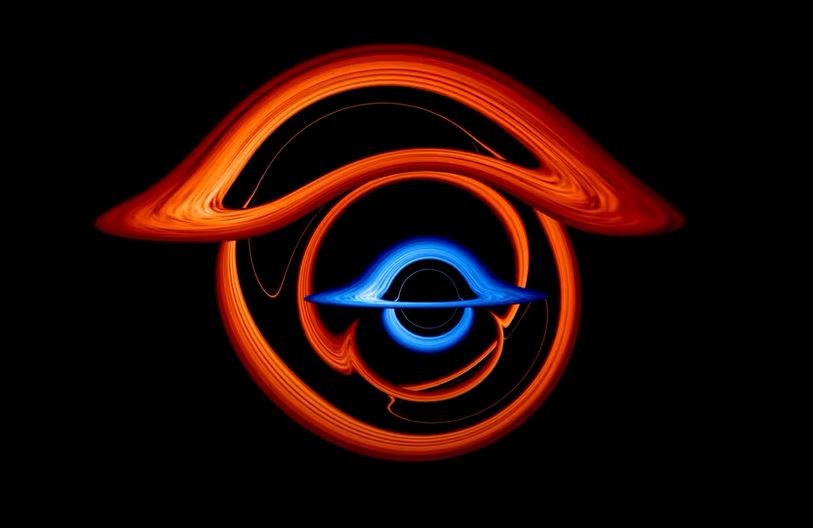
 Extreme gravity of two orbiting supermassive black holes distorts our view. In this visualization, disks of bright, hot, churning gas encircle both black holes, shown in red and blue to better track the light source. The red disk orbits the larger black hole, which weighs 200 million times the mass of our Sun, while its smaller blue companion weighs half as much Credit: NASA’s Goddard Space Flight Center/Jeremy Schnittman and Brian P. Powell

A pair of orbiting black holes millions of times the Sun’s mass perform a hypnotic pas de deux in a new NASA visualization. The movie traces how the black holes distort and redirect light emanating from the maelstrom of hot gas — called an accretion disk — that surrounds each one.

Viewed from near the orbital plane, each accretion disk takes ...

Read More

New Images reveal Magnetic Structures near Supermassive Black Hole

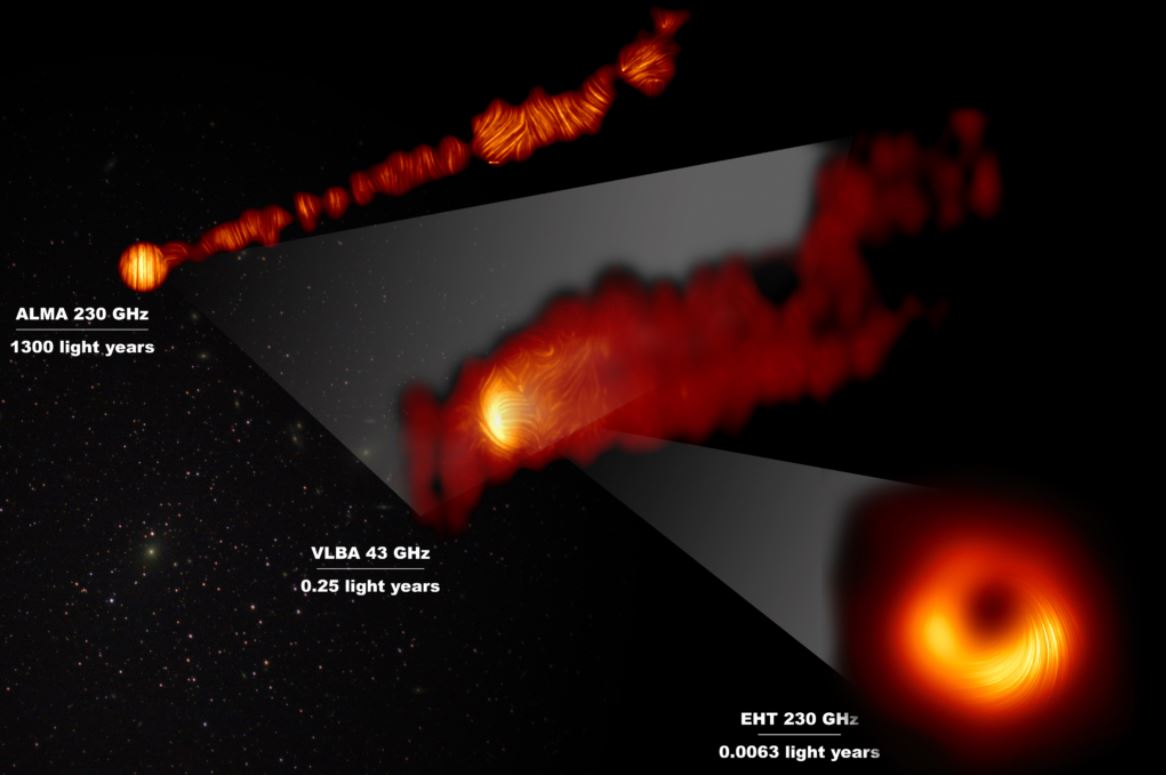
View of the M87 supermassive black hole and jet
Credit: EHT Collaboration; Goddi et al., ALMA (ESO/NAOJ/NRAO); Kravchenko et al.; J. C. Algaba, I. Martí-Vidal, NRAO/AUI/NSF.

Work gives clues about how powerful jets are driven. The Event Horizon Telescope (EHT) has produced a new image showing details of the magnetic fields in the region closest to the supermassive black hole at the core of the galaxy M87. The new work is providing astronomers with important clues about how powerful jets of material can be produced in that region.

A worldwide team of astronomers using the Event Horizon Telescope, a collection of eight telescopes, including the Atacama Large Millimeter/submillimeter Array (ALMA) in Chile, measured a signature of magnetic fields — called polarization — around the black...

Read More

New observations of Black Hole devouring a Star Reveal Rapid Disk Formation

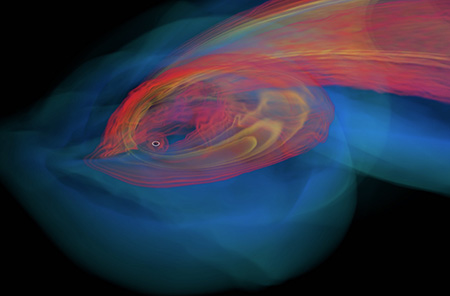
tde-simulation-450.jpg
This image from a computer simulation shows the rapid formation of an accretion disk during the disruption of a star by a supermassive black hole. (Image credit: Jamie Law-Smith and Enrico Ramirez-Ruiz)

When a star passes too close to a supermassive black hole, tidal forces tear it apart, producing a bright flare of radiation as material from the star falls into the black hole. Astronomers study the light from these “tidal disruption events” (TDEs) for clues to the feeding behavior of the supermassive black holes lurking at the centers of galaxies.

New TDE observations led by astronomers at UC Santa Cruz now provide clear evidence that debris from the star forms a rotating disk, ie an accretion disk, around the black hole...

Read More