AGN tagged posts

Hubble Sights a Galaxy with ‘Forbidden’ Light

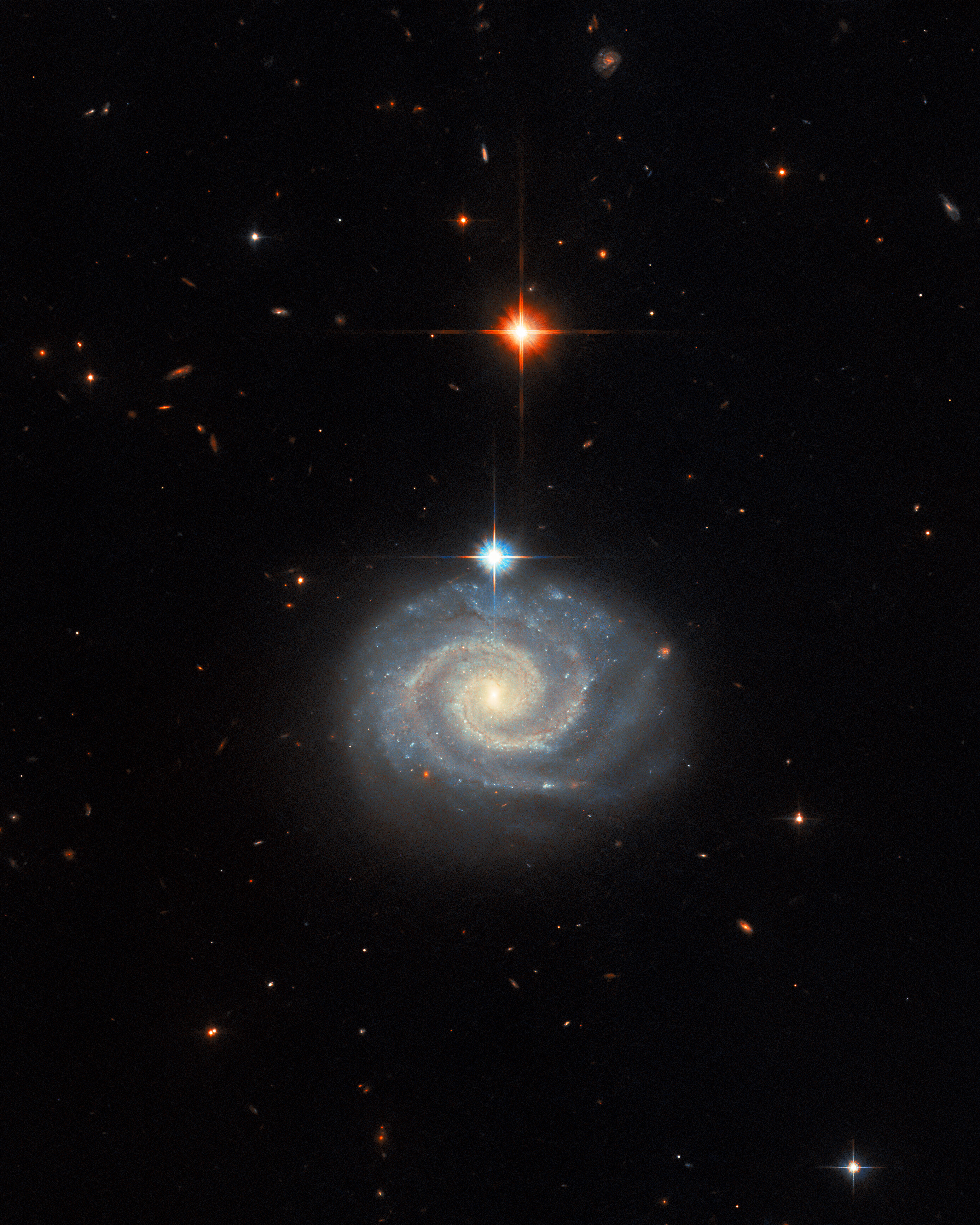
A spiral galaxy. It appears to be almost circular and seen face-on, with two prominent spiral arms winding out from a glowing core. It is centered in the frame as if a portrait. Most of the background is black, with only tiny, distant galaxies, but there are two large bright stars in the foreground, one blue and one red, directly above the galaxy.
This NASA Hubble Space Telescope image features a bright spiral galaxy known as MCG-01-24-014, which is located about 275 million light-years from Earth.
ESA/Hubble & NASA, C. Kilpatrick

This whirling image features a bright spiral galaxy known as MCG-01-24-014, which is located about 275 million light-years from Earth. In addition to being a well-defined spiral galaxy, MCG-01-24-014 has an extremely energetic core known as an active galactic nucleus (AGN) and is categorized as a Type-2 Seyfert galaxy.

Seyfert galaxies, along with quasars, host one of the most common subclasses of AGN...

Read More

Mystery resolved: Blackhole Feeding and Feedback at the Center of an Active Galaxy

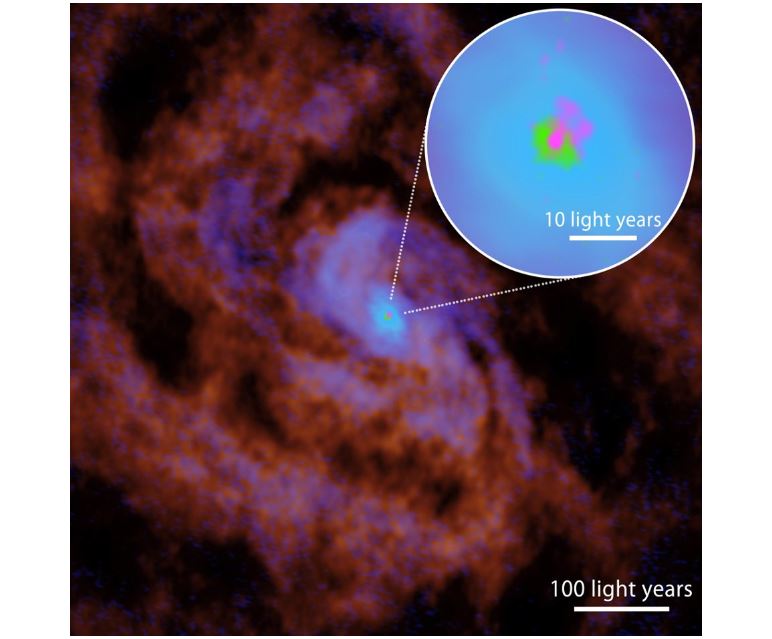
An international research team has recently observed the Circinus galaxy, which is one of the closest galaxies to the Milky Way, with high enough resolution to gain further insights into the gas flows to and from the black hole at its galactic nucleus.

An international research team led by Takuma Izumi, an assistant professor at the National Astronomical Observatory of Japan, has observed in high resolution (approximately 1 light year) the active galactic nucleus of the Circinus Galaxy — one of the closest major galaxies to the Milky Way. The observation was made possible by the Atacama Large Millimeter/Submillimeter Array (ALMA) astronomical observatory in Chile.

This breakthrough marks the world’s first quantitative measurement at this scale of gas flows and their structures o...

Read More

Astronomers discover a ‘Changing-look’ Blazar

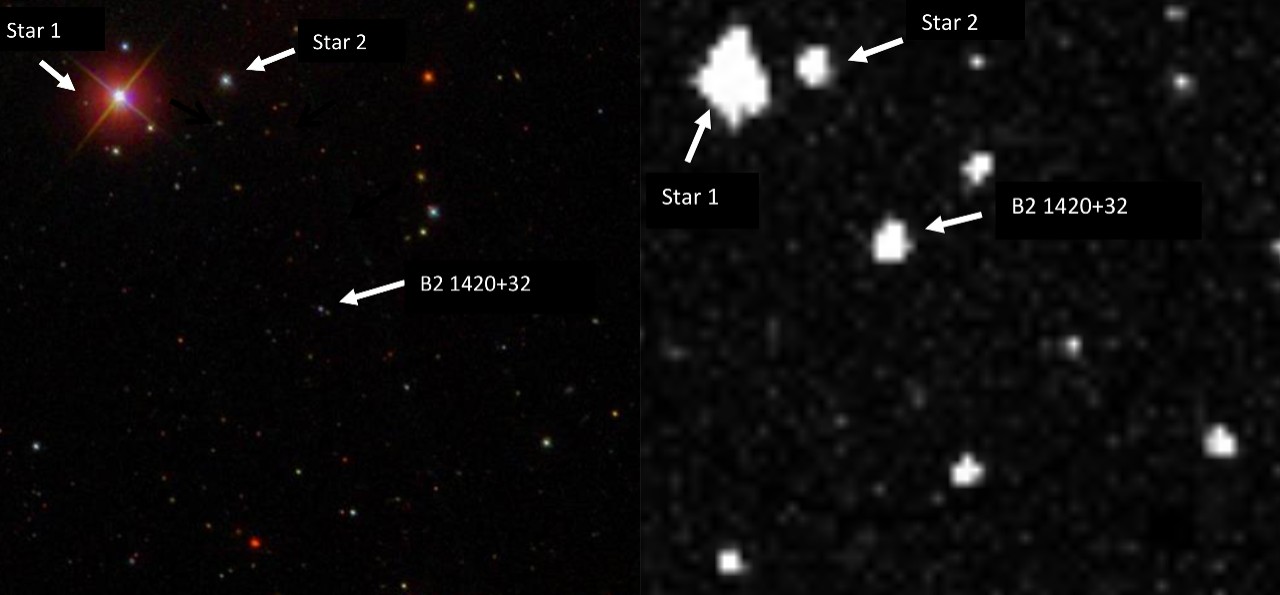
Sloan Digital Sky Survey archival image from March 2004 (top) and the image from the authors' observation campaign of the blazar, B2 1420+32, taken in January 2020 using ASAS-SN (bottom). The blazar brightness increased by a factor of 100.
Sloan Digital Sky Survey archival image from March 2004 (left) and the image from the authors’ observation campaign of the blazar, B2 1420+32, taken in January 2020 using ASAS-SN (right). The blazar brightness increased by a factor of 100.

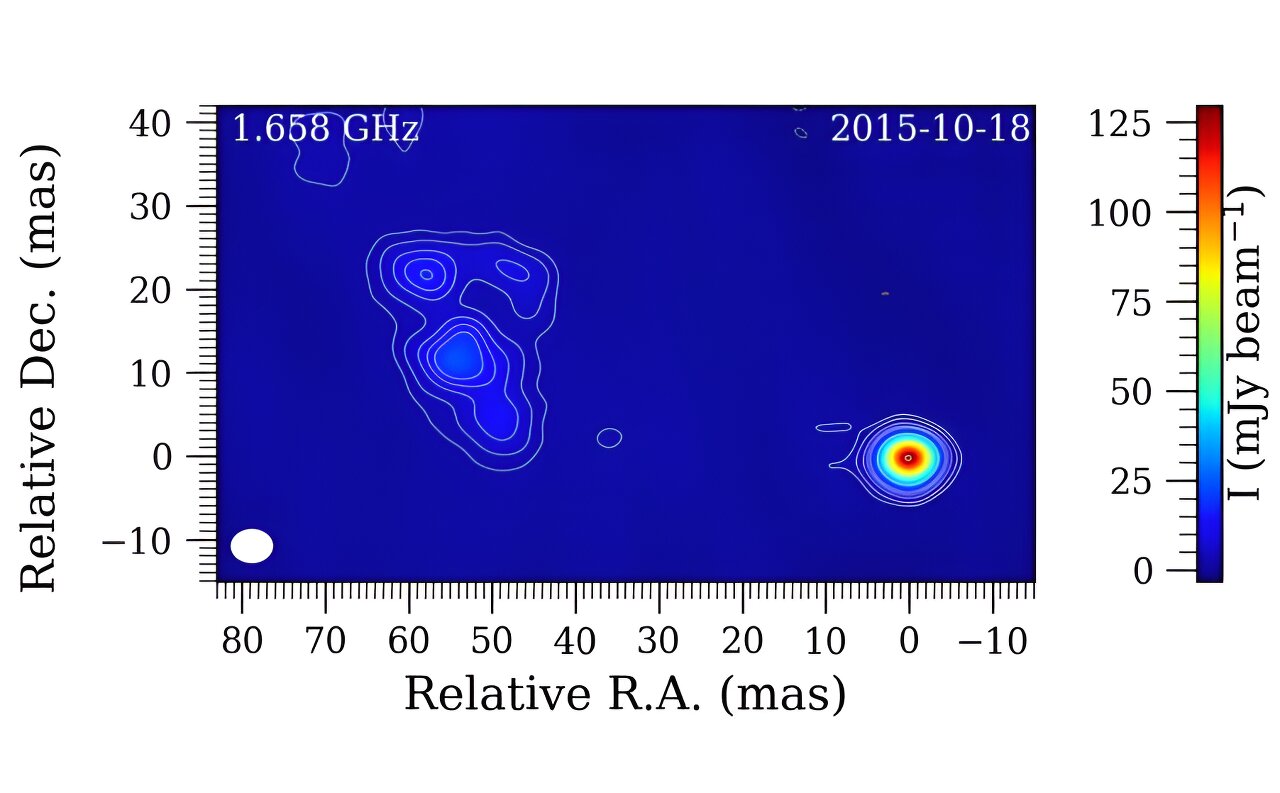
Astronomers describe a ‘changing-look’ blazar — a powerful active galactic nucleus powered by supermassive blackhole at the center of a galaxy. A University of Oklahoma doctoral student, graduate and undergraduate research assistants, and an associate professor in the Homer L. Dodge Department of Physics and Astronomy in the University of Oklahoma College of Arts and Sciences are lead authors on a paper describing a “changing-look” blazar – a powerful active galactic nucleus powered by supermassive blackhole at the center of a galaxy...

Read More

Blazar Variability

An artist’s conception of a blazar, a galay powered by an active nucleus. Blazars are the most common sources detected by NASA’s Fermi gamma-ray spacecraft. Astronomers have modeled the bright, variable emission from the blazar CTA102 between 2013-2017 using data taken from the gamma-ray to radio bands. They are able to explain the multiuwavelegnth variability observed using a geometrical model for the rapidly moving jets. Credit: M. Weiss/CfA

Active galactic nuclei (AGN) are supermassive black holes at the centers of galaxies that are accreting material. These AGN emit jets of charged particles that move at speeds close to that of light, transporting huge amounts of energy away from the central black hole region and radiating across the electromagnetic spectrum...

Read More