
AGN tagged posts

Supermassive Black Holes control Star Formation in large galaxies

centaurus-a-410.jpg

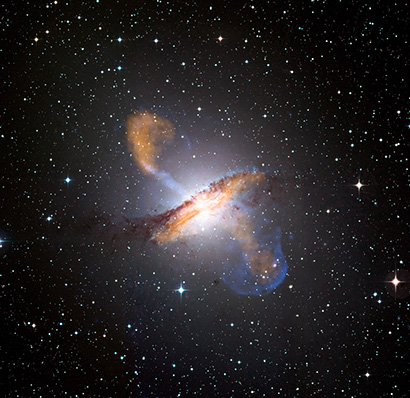
The power of a supermassive black hole is seen in this image of Centaurus A, one of the active galactic nuclei closest to Earth. The image combines data from several telescopes at different wavelengths, showing jets and lobes powered by the supermassive black hole at the center of the galaxy. Image credit: ESO/WFI (Optical); MPIfR/ESO/APEX/A.Weiss et al. (Submillimetre); NASA/CXC/CfA/R.Kraft et al. (X-ray)

Young galaxies blaze with bright new stars forming at a rapid rate, but star formation eventually shuts down as a galaxy evolves. A new study shows that the mass of the black hole in the center of the galaxy determines how soon this “quenching” of star formation occurs...

Read More
Vast Luminous Nebula poses a Cosmic Mystery

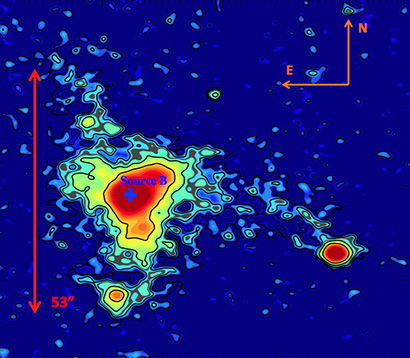
MAMMOTH-1 is an extended blob of gas in the intergalactic medium called an enormous Lyman-alpha nebula (ELAN). The color map and contours denote the surface brightness of the nebula, and the red arrows show its estimated spatial extent. (Image credit: Figure 2 of Cai et al., Astrophysical Journal)

MAMMOTH-1 is an extended blob of gas in the intergalactic medium called an enormous Lyman-alpha nebula (ELAN). The color map and contours denote the surface brightness of the nebula, and the red arrows show its estimated spatial extent. (Image credit: Figure 2 of Cai et al., Astrophysical Journal)

Glowing nebula found at the heart of a huge ‘rotocluster’ of early galaxies appears to be part of the cosmic web of filaments connecting galaxies, but what’s lighting it up? Astronomers have found an enormous, glowing blob of gas in the distant universe, with no obvious source of power for the light it is emitting. Called an “enormous Lyman-alpha nebula” (ELAN), it is the brightest and among the largest of these rare objects, only a handful of which have been observed.

ELANs are huge blobs of gas...

Read More

Markarian 1018: Starvation Diet for Black Hole Dims Brilliant Galaxy

Markarian 1018: Starvation Diet for Black Hole Dims Brilliant Galaxy

Markarian 1018 is an “active galaxy” that has brightened and dimmed over about 30 years. The black hole at the center waS being deprived of enough fuel to illuminate its surroundings. Credit X-ray: NASA/CXC/Univ of Sydney/R.McElroy et al, Optical: ESO/CARS Survey

Astronomers may have solved the mystery of the peculiar volatile behavior of a supermassive black hole at the center of a galaxy. Combined data from NASA’s Chandra X-ray Observatory and other observatories suggest the black hole is no longer being fed enough fuel to make its surroundings shine brightly. Many galaxies have an extremely bright core, or nucleus, powered by material falling toward a supermassive black hole. These “active galactic nuclei”, AGN, are some of the brightest objects in the Universe.

Astronomers classify AGN...

Read More