

We all know someone who seems to defy aging—people who look younger than their peers despite being the same age. What’s their secret? Scientists at Osaka University (Japan) may have found a way to quantify this difference...
Read More

March 18, 2025,
 Physics, Technology/Electronics
We all know someone who seems to defy aging—people who look younger than their peers despite being the same age. What’s their secret? Scientists at Osaka University (Japan) may have found a way to quantify this difference...
Read More
December 26, 2024,
Physics, Technology/Electronics
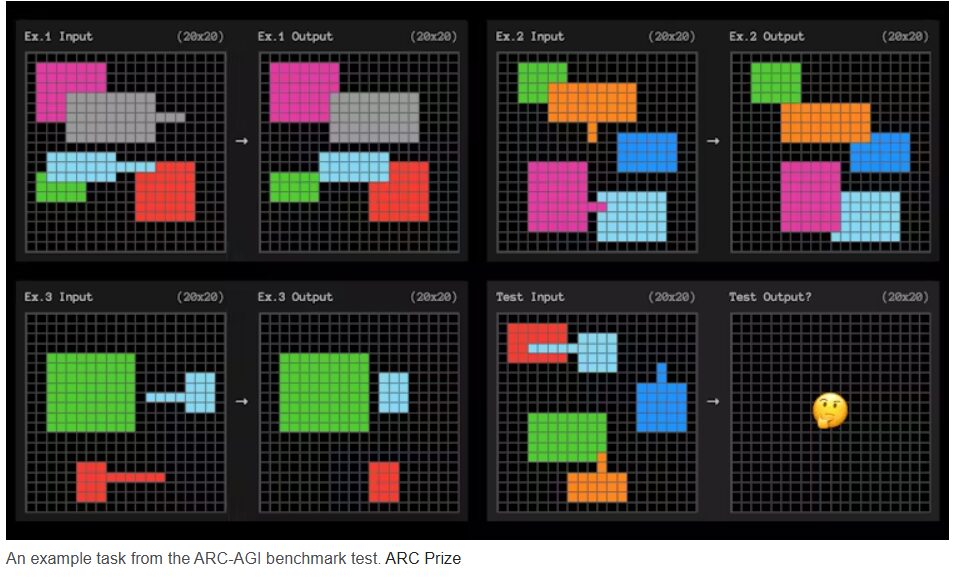
A new artificial intelligence (AI) model has just achieved human-level results on a test designed to measure “general intelligence.”
On December 20, OpenAI’s o3 system scored 85% on the ARC-AGI benchmark, well above the previous AI best score of 55% and on par with the average human score. It also scored well on a very difficult mathematics test.
Creating artificial general intelligence, or AGI, is the stated goal of all the major AI research labs. At first glance, OpenAI appears to have at least made a significant step towards this goal.
While skepticism remains, many AI researchers and developers feel something just changed. For many, the prospect of AGI now seems more real, urgent and closer than anticipated. Are they right?
Generalization and intelligence
To understand ...
December 26, 2023,
Physics, Health/Medical, Biology/Biotechnology

Researchers have created an Artificial Intelligence tool that uses sequences of life events—such as health history, education, job and income—to predict everything from a person’s personality to their mortality.
Built using transformer models, which power large language models (LLMs) like ChatGPT, the new tool, life2vec, is trained on a data set pulled from the entire population of Denmark—6 million people. The data set was made available only to the researchers by the Danish government.
The tool the researchers built based on this complex set of data is capable of predicting the future, including the lifespan of individuals, with an accuracy that exceeds state-of-the-art models...
Read More
August 9, 2023,
Physics, Technology/Electronics
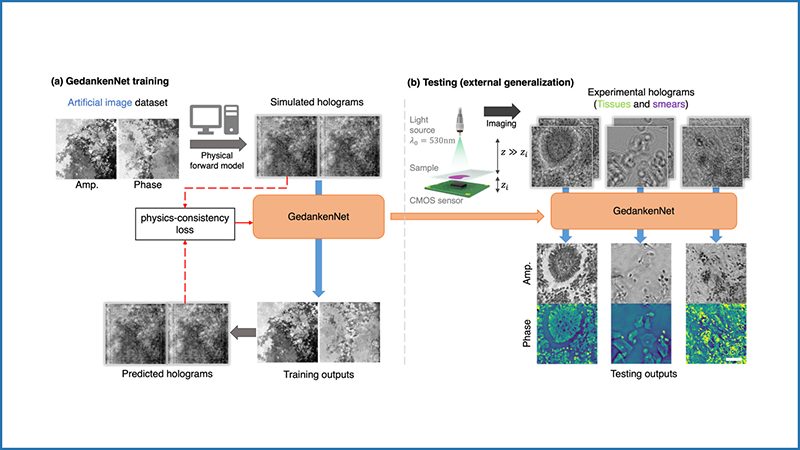
Advance uses thought experiments, instead of real data, to expedite learning. Researchers from the UCLA Samueli School of Engineering have unveiled an artificial intelligence-based model for computational imaging and microscopy without training with experimental objects or real data.
In a recent paper published in Nature Machine Intelligence, UCLA’s Volgenau Professor for Engineering Innovation Aydogan Ozcan and his research team introduced a self-supervised AI model nicknamed GedankenNet that learns f...
Read More
Recent Comments