ALMA tagged posts

ALMA Discovers Massive Rotating Disk in Early Universe

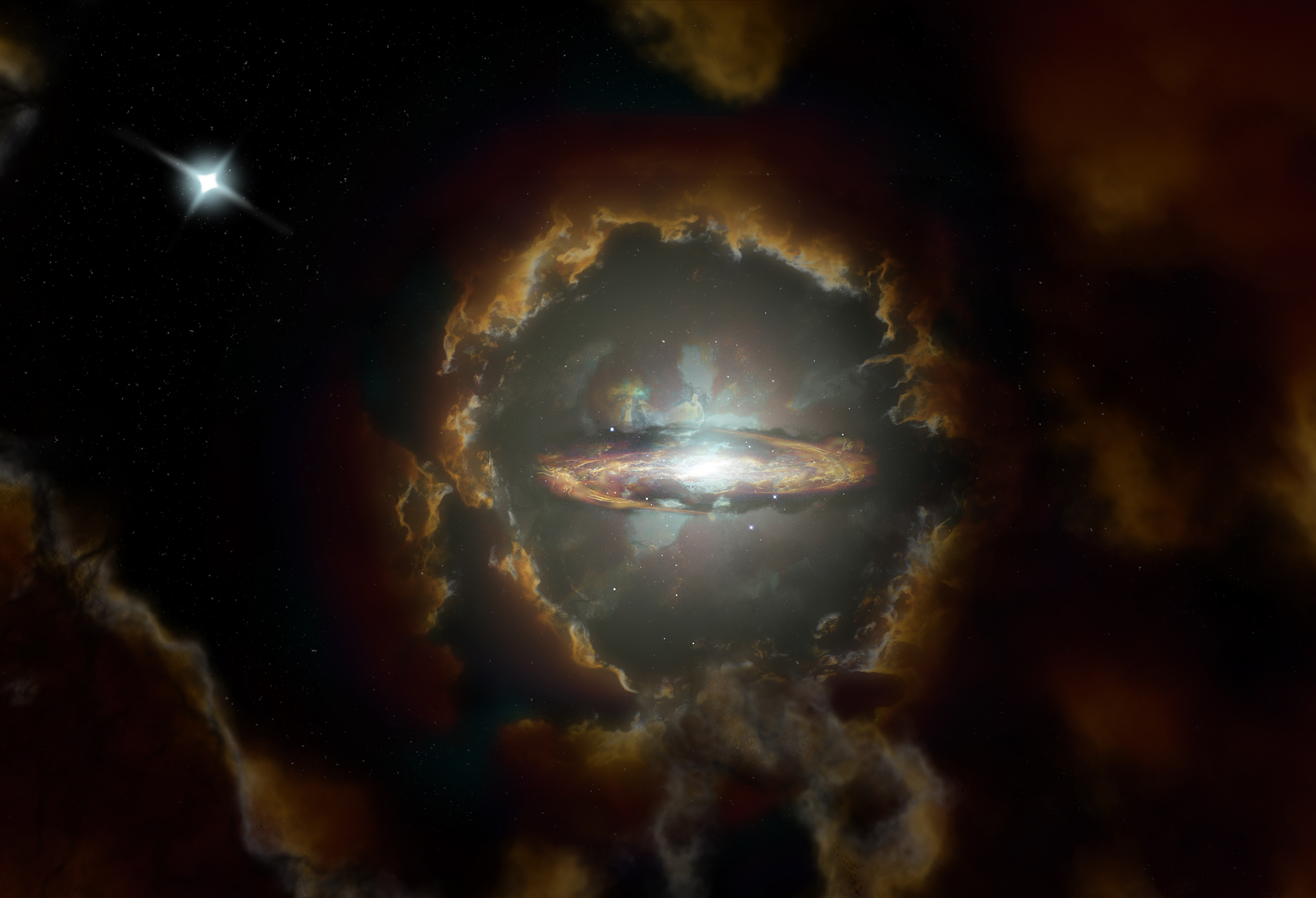
Artist impression of the Wolfe Disk, a massive rotating disk galaxy in the early, dusty universe. The galaxy was initially discovered when ALMA examined the light from a more distant quasar (top left).
Credit: NRAO/AUI/NSF, S. Dagnello

In our 13.8 billion-year-old universe, most galaxies like our Milky Way form gradually, reaching their large mass relatively late. But a new discovery made with the Atacama Large Millimeter/submillimeter Array (ALMA) of a massive rotating disk galaxy, seen when the universe was only ten percent of its current age, challenges the traditional models of galaxy formation. This research appears on 20 May 2020 in the journal Nature.

Galaxy DLA0817g, nicknamed the Wolfe Disk after the late astronomer Arthur M...

Read More

ALMA resolves Gas impacted by Young Jets from Supermassive Black Hole

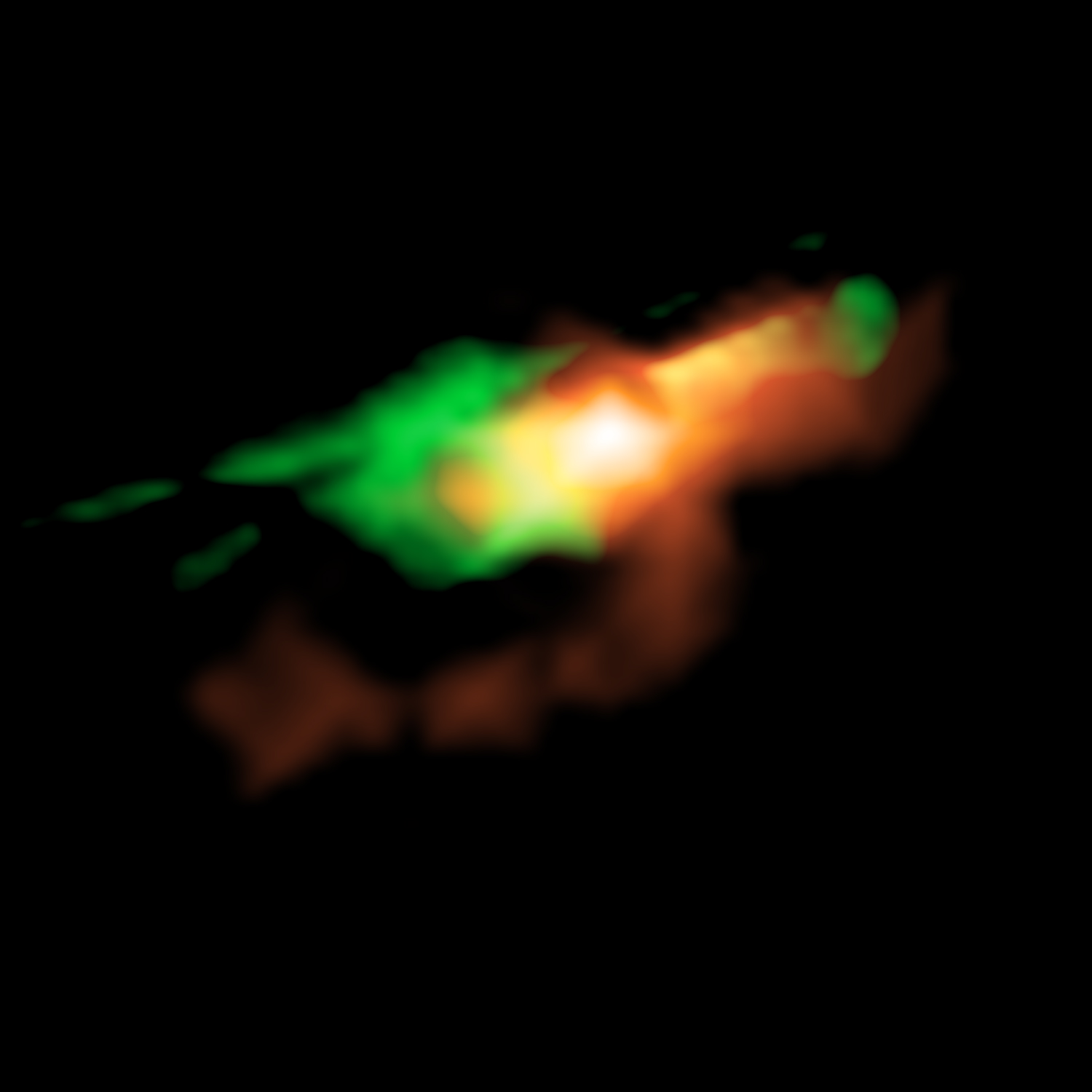
Reconstructed images of what MG J0414+0534 would look like if gravitational lensing effects were turned off. The emissions from dust and ionized gas around a quasar are shown in red. The emissions from carbon monoxide gas are shown in green, which have a bipolar structure along the jets.
Credit: ALMA (ESO/NAOJ/NRAO), K. T. Inoue et al.

Astronomers obtained the first resolved image of disturbed gaseous clouds in a galaxy 11 billion light-years away by using the Atacama Large Millimeter/submillimeter Array (ALMA). The team found that the disruption is caused by young powerful jets ejected from a supermassive black hole residing at the center of the host galaxy. This result will cast light on the mystery of the evolutionary process of galaxies in the early Universe.

It is commonly k...

Read More

Massive Gas Disk raises questions about Planet Formation Theory

20191223_Higuchi_49Ceti_ALMA_separated_E
ALMA image of the debris disk around the young star 49 Ceti. The distribution of dust is shown in red; the distribution of carbon monoxide is shown in green; and the distribution of carbon atoms is shown in blue.
Credit: ALMA (ESO/NAOJ/NRAO), Higuchi et al.

Astronomers using the Atacama Large Millimeter/submillimeter Array (ALMA) found a young star surrounded by an astonishing mass of gas. The star, called 49 Ceti, is 40 million years old and conventional theories of planet formation predict that the gas should have disappeared by that age. The enigmatically large amount of gas requests a reconsideration of our current understanding of planet formation.

Planets are formed in gaseous dusty disks called protoplanetary disks around young stars...

Read More

ALMA spots most distant Dusty Galaxy Hidden in Plain Sight

Credit: NRAO/AUI/NSF, B. Saxton

Astronomers using the Atacama Large Millimeter/submillimeter Array (ALMA) have spotted the light of a massive galaxy seen only 970 million years after the Big Bang. This galaxy, called MAMBO-9, is the most distant dusty star-forming galaxy that has ever been observed without the help of a gravitational lens.

Dusty star-forming galaxies are the most intense stellar nurseries in the universe. They form stars at a rate up to a few thousand times the mass of the Sun per year (the star-forming rate of our Milky Way is just three solar masses per year) and they contain massive amounts of gas and dust...

Read More