ALMA tagged posts

Complex organic molecules found in young star’s disk hint at cosmic origins of life

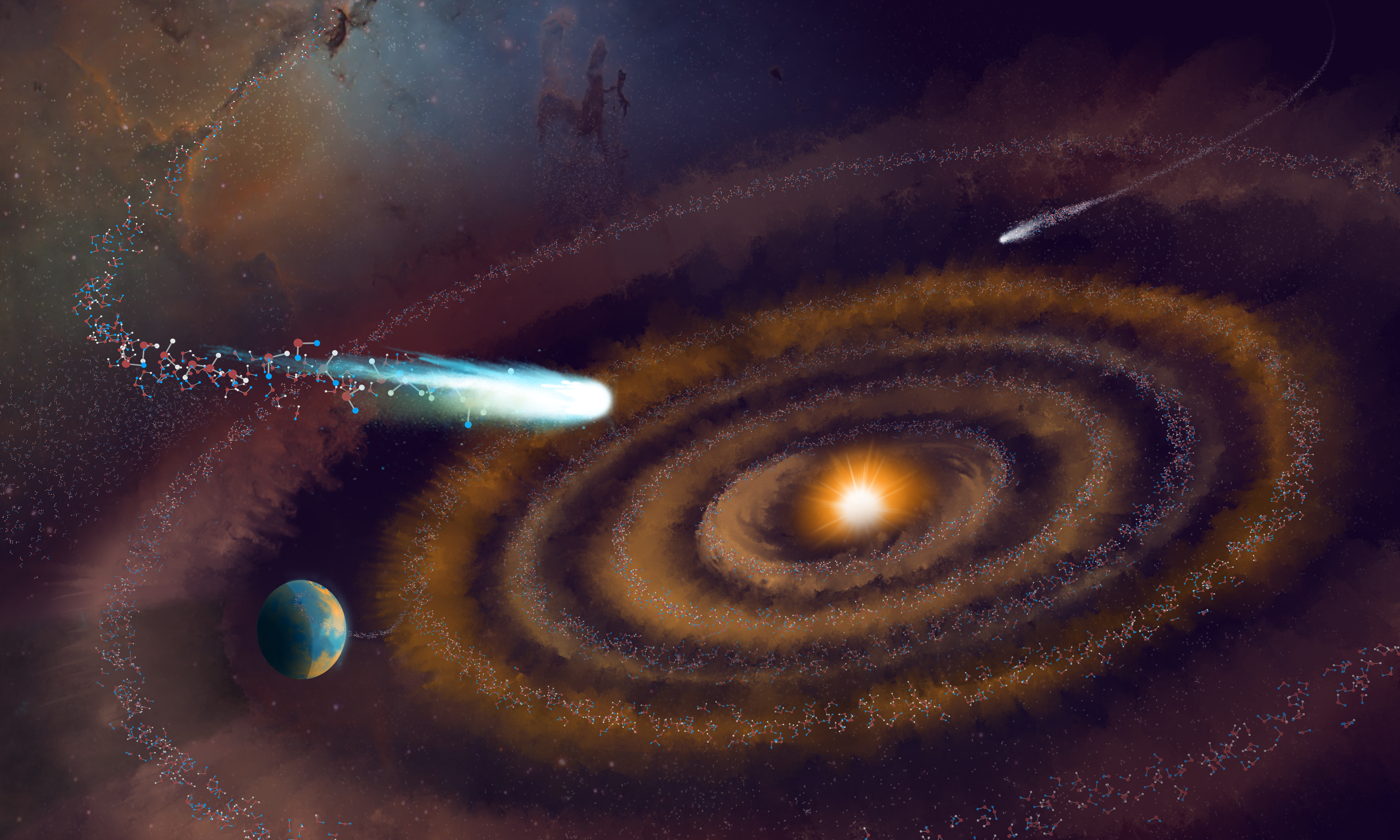
Using the Atacama Large Millimeter/submillimeter Array (ALMA), a team of astronomers led by Abubakar Fadul from the Max Planck Institute for Astronomy (MPIA) has discovered complex organic molecules—including the first tentative detection of ethylene glycol and glycolonitrile—in the protoplanetary disk of the outbursting protostar V883 Orionis.

These compounds are considered precursors to the building blocks of life. Comparing different cosmic environments reveals that the abundance and complexity of such molecules increase from star-forming regions to fully evolved planetary systems. This suggests that the seeds of life are assembled in space and are widespread.

The findings are published in the Astrophysical Journal Letters.

Astronomers have discovered complex organic m...

Read More

Planets may start forming before stars even finish growing

New high-resolution images of protoplanetary disks in the Ophiuchus star-forming region, created with improved analysis. The resolution is shown by the white ellipse in the lower left of each panel, with a smaller ellipse indicating higher resolution. The white line in the lower right of each panel indicates a scale of 30 au. The evolution stage of the central stars progresses from left to right, and from top to bottom in the same row. (Credit: ALMA(ESO/NAOJ/NRAO), A. Shoshi et al.)

In a stellar nursery 460 light-years away, astronomers sharpened old ALMA data and spotted crisp rings and spirals swirling around 27 infant stars—evidence that planets start taking shape just a few hundred thousand years after their suns ignite, far earlier than anyone expected.

Signs of planet fo...

Read More

Disk discovery changes views on star and planet formation

The combination of theoretical models and empirical data provides a new perspective for understanding the complex interactions between young stars and their environments. Credit: Paolo Padoan, Liubin Pan, Veli-Matti Pelkonen, Troels Haugbølle and Ake Nordlund

A study led by Paolo Padoan, ICREA research professor at the Institute of Cosmos Sciences of the University of Barcelona (ICCUB), is challenging the understanding of planetary disk formation around young stars.

The paper, published in Nature Astronomy, reveals that the environment plays a crucial role in determining the size and lifetime of these planetary disks, which are the sites of planet formation.

When a star forms, it is surrounded by a spinning disk of gas and dust...

Read More

Oxygen discovered in most distant known galaxy

Two different teams of astronomers have detected oxygen in the most distant known galaxy, JADES-GS-z14-0. The discovery, reported in two separate studies, was made possible thanks to the Atacama Large Millimeter/submillimeter Array (ALMA), in which the European Southern Observatory (ESO) is a partner. This record-breaking detection is making astronomers rethink how quickly galaxies formed in the early universe.

Discovered last year, JADES-GS-z14-0 is the most distant confirmed galaxy ever found: it is so far away, its light took 13.4 billion years to reach us, meaning we see it as it was when the universe was less than 300 million years old, about 2% of its present age.

The new oxygen detection with ALMA, a telescope array in Chile’s Atacama Desert, suggests the galaxy is much m...

Read More