
antibiotics tagged posts

Big Data from World’s Largest Citizen Science Microbiome Project serves Food for thought

American Gut Project, based at UC San Diego School of Medicine, is the world's largest crowdsourced, citizen science project. Credit: UC San Diego Health

American Gut Project, based at UC San Diego School of Medicine, is the world’s largest crowdsourced, citizen science project. Credit: UC San Diego Health

How factors such as diet, antibiotics and mental health status can influence the microbial and molecular makeup of your gut. Researchers at University of California San Diego School of Medicine and collaborators have published the first major results from the American Gut Project, a crowdsourced, global citizen science effort. The project, described May 15 in mSystems, is the largest published study to date of the human microbiome – the unique microbial communities that inhabit our bodies.

This publication provides the largest public reference database of the human gut microbiome, which may help drive many future microbiome studies...

Read More
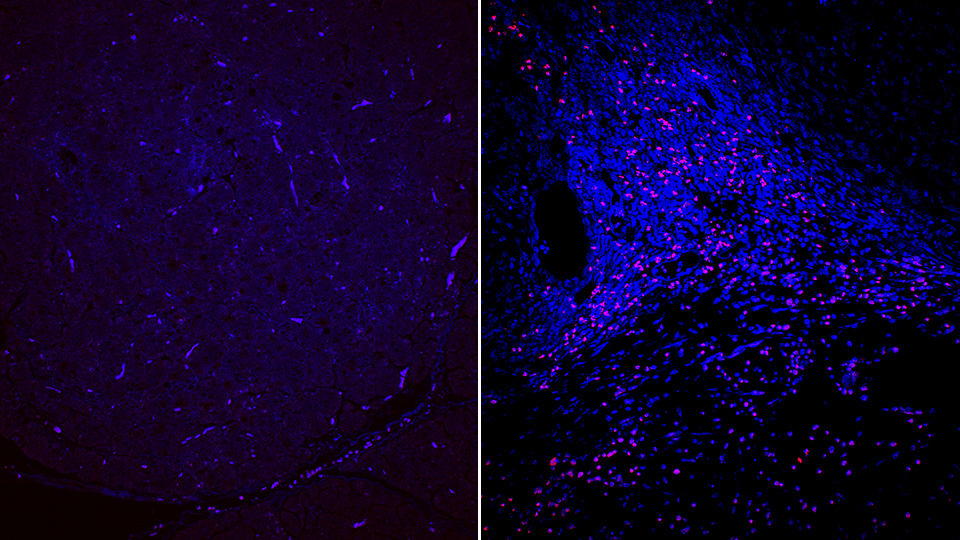
Gut Bacteria determine Speed of Tumor Growth in Pancreatic Cancer

Normal and cancerous pancreatic tissue. The blue background represents the cells that produce digestive juices supplied by the pancreas to the gut, and the red dots—seen only in the cancerous pancreas—represent the bacteria found to be a thousand times more abundant than normal.

Normal and cancerous pancreatic tissue. The blue background represents the cells that produce digestive juices supplied by the pancreas to the gut, and the red dots—seen only in the cancerous pancreas—represent the bacteria found to be a thousand times more abundant than normal.

Antibiotics may make immunotherapy more effective against pancreatic cancer. The population of bacteria in the pancreas increases more than a thousand fold in patients with pancreatic cancer, and becomes dominated by species that prevent the immune system from attacking tumor cells. These are the findings of a study conducted in mice and in patients with pancreatic ductal adenocarcinoma (PDA), a form of cancer that is usually fatal within two years...

Read More

Survey of New York City Soil uncovers medicine-making microbes

Researchers in the Brady lab, postdoc Zachary Charlop-Powers, above, examine DNA from soil samples that might encode microbial molecules with interesting properties. Credit: Zach Veilleux/The Rockefeller University

Researchers in the Brady lab, postdoc Zachary Charlop-Powers, above, examine DNA from soil samples that might encode microbial molecules with interesting properties. Credit: Zach Veilleux/The Rockefeller University

In soil collected from city parks, Rockefeller Uni researchers dug up genetic evidence of bacteria capable of producing a wide range of compounds whose potent effects might be used as medicines. “By sequencing and analyzing genes within soil samples, we found the genetic instructions for making a wide range of natural products that have the potential to become treatments for various conditions, from cancer to bacterial or fungal infections, or that are already being used as drugs,” says Sean F...

Read More

An Enzyme Enigma discovered in the Abyss

Verrucosispora maris, the bacteria in which the enzyme was found. Credit: P. Race

Verrucosispora maris, the bacteria in which the enzyme was found. Credit: P. Race

Scientists at the Universities of Bristol and Newcastle have uncovered the secret of the ‘Mona Lisa of chemical reactions’ – in a bacterium that lives at the bottom of the Pacific Ocean. It is hoped the discovery could lead to the development of new antibiotics and other medical treatments. The Diels-Alder reaction, discovered by Nobel Prize-wining chemists Otto Diels and Kurt Alder, is one of the most powerful chemical reactions known, and is used extensively by synthetic chemists to produce many important molecules, including antibiotics, anti-cancer drugs and agrochemicals.

However, there has been much debate and controversy about whether nature uses the reaction to produce its own useful molecules...

Read More