
ASKAP radio telescope tagged posts

Student astronomer discovers ‘Rosetta Stone’ for mysterious cosmic signals

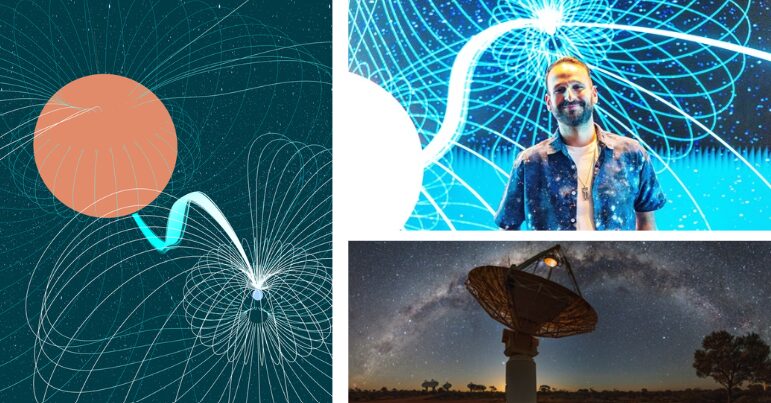
Left: Accreting white dwarf illustration, created by Carl Knox (OzGrav, Swinburne University of Technology) and Joshua Preston Pritchard (CSIRO). Top right: Lead author Kovi Rose from the University of Sydney in front of illustration of the white dwarf binary. ©  Carl Knox Bottom Left: CSIRO ’s ASKAP radio telescope on Wajarri Yamaji Country. Credit: Alex Cherney.

An international team led by astronomers at the University of Sydney has uncovered the clearest evidence yet for the origin of an unusual class of cosmic signals. In doing so, they have identified a rare stellar system that is providing scientists with a natural laboratory to study extreme physics.

Using CSIRO’s ASKAP radio telescope, the team discovered a small, dense star, called a white dwarf, shredding material ...

Read More
Telescope dons ‘Sunglasses’ to find Brightest-ever Pulsar

Dishes of the ASKAP radio telescope stretch towards the horizon beneath a dawn sky ©  CSIRO

An international research team, including scientists at Australia’s national science agency, CSIRO, has used a new observation technique to discover the brightest extragalactic pulsar known, and it could even be the most luminous one ever found.

First discovered in 1967, pulsars are remnants of massive stars and offer researchers potential applications in areas like random number generation and guidance systems for spacecraft.

The research team used the ASKAP radio telescope, owned and operated by CSIRO, to apply a new method of seeking out pulsars...

Read More

Astronomers Reveal Best Image yet of Mysterious Odd Radio Circles in Space

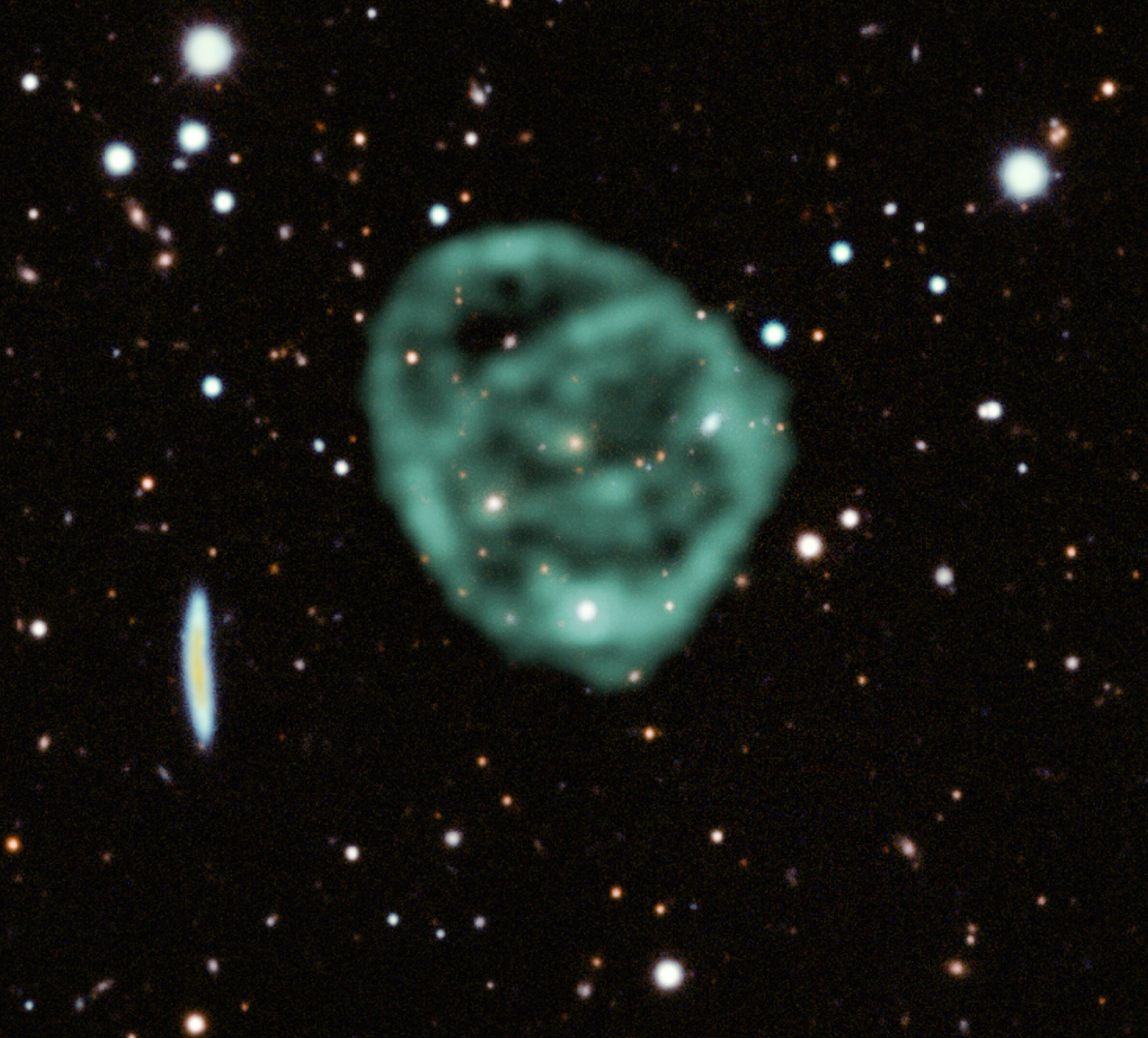
Data from SARAO’s MeerKAT radio telescope data (green) showing the odd radio circles, is overlaid on optical and near infra-red data from the Dark Energy Survey. Credit: J. English (U. Manitoba) / EMU / MeerKAT / DES(CTIO)

Astronomy’s newest mystery objects⁠—odd radio circles, or ORCs⁠—have been pulled into sharp focus by an international team of astronomers using the world’s most capable radio telescopes.
When first revealed in 2020 by the ASKAP radio telescope, owned and operated by Australia’s national science agency CSIRO, odd radio circles quickly became objects of fascination. Theories on what causes them ranged from galactic shockwaves to the throats of wormholes.

A new detailed image, captured by the South African Radio Astronomy Observatory’s MeerKAT radio telescope and publ...
Read More