
Astrochemistry tagged posts

A natural chemistry laboratory in protostar shockwaves

A natural chemistry laboratory in protostar shock waves

Life exists because elements combine to form complex organic molecules. Astrochemistry studies this process, trying to understand how nature creates carbon-based molecules critical for life. One source for these types of molecules is the outflows emitted by protostars.

Protostars grow by accreting gas, and while they do so, they also emit energy. Protostars haven’t begun fusing hydrogen yet, so their energy comes from shocks on its surface generated by in-falling gas. They can also emit high speed streams of gas as astrophysical jets. These jets carry away excess angular momentum, allowing the protostars to keep growing. These jets also create illuminated shocks in the interstellar medium (ISM).

Shock fronts like these are where energy and matter are concentrated, and that’s whe...

Read More
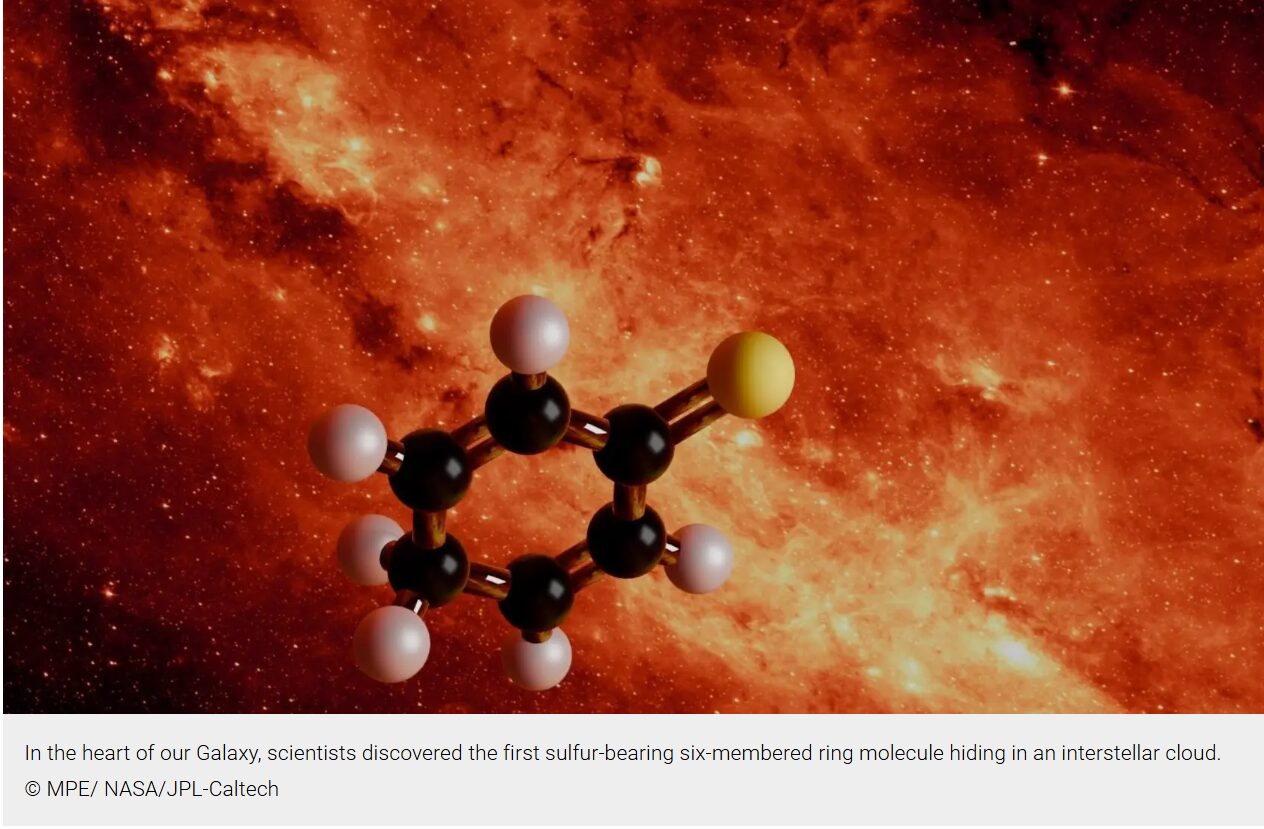
Astrophysicists discover largest sulfur-containing molecular compound in space

Researchers at the Max Planck Institute for Extraterrestrial Physics (MPE), in collaboration with astrophysicists from the Centro de Astrobiología (CAB), CSIC-INTA, have identified the largest sulfur-bearing molecule ever found in space: 2,5-cyclohexadiene-1-thione (C₆H₆S). They made this breakthrough by combining laboratory experiments with astronomical observations. The molecule resides in the molecular cloud G+0.693–0.027, about 27,000 light-years from Earth near the center of the Milky Way.

With a stable six-membered ring and a total of 13 atoms, it far exceeds the size of all previously detected sulfur-containing compounds in space. The study is published in Nature Astronomy.

Significance of the discovery for astrochemistry
“This is the first unambiguous detection of ...

Read More

Scientists discover new sources for ‘the molecule that made the universe’

MSU scientists discover new sources for 'the molecule that made the universe'
A star-forming region in the Tarantula Nebula as captured by the James Webb Space Telescope. MSU researchers have recently uncovered alternative sources of the molecule H₃⁺, which plays a crucial role in the birth of stars and other cosmic chemistry. Credit: NASA, ESA, CSA, STScI, Webb ERO Production Team

From helping catalyze interstellar reactions and fueling the birth of stars to its presence in neighborhood gas giants like Saturn and Jupiter, trihydrogen, or H3+, is best known as the “the molecule that made the universe.”

While we have a clear picture of how the majority of H3+ is formed—a hydrogen molecule, or H2, colliding with its ionized counterpart, H2+—scientists are keen to understand alternative sources of H3+ and to better measure its abundance throughout the cosmos...

Read More

Recreating Interstellar Ions with Lasers

1. Mechanisms and time-resolved dynamics for trihydrogen cation (H3 ) formation from organic molecules in strong laser fields. Scientific Reports, 2017; 7 (1) DOI: 10.1038/s41598-017-04666-w 2. MSU's Marcos Dantus has recreated interstellar ions with lasers. Credit: Courtesy of MSU

1. Mechanisms and time-resolved dynamics for trihydrogen cation (H3 ) formation from organic molecules in strong laser fields. Scientific Reports, 2017; 7 (1) DOI: 10.1038/s41598-017-04666-w
2. MSU’s Marcos Dantus has recreated interstellar ions with lasers.
Credit: Courtesy of MSU

Trihydrogen, H3+, is called the molecule that made the universe, where it plays a greater role in astrochemistry than any other molecule. While H3+ is astronomically abundant, no scientist understood the mechanisms that form it from organic molecules. Until now. Using lasers, Michigan State University scientists have unlocked the secret and published their results in the current issue of Scientific Reports...

Read More