aurora tagged posts

Risks of solar storms may be underestimated, warn researchers

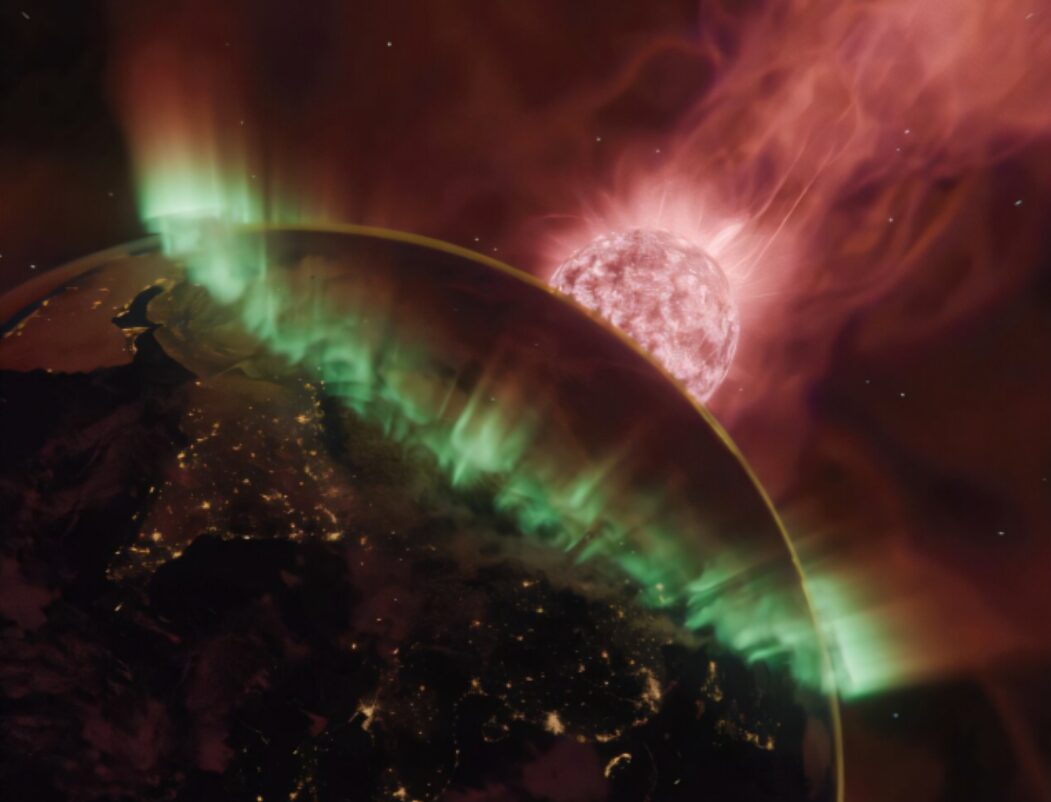
Illustration of solar wind streaming from a fuming sun drives auroras bright enough to be seen far from the poles, a dazzling signature of an extreme geomagnetic storm. Credit: Nithin Sivadas NASA Goddard Space Flight Center

The effects of extreme space weather may be larger than previously thought, research in the journal Nature reveals. The paper, titled “Regression to the mean can explain saturation of geomagnetic storms,” is led by Dr. Nithin Sivadas of NASA’s Goddard Space Flight Center and co-authored by Dr. Maria Walach from Lancaster University.

Space weather—caused by fluctuating electric fields in Earth’s magnetic field and upper atmosphere—can affect technologies on and around Earth in several ways...

Read More

New Discoveries about Jupiter’s Magnetosphere

New discoveries about Jupiter could lead to a better understanding of Earth’s own space environment and influence a long-running scientific debate about the solar system’s largest planet.
“By exploring a larger space such as Jupiter, we can better understand the fundamental physics governing Earth’s magnetosphere and thereby improve our space weather forecasting,” said Peter Delamere, a professor at the UAF Geophysical Institute and the UAF College of Natural Science and Mathematics.

“We are one big space weather event from losing communication satellites, our power grid assets, or both,” he said.

Space weather refers to disturbances in the Earth’s magnetosphere caused by interactions between the solar wind and the Earth’s magnetic field...

Read More

When is an Aurora not an Aurora?

Phenomena called ‘Steve’ and ‘picket fence’ are masquerading as auroras, graduate student argues

nighttime photo of mountain with pinkish swirls and green stripes and stars shining through
The purple and white emissions at the top are referred to as “Steve,” while the green emissions are called “picket fence.” The rare phenomena, which are distinct from the typical aurora, often occur together and may be caused by similar conditions at the edge of space. The photo was taken looking south over Berg Lake toward Mt. Robson in the Canadian Rockies, British Columbia, Canada.
Courtesy of Robert Downie, robertdowniephotography.com

While auroras occur at high latitude, the associated phenomena Steve and the picket fence occur farther south and at lower altitude. Their emissions also differ from aurora...

Read More

Comet discovered to have its own Northern Lights

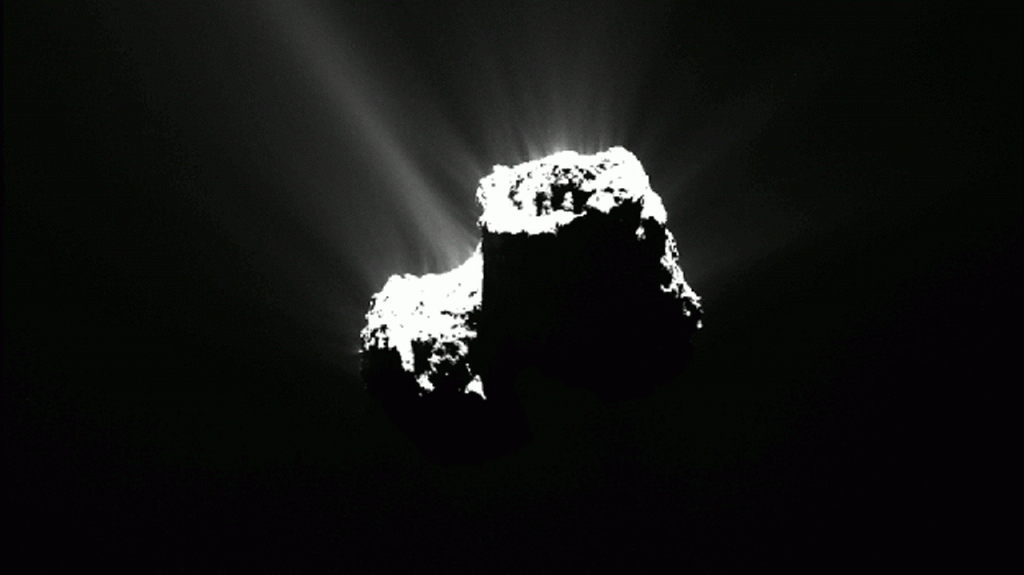
Image acquired by the navigation camera on the European Space Agency’s Rosetta spacecraft orbiting Comet 67P/Churyumov-Gerasimenko between Nov. 19 and Dec. 3, 2014. Image credit: ESA/Rosetta/NAVCAM

An atmospheric light show previously relegated to planets and Jupiter moons is found on comet using data from ESA’s Rosetta spacecraft. Data from NASA instruments aboard the ESA (European Space Agency) Rosetta mission have helped reveal that comet 67P/Churyumov-Gerasimenko has its own far-ultraviolet aurora. It is the first time such electromagnetic emissions in the far-ultraviolet have been documented on a celestial object other than a planet or moon. A paper on the findings was released today in the journal Nature Astronomy.

On Earth, aurora (also known as the northern or southern light...

Read More