
cancer tagged posts

Novel Regulator of Immune Evasion in Cancer identified

Novel regulator of immune evasion in cancer identified
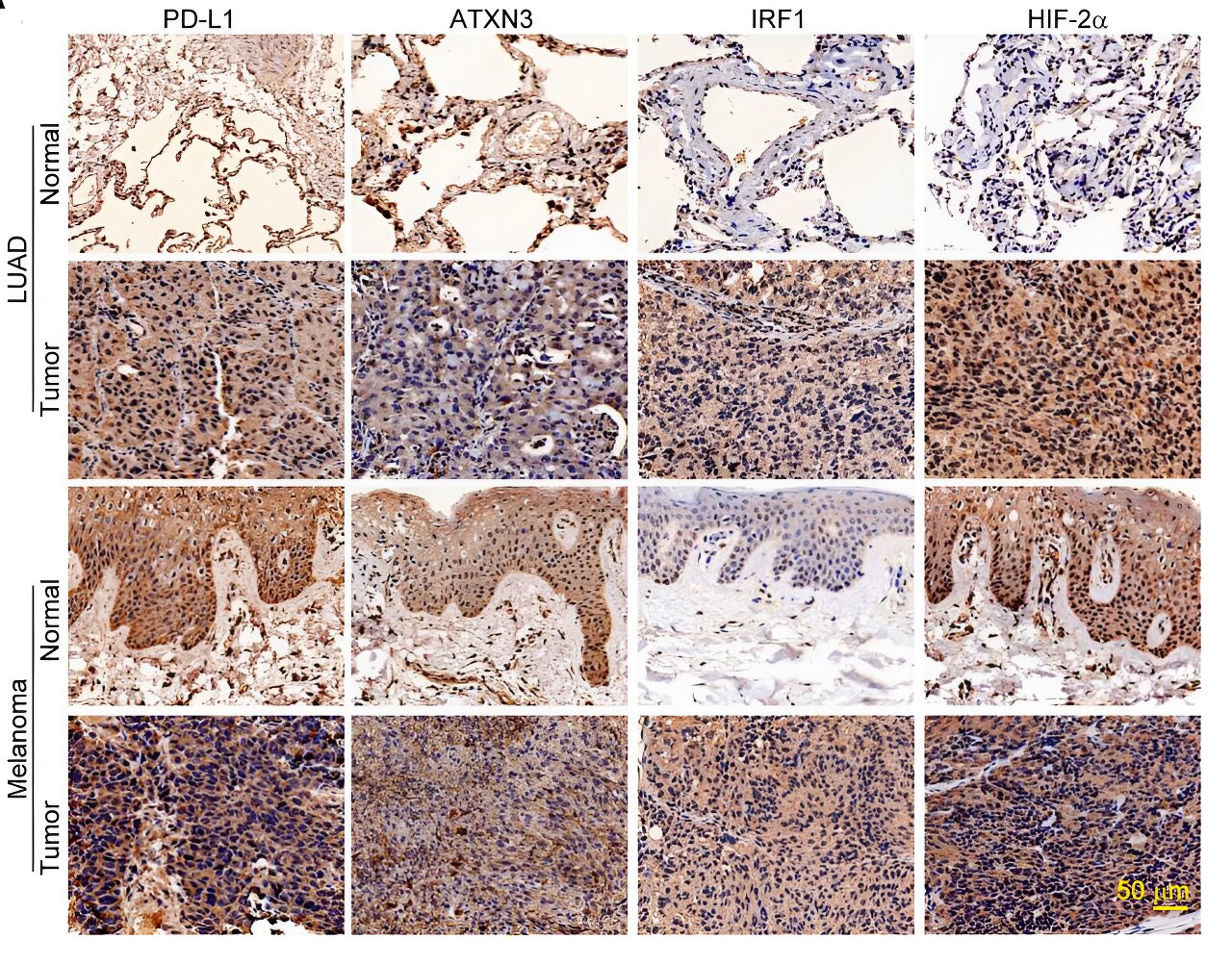
Representative images from immunohistochemical staining of PD-L1, ATXN3, IRF1, and HIF-2α in human lung adenocarcinoma (LUAD) and melanoma patients. Courtesy of Deyu Fang, PhD. Credit: Journal of Clinical Investigation (2023). DOI: 10.1172/JCI167728

Northwestern Medicine investigators have identified a previously unknown regulator of tumor immune evasion, which may help improve the efficacy of current and future antitumor immunotherapies, according to recent findings published in the Journal of Clinical Investigation.

“The study provides a molecular insight into understanding why some cancer patients cannot be treated by the checkpoint blockade antitumor therapy, but others can,” said Deyu Fang, Ph.D...

Read More
‘Spider-like’ Mitochondrial Structure Initiates Cell-wide Stress Response

“Spider-like” mitochondrial structure initiates cell-wide stress response
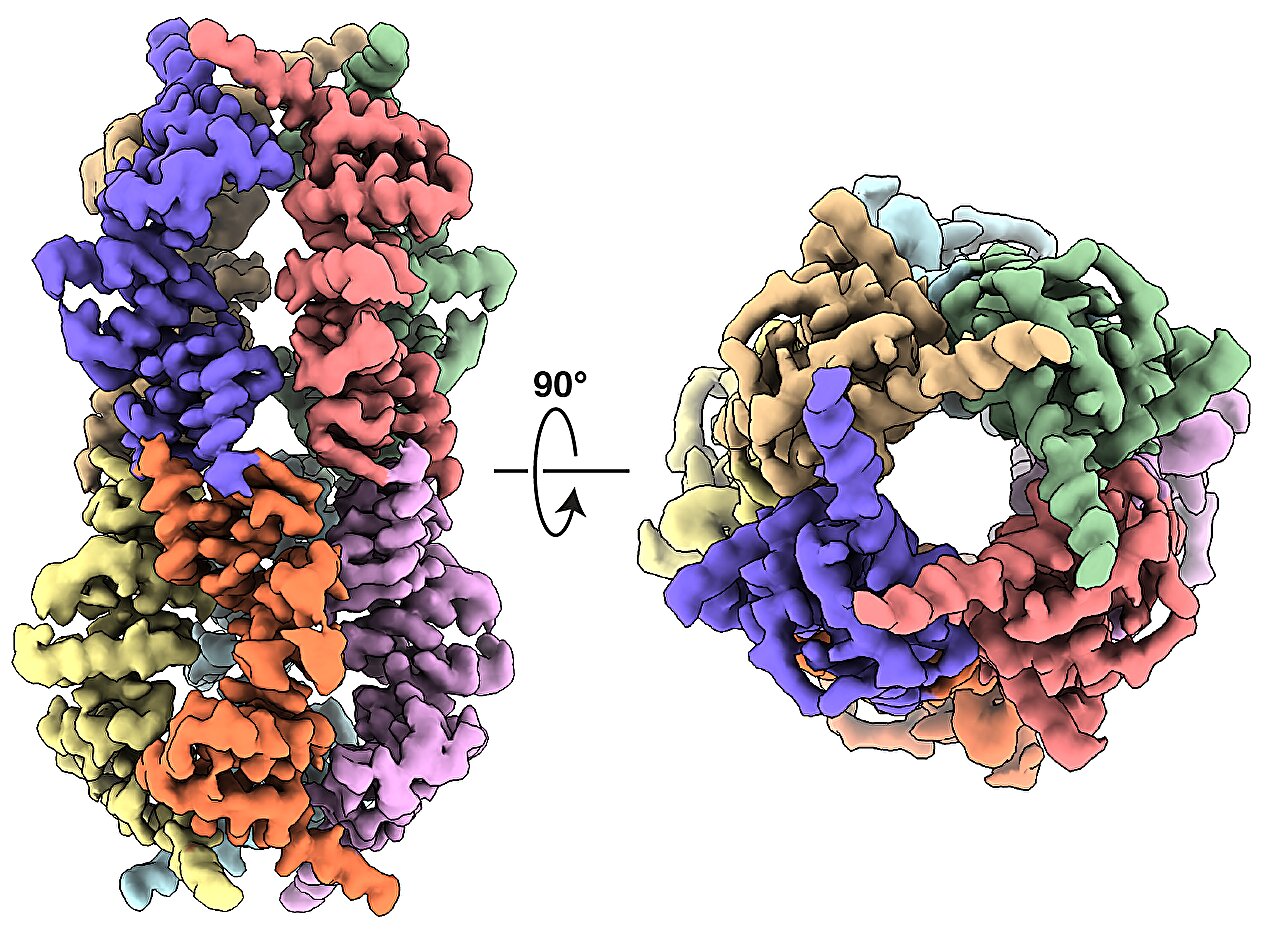
A structural depiction of a mitochondrial protein structure that initiates a cell-wide stress response. Using electron microscopy, Scripps Research scientists showed that this protein complex is made up of eight identical fragments of a protein called DELE1 that bind together into a highly symmetrical cylindrical. Credit: Jie Yang, Scripps Research

Often referred to as the “powerhouses of the cell,” mitochondria are well known for their role as energy suppliers, but these organelles are also critical for maintaining our overall health. Mitochondrial stress is associated with aging and age-related diseases, including neurodegeneration, but there has been a limited understanding of the cellular mechanisms behind this mitochondrial stress signaling...

Read More

Wear and forget: An Ultrasoft Material for On Skin Health Devices

. Leakage-resistant property.
Conceptual illustration of conventional nonporous (A) and multifunctional porous (B) EGaIn composites upon compression. Here, porous structures can provide damping effect to substantially reduce stresses induced on liquid metal conductive pathways (see details in fig. S5), therefore endowing leakage-resistant property. In addition, antimicrobial additive can offer antibacterial and antiviral property. (C) Chemical structure of the antimicrobial additive, ε-PL, modified with BEHS for uniform dispersion in solvents. (D) Schematic of the EGaIn particle made by tip sonication of bulk EGaIn. (E) 3D tomography image of porous composites before sintering, showing EGaIn particle (yellow) distributions in elastomers (pink). Scale bar, 100 μm. (F) Photographs of compr...
Read More

Treating Tough Tumors by exploiting their Iron ‘Addiction’

A microscopic image of KRAS-driven lung cancer (purple) in a mouse model. Researchers found that KRAS-driven tumors have higher levels of ferrous iron, which correlates with shorter survival times. Image by National Cancer Institute, National Institutes of Health

Researchers at the University of California, San Francisco, have successfully leveraged an FDA-approved drug to halt growth of tumors driven by mutations in the RAS gene, which are famously difficult to treat and account for about 1 in 4 cancer deaths.

Taking advantage of what they discovered to be the cancer cells’ appetite for a reactive form of iron, the researchers tweaked an anticancer drug to operate only in these iron-rich cells, leaving other cells to function normally...

Read More