Cassini spacecraft tagged posts

New study assesses Titan’s resources and their potential uses

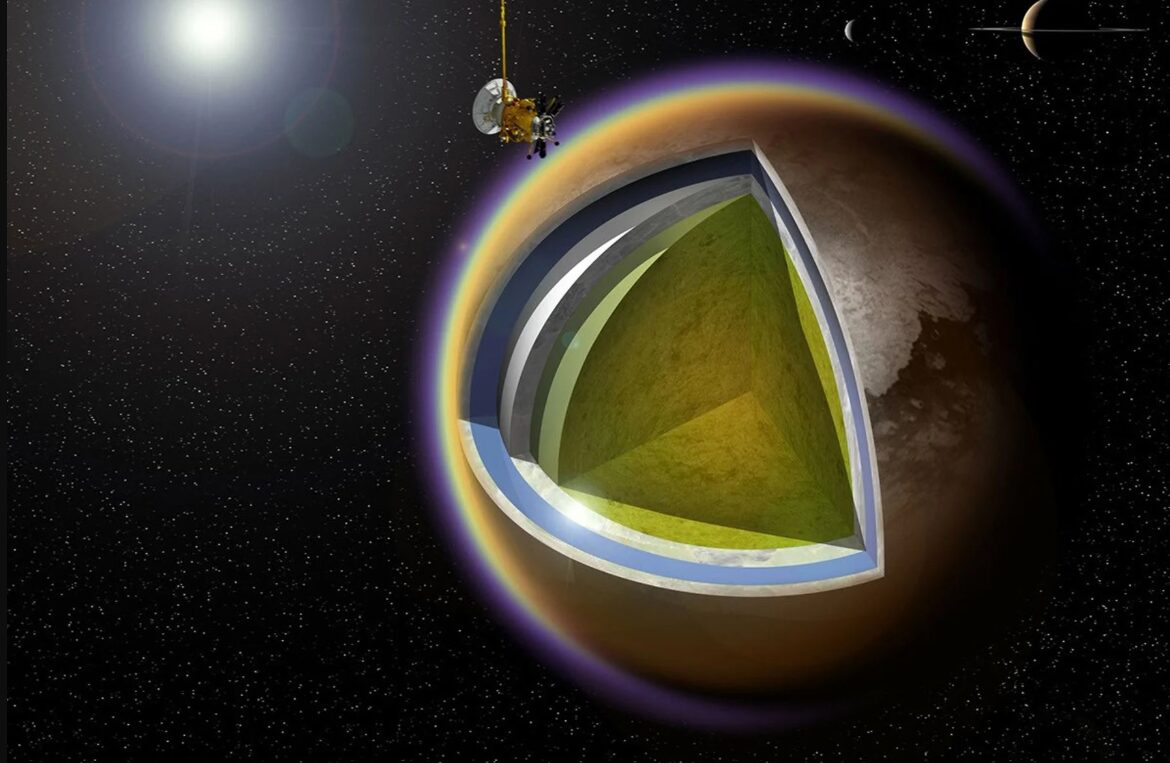
Artist’s rendering of Titan’s interior, with the Cassini spacecraft in orbit and Saturn in the distance. Credit: NASA

Saturn’s largest moon, Titan, is a unique environment in our solar system. It is the only moon (or body beyond Earth) to have a dense, nitrogen-rich atmosphere, and its methane cycle is very similar to Earth’s hydrological cycle, in which solid and liquid methane evaporate to form clouds and return to the surface as precipitation. In addition, its prebiotic surface environment and rich organic chemistry make it a prime destination for astrobiology missions, such as NASA’s Dragonfly mission (set to launch no earlier than July 2028).

And as Robert Zubrin said in his book, “Entering Space: Creating a Spacefaring Civilization,” Saturn’s moons could become the “Persian Gu...

Read More

Boiling oceans may lurk beneath the ice of solar system’s smallest moons

Looking inside icy moons
Saturn’s moon Mimas, imaged by the Cassini spacecraft. A new study shows how such small ice moons could sustain a liquid ocean beneath an icy shell, and how that could give rise to surface features. Credit: By NASA / JPL-Caltech / Space Science Institute – This image or video was catalogued by Jet Propulsion Laboratory of the United States National Aeronautics and Space Administration (NASA) under Photo ID: PIA12570., Public Domain, https://commons.wikimedia.org/w/index.php?curid=10371541

The outer planets of the solar system are swarmed by ice-wrapped moons. Some of these, such as Saturn’s moon Enceladus, are known to have oceans of liquid water between the ice shell and the rocky core and could be the best places in our solar system to look for extraterrestrial life...

Read More

Saturn’s icy moon may host a stable ocean fit for life

Enceladus heat transfer infographic
A new study has constrained the Enceladus’ global conductive heat flow by studying its seasonal temperature variations at its north pole (yellow). These results, when combined with existing ones of its highly active south polar region (red) provide the first observational constraint of Enceladus’ energy loss budget (<54 GW) – which is consistent with the predicted energy input (50 to 55 GW) from tidal heating. This implies Enceladus’ current activity is sustainable in the long term – an important prerequisite for the evolution of life, which is thought possible to exist in its global sub-surface ocean. Image credit: University of Oxford/NASA/JPL-CalTech/Space Science Institute (PIA19656 and PIA11141)

A new study led by researchers from Oxford University, Southwest Research I...

Read More

Researcher Helps Identify New Evidence for Habitability in Ocean of Saturn’s Moon Enceladus

Enceladus logo graphic
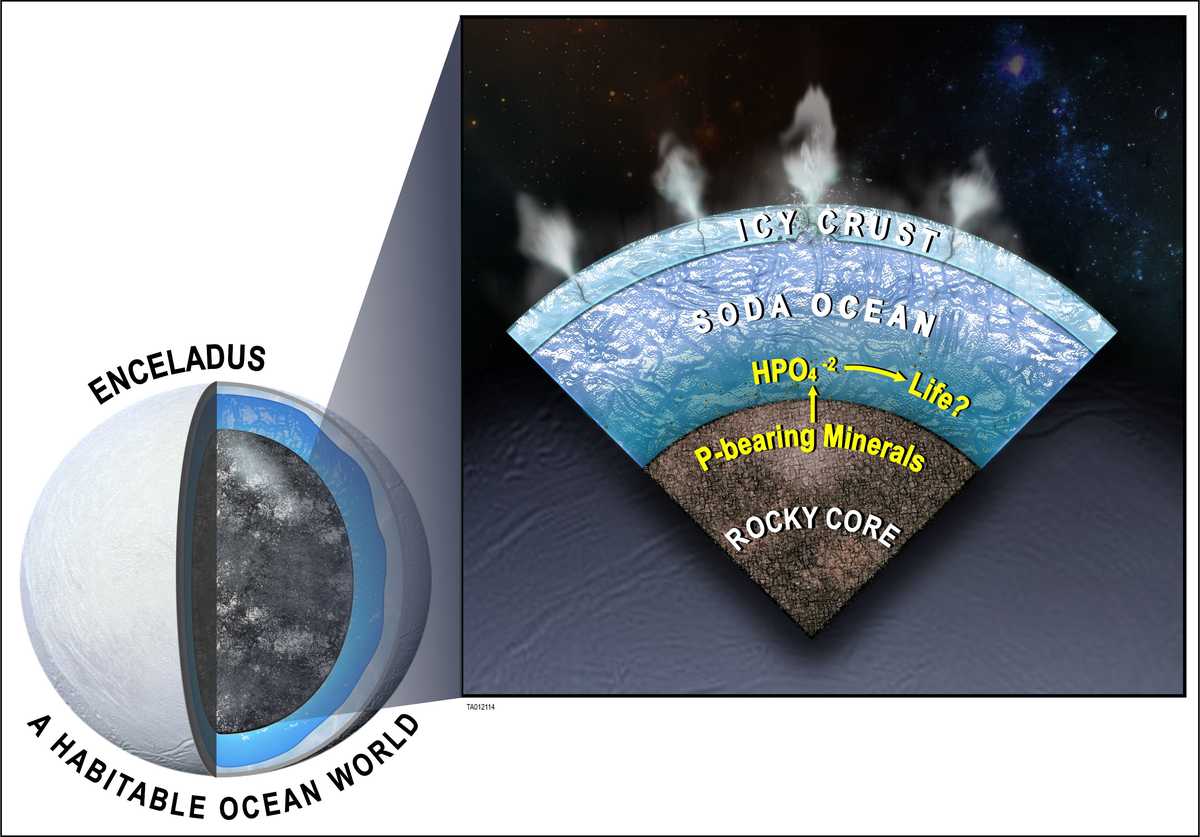
SwRI Lead Scientist Dr. Christopher Glein contributed to new findings that phosphorus in the form of orthophosphate (e.g., HPO4-2) is likely abundant in the subsurface ocean of Saturn’s moon Enceladus.

The search for extraterrestrial life has just become more interesting as a team of scientists, including Southwest Research Institute’s Dr. Christopher Glein, has discovered new evidence for a key building block for life in the subsurface ocean of Saturn’s moon Enceladus. New modeling indicates that Enceladus’s ocean should be relatively rich in dissolved phosphorus, an essential ingredient for life.

“Enceladus is one of the prime targets in humanity’s search for life in our solar system,” said Glein, a leading expert in extraterrestrial oceanography...

Read More