
Chandra X-ray tagged posts

Chandra resolves why black holes hit the brakes on growth

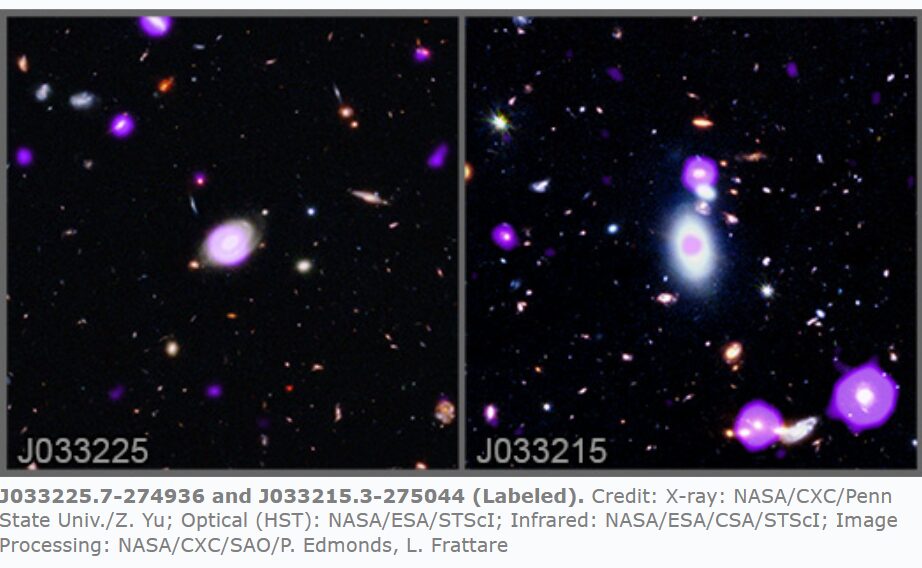
Astronomers have an answer for a long-running mystery in astrophysics: why is the growth of supermassive black holes so much lower today than in the past? A study using NASA’s Chandra X-ray Observatory and other X-ray telescopes found that supermassive black holes are unable to consume material as rapidly as they did in the distant past. The results appeared in the December 2025 issue of The Astrophysical Journal.

Ten billion years ago, there was a period that astronomers call “cosmic noon,” when the growth of supermassive black holes (those with millions to billions of times the mass of the sun) was at its peak across the entire history of the universe. Between cosmic noon and now, however, astronomers have seen a major slowdown in how rapidly black holes are growing.

“A longst...

Read More
X-ray and Radio go ‘Hand in Hand’ in New Image

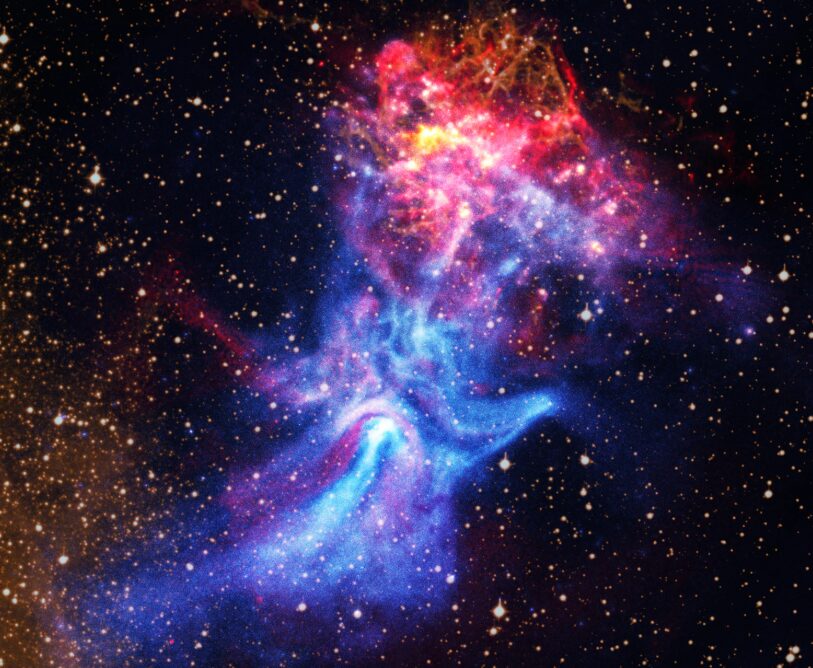
X-ray: NASA/CXC/Univ. of Hong Kong/S. Zhang et al.; Radio: ATNF/CSIRO/ATCA; H-alpha: UK STFC/Royal Observatory Edinburgh; Image Processing: NASA/CXC/SAO/N. Wolk

In 2009, NASA’s Chandra X-ray Observatory released a captivating image: a pulsar and its surrounding nebula that is shaped like a hand. Since then, astronomers have used Chandra and other telescopes to continue to observe this object. Now, new radio data from the Australia Telescope Compact Array (ATCA) has been combined with Chandra’s X-ray data to provide a fresh view of this exploded star and its environment, to help understand its peculiar properties and shape.

At the center of this new image lies the pulsar B1509-58, a rapidly spinning neutron star that is only about 12 miles in diameter...

Read More

Is Dark Matter ‘Fuzzy’?

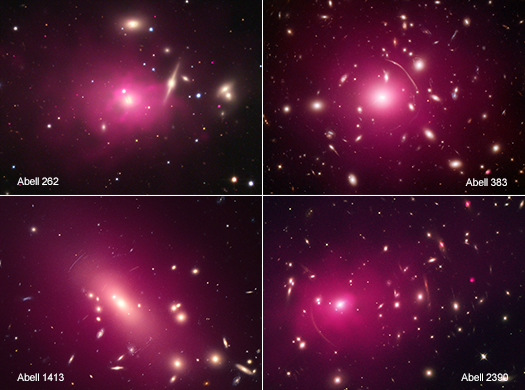
Four of the 13 galaxies clusters used in the study. The clusters are, starting at the top left and going clockwise, Abell 262, Abell 383, Abell 1413, and Abell 2390.

Four of the 13 galaxies clusters used in the study. The clusters are, starting at the top left and going clockwise, Abell 262, Abell 383, Abell 1413, and Abell 2390.

Astronomers have used data from NASA’s Chandra X-ray Observatory to study the properties of dark matter. The study, which involves 13 galaxy clusters, explores the possibility that dark matter may be more “fuzzy” than “cold,” perhaps even adding to the complexity surrounding this cosmic conundrum.
For several decades, astronomers have known about dark matter. Although it cannot be observed directly, dark matter does interact via gravity with normal, radiating matter (that is, anything made up of protons, neutrons, and electrons bundled into atoms)...

Read More

Bump on a Plot from Chandra X-ray observatory reveals excess of X-rays, hinting at Dark Matter

A massive cluster of yellowish galaxies, seemingly caught in a red and blue spider web of eerily distorted background galaxies, makes for a spellbinding picture from the new Advanced Camera for Surveys aboard NASA's Hubble Space Telescope. To make this unprecedented image of the cosmos, Hubble peered straight through the center of one of the most massive galaxy clusters known, called Abell 1689. The gravity of the cluster's trillion stars — plus dark matter — acts as a 2-million-light-year-wide lens in space. This gravitational lens bends and magnifies the light of the galaxies located far behind it. Some of the faintest objects in the picture are probably over 13 billion light-years away (redshift value 6). Strong gravitational lensing as observed by the Hubble Space Telescope in Abell 1689 indicates the presence of dark matter. Credit: NASA, N. Benitez (JHU), T. Broadhurst (Racah Institute of Physics/The Hebrew University), H. Ford (JHU), M. Clampin (STScI),G. Hartig (STScI), G. Illingworth (UCO/Lick Observatory), the ACS Science Team and ESA Read more at: https://phys.org/news/2017-02-plot-chandra-x-ray-observatory-reveals.html#jCp

A massive cluster of yellowish galaxies, seemingly caught in a red and blue spider web of eerily distorted background galaxies, makes for a spellbinding picture from the new Advanced Camera for Surveys aboard NASA’s Hubble Space Telescope. To make this unprecedented image of the cosmos, Hubble peered straight through the center of one of the most massive galaxy clusters known, called Abell 1689. The gravity of the cluster’s trillion stars — plus dark matter — acts as a 2-million-light-year-wide lens in space. This gravitational lens bends and magnifies the light of the galaxies located far behind it. Some of the faintest objects in the picture are probably over 13 billion light-years away (redshift value 6)...

Read More