Chandra tagged posts

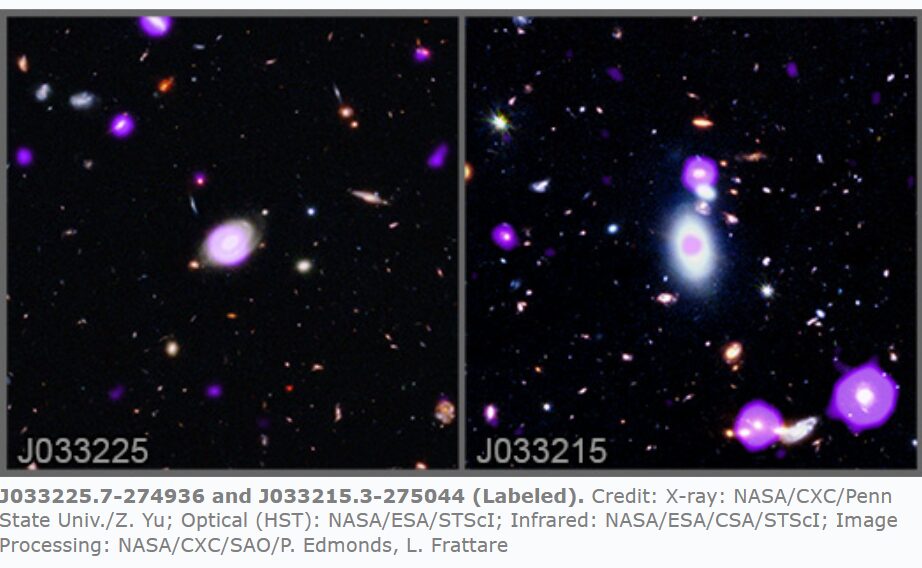
Chandra resolves why black holes hit the brakes on growth

Astronomers have an answer for a long-running mystery in astrophysics: why is the growth of supermassive black holes so much lower today than in the past? A study using NASA’s Chandra X-ray Observatory and other X-ray telescopes found that supermassive black holes are unable to consume material as rapidly as they did in the distant past. The results appeared in the December 2025 issue of The Astrophysical Journal.

Ten billion years ago, there was a period that astronomers call “cosmic noon,” when the growth of supermassive black holes (those with millions to billions of times the mass of the sun) was at its peak across the entire history of the universe. Between cosmic noon and now, however, astronomers have seen a major slowdown in how rapidly black holes are growing.

“A longst...

Read More
Chandra finds black hole that’s growing at 2.4 times the Eddington limit

An artist's concept of a supermassive black hole, a surrounding disk of material falling towards the black hole and a jet containing particles moving away at close to the speed of light. This black hole represents a recently-discovered quasar powered by a black hole. New Chandra observations indicate that the black hole is growing at a rate that exceeds the usual limit for black holes, called the Eddington Limit. Credit: NASA/CXC/SAO/M. Weiss
An artist’s concept of a supermassive black hole, a surrounding disk of material falling towards the black hole and a jet containing particles moving away at close to the speed of light. This black hole represents a recently-discovered quasar powered by a black hole. New Chandra observations indicate that the black hole is growing at a rate that exceeds the usual limit for black holes, called the Eddington Limit. Credit: NASA/CXC/SAO/M. Weiss
X-ray: NASA/CXC/INAF-Brera/L. Ighina et al.; Illustration: NASA/CXC/SAO/M. Weiss; Image Processing: NASA/CXC/SAO/N. Wolk

A black hole is growing at one of the fastest rates ever recorded, according to a team of astronomers...

Read More

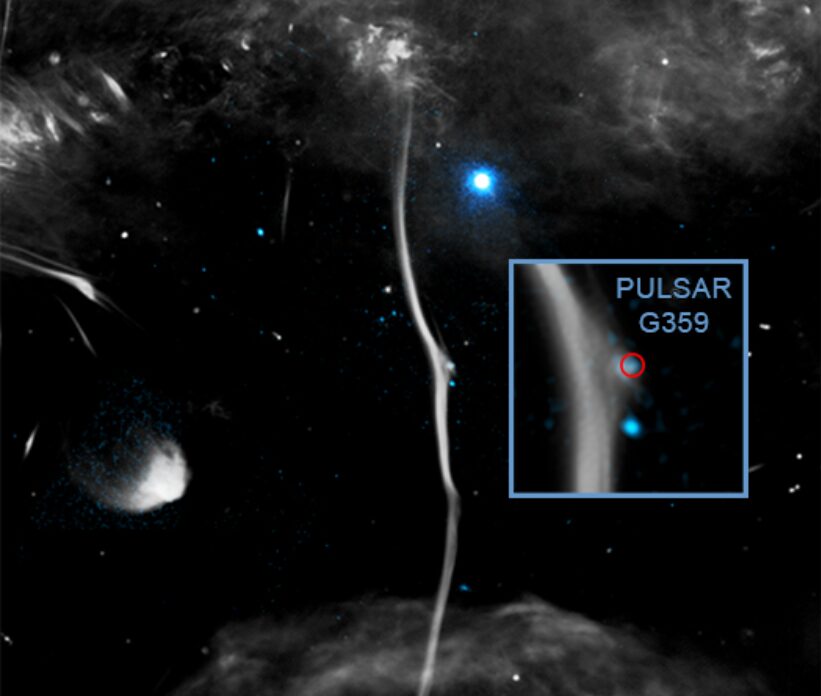
Chandra diagnoses cause of fracture in galactic ‘bone’

G359.13142-0.20005
Credit: X-ray: NASA/CXC/Northwestern Univ./F. Yusef-Zadeh et al; Radio: NRF/SARAO/MeerKat; Image Processing: NASA/CXC/SAO/N. Wolk

Astronomers have discovered a likely explanation for a fracture in a huge cosmic “bone” in the Milky Way galaxy, using NASA’s Chandra X-ray Observatory and radio telescopes.

The bone appears to have been struck by a fast-moving, rapidly spinning neutron star, or a pulsar. Neutron stars are the densest known stars and form from the collapse and explosion of massive stars. They often receive a powerful kick from these explosions, sending them away from the explosion’s location at high speeds.

Enormous structures resembling bones or snakes are found near the center of the galaxy...

Read More

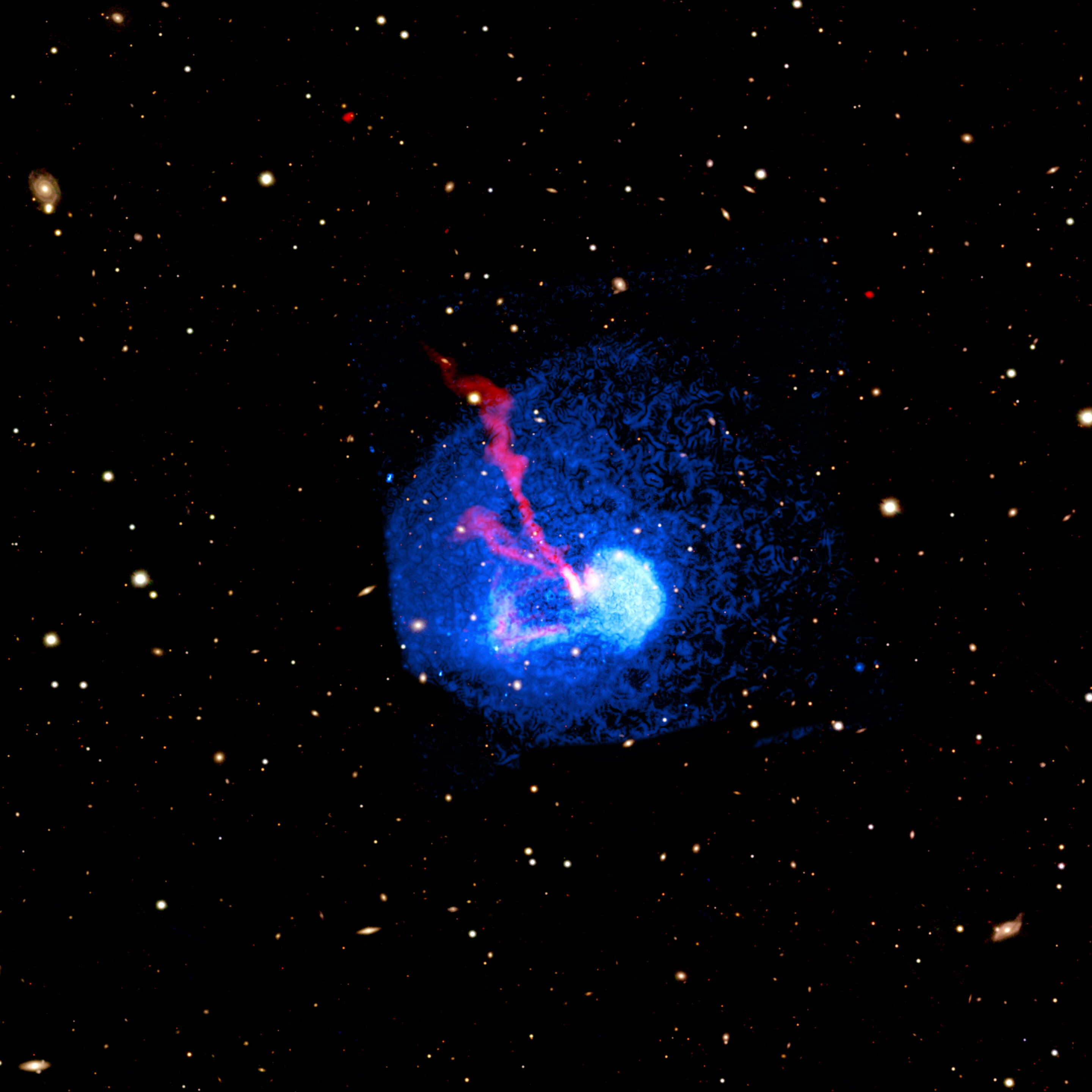
Abell 1775: Chandra catches Slingshot during Collision

Abell 1775: Chandra catches slingshot during collision
Credit: X-ray: NASA/CXC/Leiden Univ./A. Botteon et al.; Radio: LOFAR/ASTRON; Optical/IR:PanSTARRS

When the titans of space—galaxy clusters—collide, extraordinary things can happen. A new study using NASA’s Chandra X-ray Observatory examines the repercussions after two galaxy clusters clashed.

Galaxy clusters are the largest structures in the Universe held together by gravity, containing hundreds or even thousands of individual galaxies immersed in giant oceans of superheated gas. In galaxy clusters, the normal matter—like the atoms that make up the stars, planets, and everything on Earth—is primarily in the form of hot gas and stars. The mass of the hot gas between the galaxies is far greater than the mass of the stars in all of the galaxies...

Read More