climate change tagged posts

Global Warming Already Responsible for 1 in 3 Heat-related Deaths

Sunrise in London, UK. Credit: Kasim Rashid/Flickr

New estimates suggest Central and South America and South-East Asia most affected regions. Between 1991 and 2018, more than a third of all deaths in which heat played a role were attributable to human-induced global warming, according to a new article in Nature Climate Change.

The study, the largest of its kind, was led by the London School of Hygiene & Tropical Medicine (LSHTM) and the University of Bern within the Multi-Country Multi-City (MCC) Collaborative Research Network. Using data from 732 locations in 43 countries around the world it shows for the first time the actual contribution of human-made climate change in increasing mortality risks due to heat.

Overall, the estimates show that 37% of all heat-related deaths in the recent summer periods were attributable to the w...

Read More

New Green Technology generates

The current Air-gen device can power small devices. Photos courtesy: UMass Amherst/Yao and Lovley labs.

Renewable device could help mitigate climate change, power medical devices. Scientists at the University of Massachusetts Amherst have developed a device that uses a natural protein to create electricity from moisture in the air, a new technology they say could have significant implications for the future of renewable energy, climate change and in the future of medicine.

As reported today in Nature, the laboratories of electrical engineer Jun Yao and microbiologist Derek Lovley at UMass Amherst have created a device they call an “Air-gen.” or air-powered generator, with electrically conductive protein nanowires produced by the microbe Geobacter...

Read More

Reduced Energy from the Sun might occur by mid-century: Now scientists know by How Much

Magnetic loops gyrate above the sun, March 23-24, 2017. Credit: NASA/GSFC/Solar Dynamics Observatory

Magnetic loops gyrate above the sun, March 23-24, 2017. Credit: NASA/GSFC/Solar Dynamics Observatory

The Sun might emit less radiation by mid-century, giving planet Earth a chance to warm a bit more slowly but not halt the trend of human-induced climate change. The cooldown would be the result of what scientists call a grand minimum, a periodic event during which the Sun’s magnetism diminishes, sunspots form infrequently, and less ultraviolet radiation makes it to the surface of the planet. Scientists believe that the event is triggered at irregular intervals by random fluctuations related to the Sun’s magnetic field.

Scientists have used reconstructions based on geological and historical data to attribute a cold period in Europe in the mid-17th Century to such an event, named the “Maunder...

Read More

Heat Stress Escalates in Cities under Global Warming

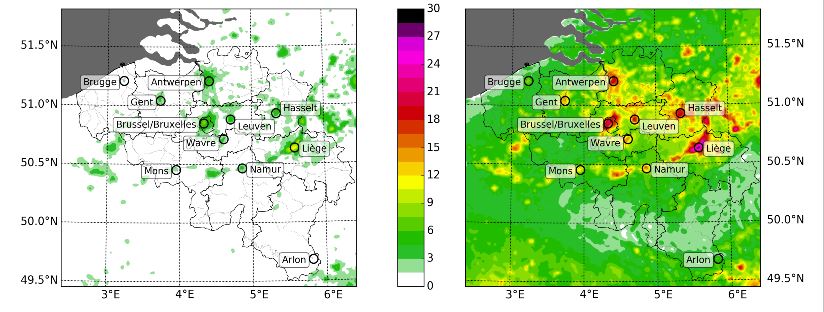
Annual mean heatwave degree days in Belgium. Historical on the left, and under business-as-usual climate change scenario on right. Not only the number of hot days days, but also the heatwave intensity are rising drastically under global warming, especially in the cities.

Annual mean heatwave degree days in Belgium. Historical on the left, and under business-as-usual climate change scenario on right. Not only the number of hot days days, but also the heatwave intensity are rising drastically under global warming, especially in the cities.

Heatwaves are intensifying in cities due to the double whammy of the urban heat island effect and global warming, according to a new study. The study’s authors used computer models to simulate with unprecedented detail the temperature changes through the mid-21st century in Belgian cities. They found that heatwaves become hotter, longer and more frequent because of greenhouse gas emissions, and that temperature above the heat stress alarm level increases by a factor of between 1.4 and 15 by the middle of this century.

“The...

Read More