
CMEs tagged posts

Citizen Scientists discover Cyclical Pattern of Complexity in Solar Storms

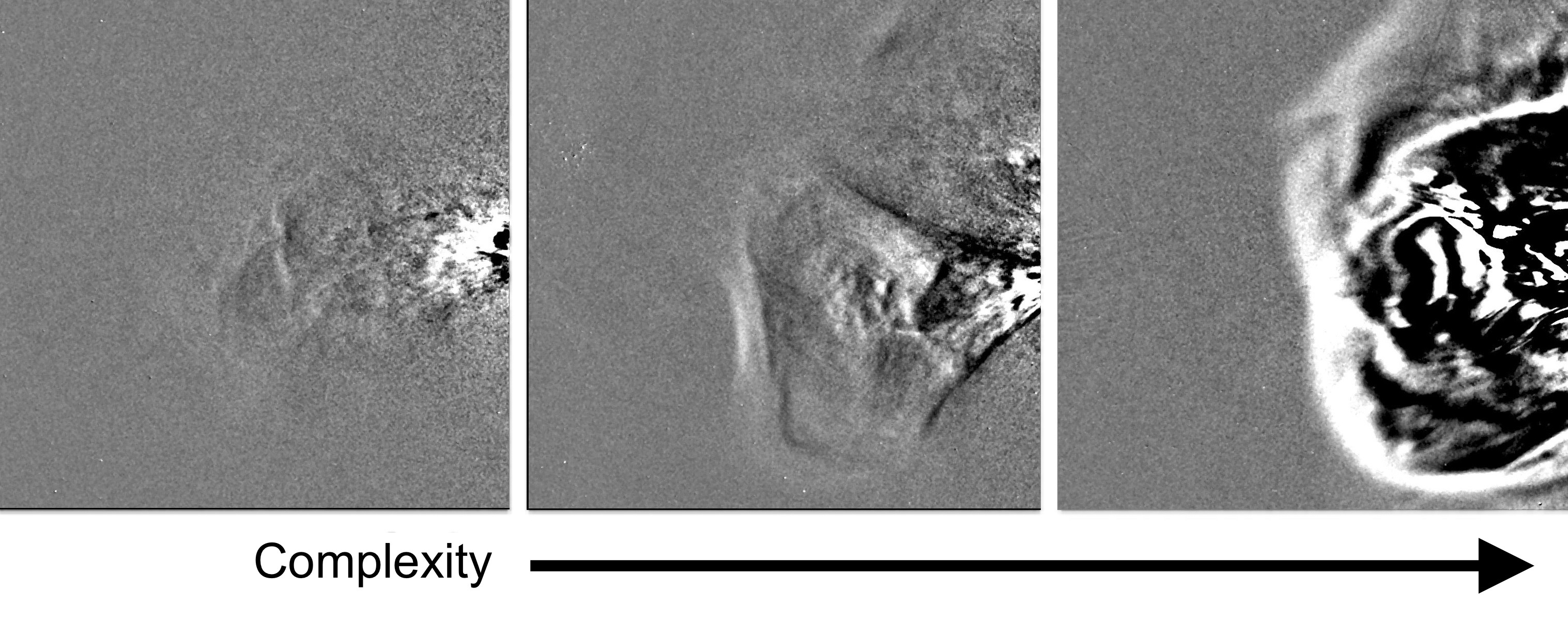
Example images showing three example CMEs in ranked order of subjective complexity increasing from low (left-hand image) through to high (right-hand image). Credit: NASA Heliospheric Imager data courtesy of RAL Space, made available by the UK Solar System Data Centre.

Findings could help forecasters predict these potentially devastating space weather events. Citizen scientists found that solar storms become more complex as the Sun’s 11-year activity cycle reaches its maximum.

‘Protect our Planet from Solar Storms’, a research project launched by the University of Reading, the Science Museum Group and Zooniverse in May 2018, asked volunteers to evaluate pairs of images of Coronal Mass Ejections (CMEs) and decide which seemed the most visually complex.

Overall, the project ranke...

Read More

Solar Eruptions May Not have Slinky-like Shapes after all

An image from NASA Solar Dynamics Observatory (SDO) satellite that shows an example of a commonly believed Slinky-like shaped coronal mass ejection (CME) -- in this case a long filament of solar material hovering in the sun's atmosphere, or corona. This CME traveled 900 miles per second connecting with Earth's magnetic environment and causing aurora to appear four days later on Sept. 3, 2012. Credit: NASA/GSFC/SDO

An image from NASA Solar Dynamics Observatory (SDO) satellite that shows an example of a commonly believed Slinky-like shaped coronal mass ejection (CME) — in this case a long filament of solar material hovering in the sun’s atmosphere, or corona. This CME traveled 900 miles per second connecting with Earth’s magnetic environment and causing aurora to appear four days later on Sept. 3, 2012.
Credit: NASA/GSFC/SDO

As the saying goes, everything old is new again. While the common phrase often refers to fashion, design, or technology, scientists at the University of New Hampshire have found there is some truth to this mantra even when it comes to research...

Read More

3 NASA Satellites Recreate Solar Eruption in 3D

Using data from three different satellites, scientists have developed new models that recreate, in 3-D, CMEs and shocks, separately. Credit: Image courtesy of NASA/Goddard Space Flight Center

Using data from three different satellites, scientists have developed new models that recreate, in 3-D, CMEs and shocks, separately. Credit: Image courtesy of NASA/Goddard Space Flight Center

Scientists have developed new models to see how shocks associated with coronal mass ejections, or CMEs, propagate from the Sun – an effort made possible only by combining data from 3 NASA satellites to produce a much more robust mapping of a CME than any one could do alone. CMEs set off interplanetary shocks when they erupt from the Sun at extreme speeds, propelling a wave of high-energy particles. These particles can spark space weather events around Earth, endangering spacecraft and astronauts.

Understanding a shock’s structure – particularly how it develops and accelerates – is key to predicting ho...

Read More