Comet tagged posts

When a comet hits a tidally locked exo-Earth

When a comet hits a tidally locked exo-Earth
An ultraviolet image of the train of Shoemaker-Levy 9 comet fragments impacting Jupiter’s atmosphere in 1994. The black dot near the top is Jupiter’s moon Io. Credit: Hubble Space Telescope Comet Team, NASA

Comets that have hit Earth have been a mixed bag. Early in Earth’s history, during the solar system’s chaotic beginning, they were likely the source of our planet’s water, ultimately making up about 0.02% of the planet’s mass. (Mars and Venus received a similar fraction.)

Comets brought complex organic molecules and the biosphere, but later posed a threat to the same in cometary collisions...

Read More

New Measurement Method promises Spectacular Insights into the Interior of Planets

High-resolution spectroscopy will enable unique insights into chemistry happening deep inside planets.
Foto: HZDR / U. Lehmann

At the heart of planets, extreme states are to be found: temperatures of thousands of degrees, pressures a million times greater than atmospheric pressure. They can therefore only be explored directly to a limited extent — which is why the expert community is trying to use sophisticated experiments to recreate equivalent extreme conditions...

Read More

Recently discovered Comet seen during 2020 total Solar Eclipse

(left) The LASCO C2 camera on the ESA/NASA SOHO observatory shows comet C/2020 X3 (SOHO) in the bottom left-hand corner. (right) A composite image of the total solar eclipse on Dec. 14, 2020, based on 65 frames taken by Andreas Möller (Arbeitskreis Meteore e.V.) in Piedras del Aguila, Argentina, and processed by Jay Pasachoff and Roman Vanur.
Credits: ESA/NASA/SOHO/Andreas Möller (Arbeitskreis Meteore e.V.)/processed by Jay Pasachoff and Roman Vanur/Joy Ng. Eclipse image used with permission.

As Chile and Argentina witnessed the total solar eclipse on Dec. 14, 2020, unbeknownst to skywatchers, a little tiny speck was flying past the Sun — a recently discovered comet.

This comet was first spotted in satellite data by Thai amateur astronomer Worachate Boonplod on the NASA-funded Sung...

Read More

Comet discovered to have its own Northern Lights

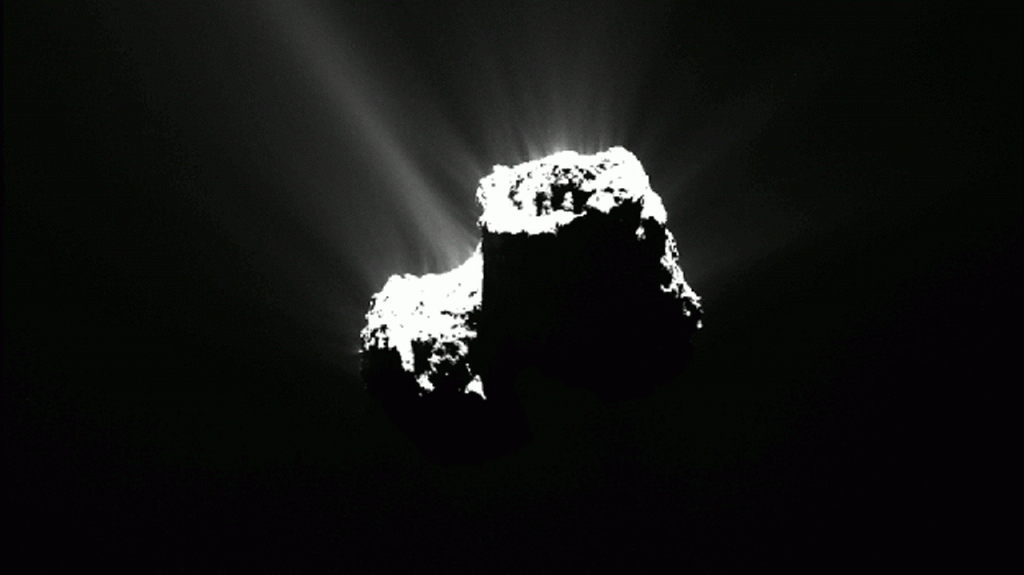
Image acquired by the navigation camera on the European Space Agency’s Rosetta spacecraft orbiting Comet 67P/Churyumov-Gerasimenko between Nov. 19 and Dec. 3, 2014. Image credit: ESA/Rosetta/NAVCAM

An atmospheric light show previously relegated to planets and Jupiter moons is found on comet using data from ESA’s Rosetta spacecraft. Data from NASA instruments aboard the ESA (European Space Agency) Rosetta mission have helped reveal that comet 67P/Churyumov-Gerasimenko has its own far-ultraviolet aurora. It is the first time such electromagnetic emissions in the far-ultraviolet have been documented on a celestial object other than a planet or moon. A paper on the findings was released today in the journal Nature Astronomy.

On Earth, aurora (also known as the northern or southern light...

Read More