coronal mass ejection tagged posts

Interplanetary spacecraft capture a coronal mass ejection component hidden from Earth

Interplanetary spacecraft capture a coronal mass ejection component hidden from Earth
Extreme ultraviolet (EUV) and coronagraph observations of the solar disk and corona highlighting the extended filament that produced the complex CME. Credit: Science Advances (2026). DOI: 10.1126/sciadv.aed9960

During a coronal mass ejection (CME), the sun hurls billions of tons of magnetized plasma into space. These eruptions are among the most powerful events in the solar system, and when they are aimed toward Earth, they can seriously threaten the satellites and power grids we depend on. For now, it remains notoriously difficult to predict how these eruptions evolve over time—and, in turn, whether they might be heading toward us.

Taking observations from an extensive network of spacecraft across the solar system, a team led by Adrienn Luspay-Kuti at Johns Hopkins University h...

Read More
Astronomers spot a rare planet-stripping eruption on a nearby star

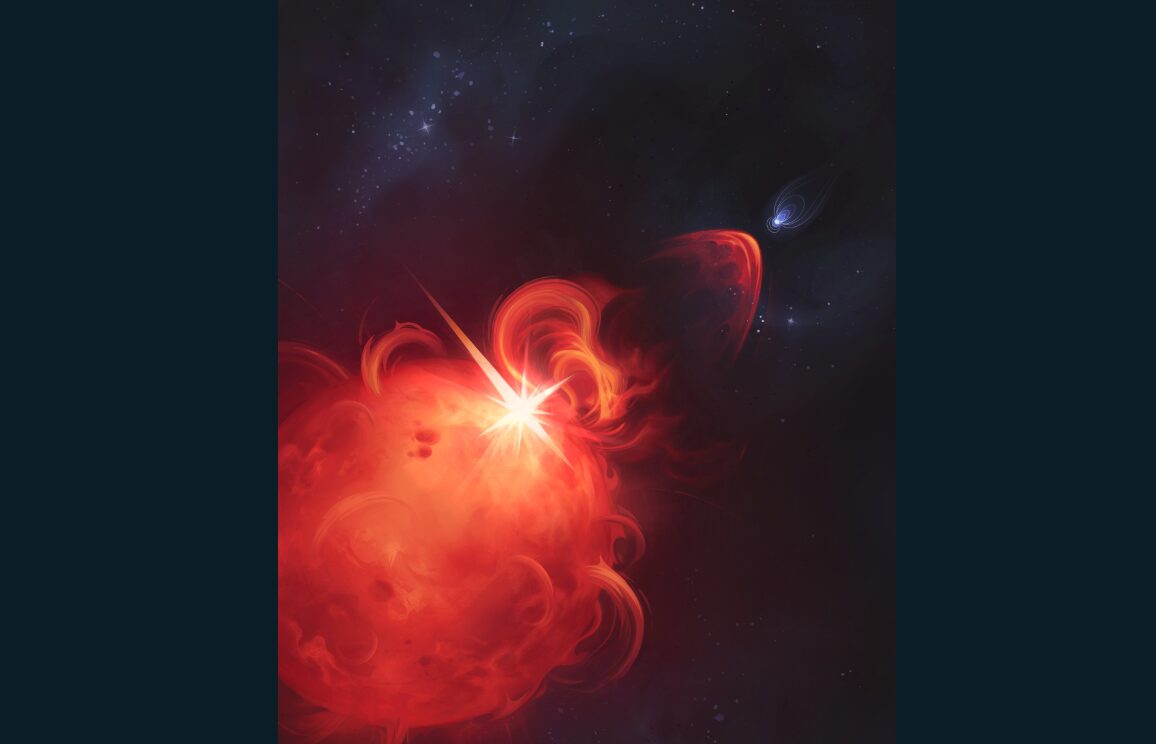
Artist’s impression of an explosion on another star

Scientists have finally confirmed a powerful coronal mass ejection from another star, using LOFAR radio data paired with XMM-Newton’s Xray insights. The eruption blasted into space at extraordinary speeds, strong enough to strip atmospheres from close-orbiting worlds. This suggests planets around active red dwarfs may be far less hospitable than hoped.

Astronomers working with the European Space Agency’s XMM-Newton observatory and the LOFAR radio telescope have obtained clear evidence of a violent burst of material hurled into space by a distant star. The outflow was strong enough that any nearby planet in its path would likely have its atmosphere stripped away.

This burst was identified as a coronal mass ejection (CME), a typ...

Read More

A Stormy, Active Sun may have Kickstarted Life on Earth

An animation of the sun shows a bright spot, from which erupts a cloud of solar material and burst of bright particles.
A close up of a solar eruption, including a solar flare, a coronal mass ejection, and a solar energetic particle event.
Credits: NASA’s Goddard Space Flight Center

The first building blocks of life on Earth may have formed thanks to eruptions from our sun, a new study finds.

A series of chemical experiments show how solar particles, colliding with gases in Earth’s early atmosphere, can form amino acids and carboxylic acids, the basic building blocks of proteins and organic life. The findings were published in the journal Life.

To understand the origins of life, many scientists try to explain how amino acids, the raw materials from which proteins and all cellular life, were formed...

Read More

A Young, Sun-like Star may hold Warnings for Life on Earth

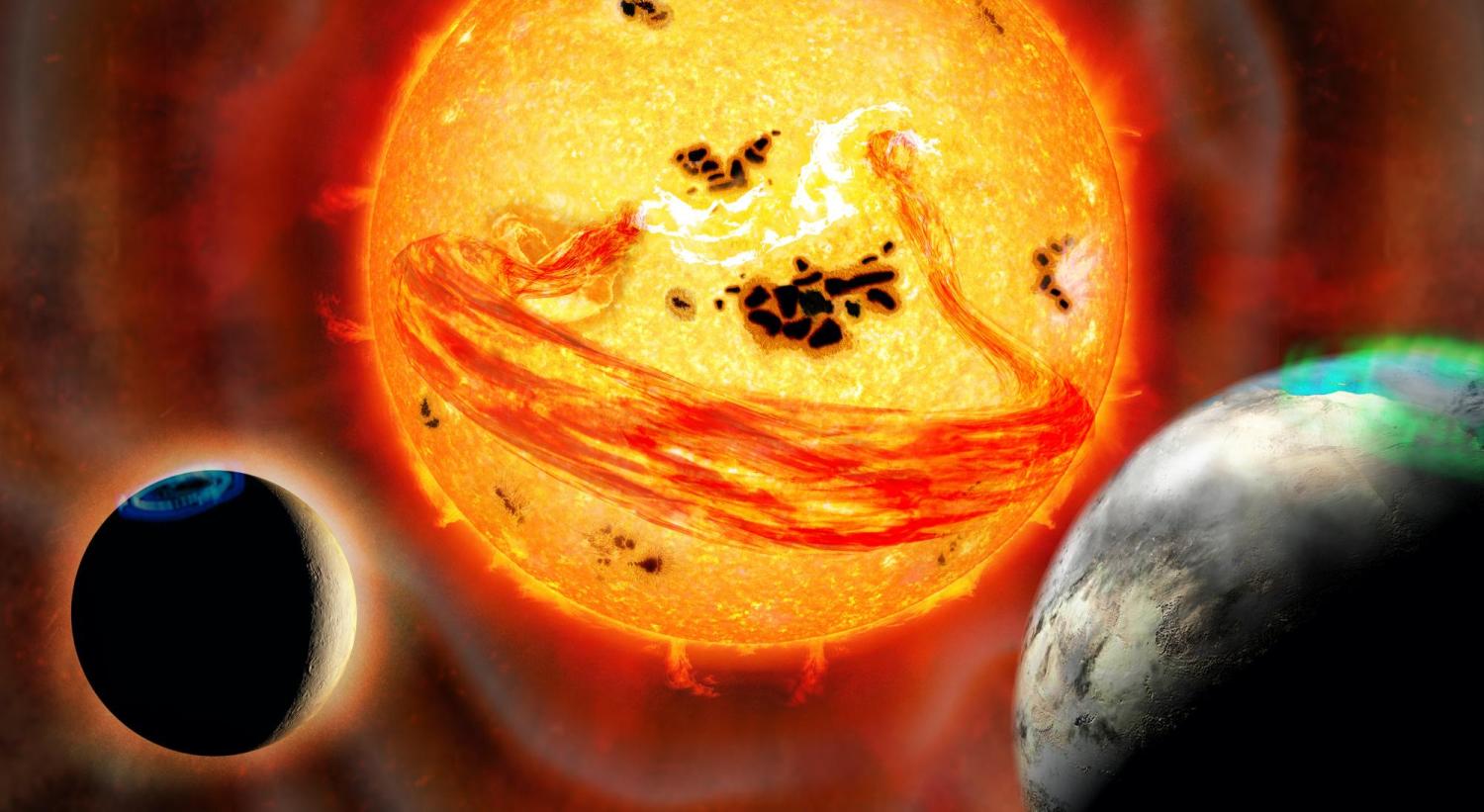
Artist’s depiction of the star EK Draconis ejecting a coronal mass ejection as two planets orbit. (Credit: National Astronomical Observatory of Japan)

Astronomers spying on a stellar system located dozens of lightyears from Earth have, for the first time, observed a troubling fireworks show: A star, named EK Draconis, ejected a massive burst of energy and charged particles much more powerful than anything scientists have seen in our own solar system.

The researchers, including astrophysicist Yuta Notsu of the University of Colorado Boulder, will publish their results Dec. 9 in the journal Nature Astronomy.

The study explores a stellar phenomenon called a “coronal mass ejection,” sometimes known as a solar storm...

Read More