Artist’s conception illustrating the aftermath of an intermediate-mass black hole tearing apart a passing star, resulting in an accretion disk and narrow relativistic jet (top left). The dotted line indicates our line of sight from Earth. The jet’s off-axis afterglow only became visible once the expanding radio emission (bottom right) had grown wide enough to sweep into our line of sight, causing that emission to brighten dramatically years after the initial event. Credit: NSF/AUI/NSF NRAO/M.Weiss
Chinese astronomers report the detection of a peculiar optical transient event that occurred in the center of a dwarf galaxy. The newly discovered event, designated AT2019ijncn a paper published July 6 in The Astrophysical Journal Letters.
One of the rarest transients Among astronomical tra...
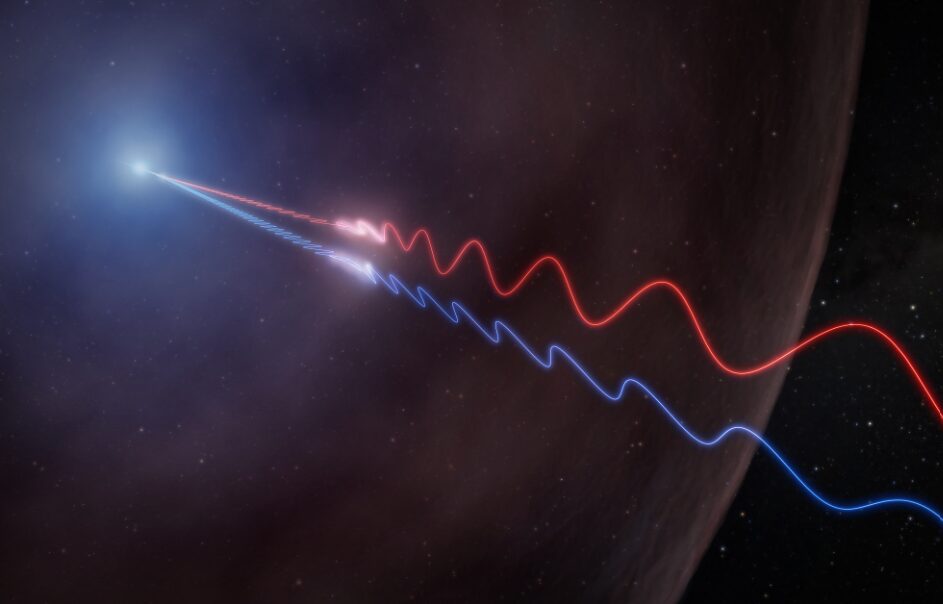
This illustration depicts Faraday rotation in the afterglow of a gamma-ray burst. A powerful jet (upper left) sends polarized radio waves outward through the thin wall of a surrounding bubble of magnetized gas called an HII region. As the light passes through this material, its polarization angle is twisted by the magnetic field. Because the effect is stronger at longer wavelengths, the red and blue waves, which represent different radio wavelengths, exit the bubble oscillating in different directions. By measuring this difference, astronomers were able to map the magnetic environment surrounding GRB 260310A for the first time. Credit: NSF/AUI/NSF NRAO/M.Weiss
Astronomers have made a series of landmark observations of one of the universe’s most violent events. Using the U.S...
Image Credit: NASA, ESA, and Y. Chou (Academia Sinica, Institute of Astronomy and Astrophysics); Processing: Gladys Kober (NASA/Catholic University of America)
These cosmic ribbons of gas have been left behind by a titanic stellar explosion called a supernova. DEM L249 is thought to be the remnant of a Type 1a supernova, the death of a white dwarf star. White dwarf stars are usually stable, but in a binary system—two stars orbiting each other—a white dwarf can gravitationally pull so much matter from its companion that it reaches critical mass and explodes.
DEM L249, located in the Large Magellanic Cloud, is an unusual supernova remnant...
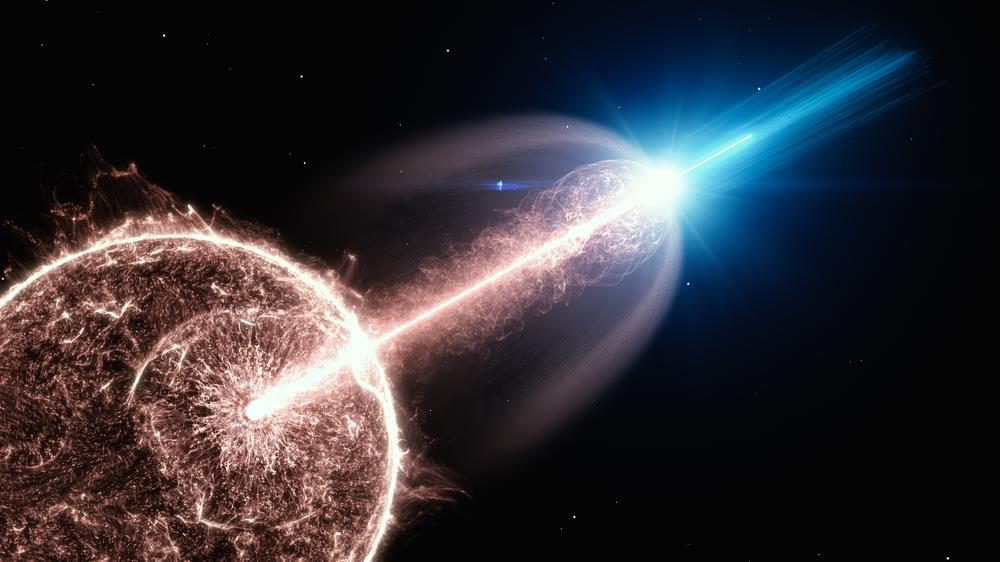
Artist’s impression of a relativistic jet of a gamma-ray burst (GRB), breaking out of a collapsing star, and emitting very-high-energy photons. Credit: DESY, Science Communication Lab
Observation challenges established theory of gamma-ray bursts in the universe. Scientists have gained the best view yet of the brightest explosions in the universe: A specialised observatory in Namibia has recorded the most energetic radiation and longest gamma-ray afterglow of a so-called gamma-ray burst (GRB) to date. The observations with the High Energy Stereoscopic System (H.E.S.S.) challenge the established idea of how gamma-rays are produced in these colossal stellar explosions which are the birth cries of black holes, as the international team reports in the journal Science.






Recent Comments